You Don't Need to Understand AI to Use It — Here's What Small Business Owners Actually Need to Know
Table of Contents
The Myth of the Prompt Engineer
Think Onboarding, Not Programming
What the Day-to-Day Experience Actually Looks Like
If you have been paying attention to the conversation around artificial intelligence over the past couple of years, there is a reasonable chance it has made you feel more confused than informed.
Tech influencers talk about prompt engineering, fine-tuning vector databases, and building neural networks. Industry articles are full of terminology that sounds impressive but means very little to a business owner who is primarily focused on running a good business and serving clients well. And somewhere in the middle of all that jargon, a quiet but powerful belief takes hold: this stuff is not for me. It is for big companies with IT departments and software budgets and people whose entire job is understanding this technology.
If that is where you are, this article is for you. Because the belief is understandable and it is wrong. And the gap between what AI sounds like from the outside and what it actually requires of a small business owner to use effectively is far wider than most people realize.
The Myth of the Prompt Engineer
One of the most persistent misconceptions about AI in business is that using it requires you to understand how it works at a technical level. That to get an AI system to perform tasks for your business, you need to sit in front of a screen typing complex commands, adjusting parameters, and managing technical configurations.
This is true for the people who build AI systems. It is completely irrelevant to the people who use them.
Think about how you use your smartphone. You send messages, check the weather, pay bills, navigate to appointments, and manage your calendar all without any understanding of the iOS or Android code running underneath those functions. The engineering that makes all of it possible is real, sophisticated, and genuinely complex. But it is entirely invisible to you as the user, packaged inside an interface that requires nothing more than tapping a screen.
AI business tools work exactly the same way. The complex engineering, the natural language processing, the machine learning, the infrastructure that makes an AI assistant sound natural and respond intelligently happens entirely in the background. What you interact with as a business owner is a clean, intuitive interface that looks a lot less like a coding environment and a lot more like a CRM dashboard or a chat window.
You do not need to understand what is happening under the hood. You just need to know how to drive.
Think Onboarding, Not Programming
The most useful reframe for any small business owner approaching AI for the first time is this: implementing an AI employee is not a software development project. It is an onboarding process.
Because modern conversational AI operates on natural language processing meaning it understands and communicates in plain English rather than code, the way you train it is remarkably similar to the way you would bring a new human team member up to speed.
You give it your FAQs. Your standard pricing information. Your service guidelines and operational procedures. You share examples of how you like to communicate with clients, the tone you prefer, the terms you use, the things you would never say. You give it clear instructions about what it should handle independently and when it should bring a human into the conversation.
That is the preparation process. No code. No technical configuration on your end. No requirement to understand anything beyond how your own business operates which, as the person who built and runs it, you already know better than anyone.
Once those foundations are in place, the technical framework takes care of everything else. The AI draws on the information you have provided, applies it consistently across every conversation, and continues to refine its performance over time based on real interactions.
What the Day-to-Day Experience Actually Looks Like
Here is what a small business owner actually experiences once an AI employee is up and running because it is important to ground this in reality rather than abstraction.
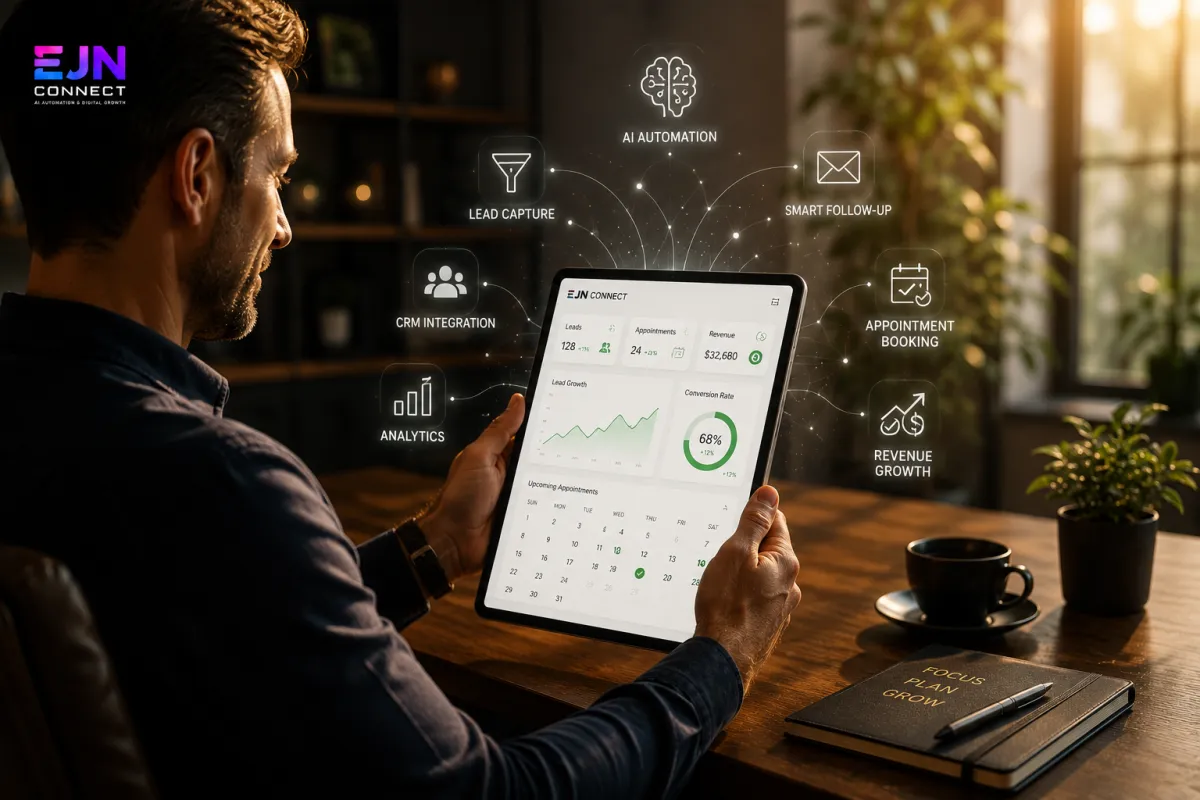
You do not look at lines of code. You do not manage technical configurations or monitor system performance through a developer dashboard. You open your CRM, the same platform where you already manage your client relationships and your pipeline and you see a calendar populated with qualified leads. You see organized contact cards with conversation summaries already filled in. You see pipeline updates that reflect exactly where every enquiry sits in the journey from first contact to confirmed booking.
The AI is operating in the background, handling every inbound conversation across every channel, qualifying every lead, booking every appointment, and updating every record and the result of all of that activity shows up in your existing tools as clean, organized, actionable business data.
For your clients, the experience is equally invisible in the best possible way. They interact with a natural, conversational chat window or a standard phone call. They have no awareness of the technical infrastructure behind the experience. They simply notice that your business responds quickly, communicates clearly, and makes it easy to get what they need.
The Real Barrier And Why It Is Smaller Than You Think
Tech anxiety is a real and understandable response to an industry that communicates in deliberately complex language. But it is worth separating the complexity of the technology from the complexity of using it because they are not the same thing.
A commercial aircraft is one of the most technically sophisticated machines ever built. The engineering behind it is extraordinary. But sitting in the passenger seat and arriving at your destination does not require you to understand any of it. The complexity serves you without requiring you to engage with it.
AI business tools, implemented well, work the same way. The technical complexity is real but it belongs to the people who build and configure these systems, not to the business owners who use them. Your role is not to understand the machine. Your role is to know what you want it to do, communicate that clearly during the onboarding process, and then let it work.
That is a very achievable threshold for any business owner regardless of technical background, regardless of industry, regardless of how skeptical you currently feel about whether this technology is actually relevant to a business like yours.
What You Need to Get Started
No coding knowledge. No technical background. No IT team. No special software skills.
What you actually need is a clear picture of how your business operates: what questions your clients commonly ask, how you like to communicate, what your services include and what they cost, where the boundaries of your AI's responsibilities should sit, and what a successful client interaction looks like for your business.
If you can brief a new employee, you can onboard an AI. The process is that similar and the outcome, for businesses that have made the shift from manual processes to intelligent automation, consistently exceeds expectations.
At ejnconnect.com.au, we handle the entire implementation process for Australian small businesses from building the knowledge base to configuring the AI's communication style to integrating it with your existing systems, so that what you experience on day one is not a complex technical project, but a smoothly running digital team member that already knows your business and is ready to work.
Because the most powerful thing about modern AI for small business is not how sophisticated it is. It is how simple it is to use once someone removes the jargon and shows you what it actually looks like in practice.
