
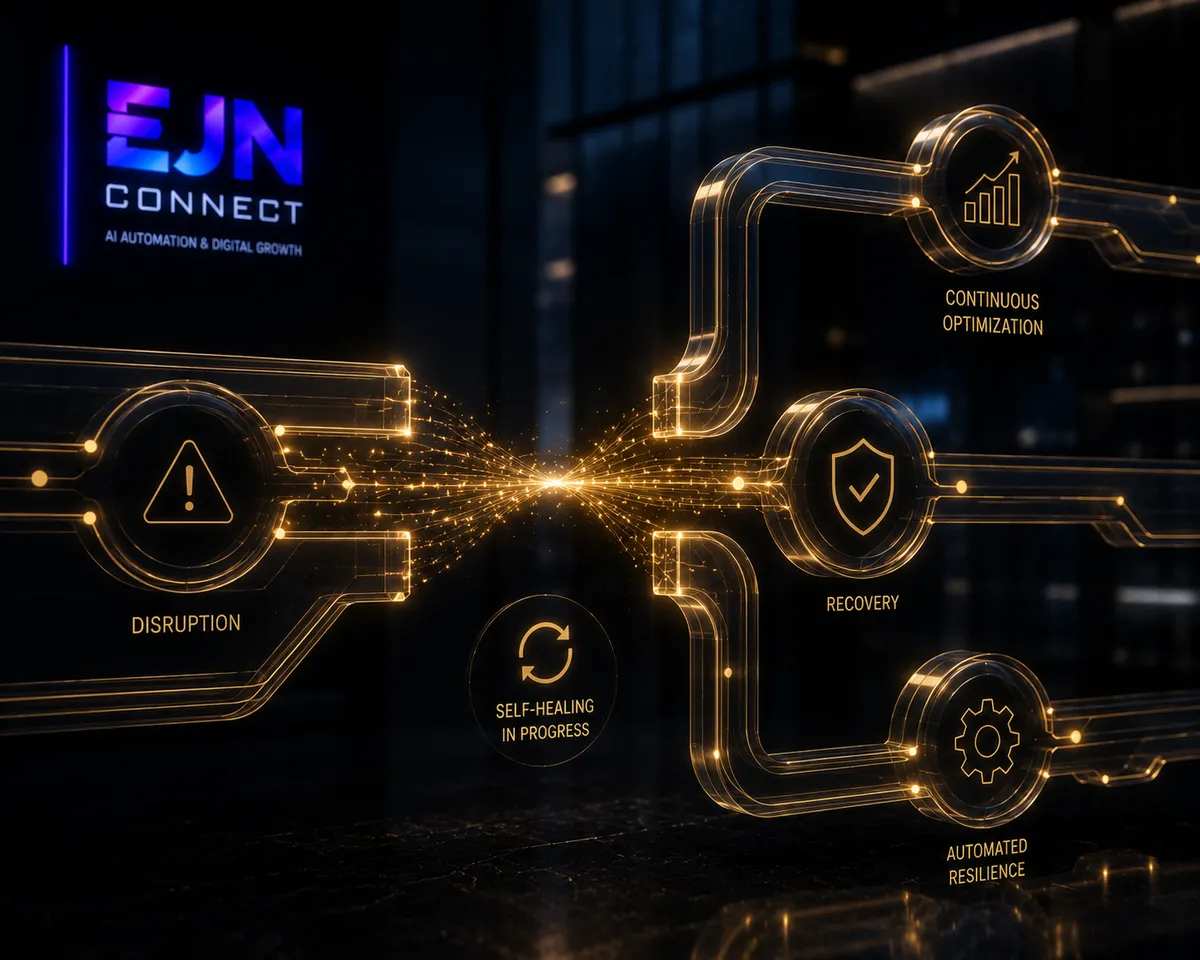
Why your AI system should get smarter every month and how self-healing automation pipelines make that happen
Table of Contents
What Workflow Drift Actually Is
How a Self-Healing Pipeline Actually Works
There is a misconception about AI automation that is worth addressing directly because it affects how business owners approach the investment and, more importantly, how they manage it after implementation.
The misconception is that deploying an AI system is a project with a completion date. That once it is built, configured, and launched, it continues to perform at the same level indefinitely without ongoing attention. That it is, in the language of technology, a set-and-forget solution.
It is not. And businesses that treat it that way discover gradually, invisibly, and at real cost, what happens when automation is left to run without a continuous improvement mechanism.
The problem has a name: workflow drift. And understanding it is essential for any business that wants its AI infrastructure to remain a genuine competitive asset over time rather than a slowly degrading system that no longer performs as well as it did when it launched.
What Workflow Drift Actually Is
Workflow drift describes the gradual decline in alignment, accuracy, and conversion performance that occurs in any static automation system as the environment around it changes.
Your market evolves. The language your clients use to describe their problems shifts. New objections emerge. Services change. Pricing structures update. Compliance requirements are modified. Your standard operating procedures develop as the business learns what works. New types of enquiries arrive that the original system was not configured to handle.
Any one of these changes, left unaddressed in the automation system, creates a small gap between what the system was built to do and what the current environment requires of it. Individually, these gaps are minor. Cumulatively, across months of accumulated drift, they produce meaningful degradation in performance, conversations that used to convert smoothly now stall, questions that used to be answered accurately now produce generic responses, qualification criteria that used to filter effectively now let the wrong prospects through or filter out the right ones.
The particularly damaging characteristic of workflow drift is that it is slow and invisible. There is no dramatic failure event that triggers an alert. Performance declines gradually, in ways that are easy to attribute to other causes or simply not notice until the gap between where the system should be performing and where it actually is has become significant.
Self-healing automation architecture is the structural response to this problem — not periodic manual maintenance, but a continuous, automated feedback loop built directly into the system that detects performance gaps in real time and initiates corrections before drift becomes costly.
How a Self-Healing Pipeline Actually Works
A self-healing automation system embeds three interconnected mechanisms into the operational architecture that work together to maintain performance continuously without requiring manual review of every interaction.
The Evaluator Agent — Automated Quality Assurance
Running in parallel to your customer-facing AI agents, an evaluator agent continuously reviews execution logs and scores each conversation and workflow step against predefined performance benchmarks.
It is asking specific, measurable questions about every interaction. Was the client's intent correctly identified on the first touch? Did the conversation follow the required compliance guardrails throughout? Was the CRM record updated with complete and accurate data? Did the qualification criteria perform as intended, passing through the right prospects and routing the others appropriately? Was the response to this type of enquiry aligned with the current knowledge base?
This evaluation happens in real time, across every interaction, without requiring a human to review individual conversations. The evaluator agent is not assessing subjective quality, it is measuring specific, objectively defined performance criteria and flagging deviations from baseline.
Automated Friction Identification
When the evaluator agent detects a pattern that indicates a performance gap, a sudden drop in bookings from a specific campaign source, a recurring question that consistently triggers human escalation rather than being resolved by the AI, a category of enquiry where sentiment consistently drops at a specific point in the conversation, it does not wait for a monthly report to surface the finding.
It flags the specific friction point in real time, with the precise context that locates the problem which conversation type, which stage of the workflow, which category of enquiry, which knowledge base gap, so that the issue can be understood and addressed specifically rather than generally.
This real-time friction identification is what separates a self-healing system from one that relies on human review of aggregate performance data. By the time a performance decline shows up in a monthly report, it has already been occurring for weeks. A self-healing system identifies the anomaly at the point it first appears before it has had time to compound into a significant and costly drift.
Dynamic Knowledge Base Updates
When a friction point is identified and the corrective action is clear, a new service has been added that the AI does not yet know about, a compliance requirement has changed that affects how certain questions should be answered, a new objection has emerged that the current knowledge base does not address, the system queues a specific, targeted knowledge gap ticket for the management team.
The ticket is precise: this specific type of enquiry is producing this specific gap in the AI's response, and this is the information needed to resolve it. The management team provides the answer. The knowledge base is updated immediately. And the update propagates instantly across every AI agent and every touchpoint in the system, so that the correction is live everywhere simultaneously the moment it is made.
This is fundamentally different from how static systems are maintained, where updates require manual reconfiguration, often have lag times between identification and deployment, and may need to be applied separately to each component of the system. In a self-healing architecture, the update mechanism is built in, the knowledge base is the single source of truth for every component, and changes are immediately universal.
The Compounding Performance Advantage
The reason self-healing automation architecture matters strategically beyond the operational benefit of catching and correcting drift is what it does to the trajectory of system performance over time.
A static automation system starts at its peak performance the day it launches and degrades from there as the environment around it evolves. A self-healing system starts at its initial performance level and improves from there, each identified friction point resolved, each knowledge gap closed, each refinement applied across the entire system, compounding into a progressively more effective, more accurate, and more conversion-efficient infrastructure month after month.
After twelve months of continuous refinement, a self-healing system is not the same system that launched on day one. It is significantly better, sharper in its qualification, more accurate in its information, more effective in its conversion, more closely calibrated to the current state of your market and your business. And the business that built it has been accumulating that improvement as a compounding competitive advantage while competitors operating on static systems have been experiencing the opposite trajectory.
What This Means for Your AI Investment
The practical implication for business owners considering AI infrastructure is this: the quality of the ongoing optimization mechanism is as important as the quality of the initial implementation.
An AI system built with a continuous refinement architecture built in will outperform a better-configured but static system within months because the refinement compounds while the static system drifts. The investment in building the self-healing mechanisms is not an optional enhancement. It is what determines whether your AI infrastructure remains a genuinely valuable business asset over time or gradually becomes an increasingly costly liability that nobody has the time to maintain properly.
The businesses that build AI infrastructure with self-healing pipelines are not just investing in better performance today. They are investing in an asset that becomes more valuable, more effective, and more defensible as a competitive advantage every month it operates.
At ejnconnect.com.au, we build AI automation systems for Australian businesses with continuous refinement architecture built in from the foundation, evaluator agents, real-time friction detection, dynamic knowledge base update mechanisms, so that your AI infrastructure does not just perform well on launch day but compounds in performance and value every month thereafter.
Because the best AI system is not the one that works perfectly when it launches. It is the one that keeps getting better automatically, systematically, and without requiring your team to manually manage the improvement process.

