Why Australian Small Businesses Need Full-Workflow AI Agents, Not Glorified FAQ Boxes
Table of COntents
The Core Distinction: Talking Versus Acting
What Changes Across Every Key Capability
When most small business owners picture AI for their business, a specific image comes to mind and it is not a particularly inspiring one.
A small floating chat box in the bottom right corner of a website. A limited menu of pre-programmed responses. The inevitable moment when the system fails to recognize what you are asking and redirects you to "please call our main office during business hours."
This experience repeated across thousands of business websites over the past decade gave automated chat a reputation that it has been struggling to shake ever since. Impersonal. Rigid. More frustrating than helpful. A tool that felt like it was there to avoid giving you what you needed rather than to genuinely assist.
If that is your mental model of what AI business communication looks like, it is both understandable and outdated. Because the technology has undergone a transformation so significant that the old chatbot and the modern full-workflow AI agent barely deserve to share a category.
Understanding the difference specifically the operational difference is one of the most practically important things a small business owner can do before making any decision about AI infrastructure. Because the gap between the two is not incremental. It is fundamental.
The Core Distinction: Talking Versus Acting
The most important difference between a legacy chatbot and a modern full-workflow AI agent is captured in a single word: action.
A traditional chatbot can talk. It receives text input, scans it for keywords that match its programmed list, and delivers a pre-written response. When the input matches a keyword it recognizes, it works reasonably well. When the input does not match when the user phrases their question differently, asks something outside the narrow FAQ list, or makes a simple typo the system breaks down. It loops. It offers irrelevant options. It tells the user to call during business hours.
And critically: when the interaction is over, nothing has happened. No record has been created. No system has been updated. No action has been taken. The chatbot talked and that was the entirety of its capability.
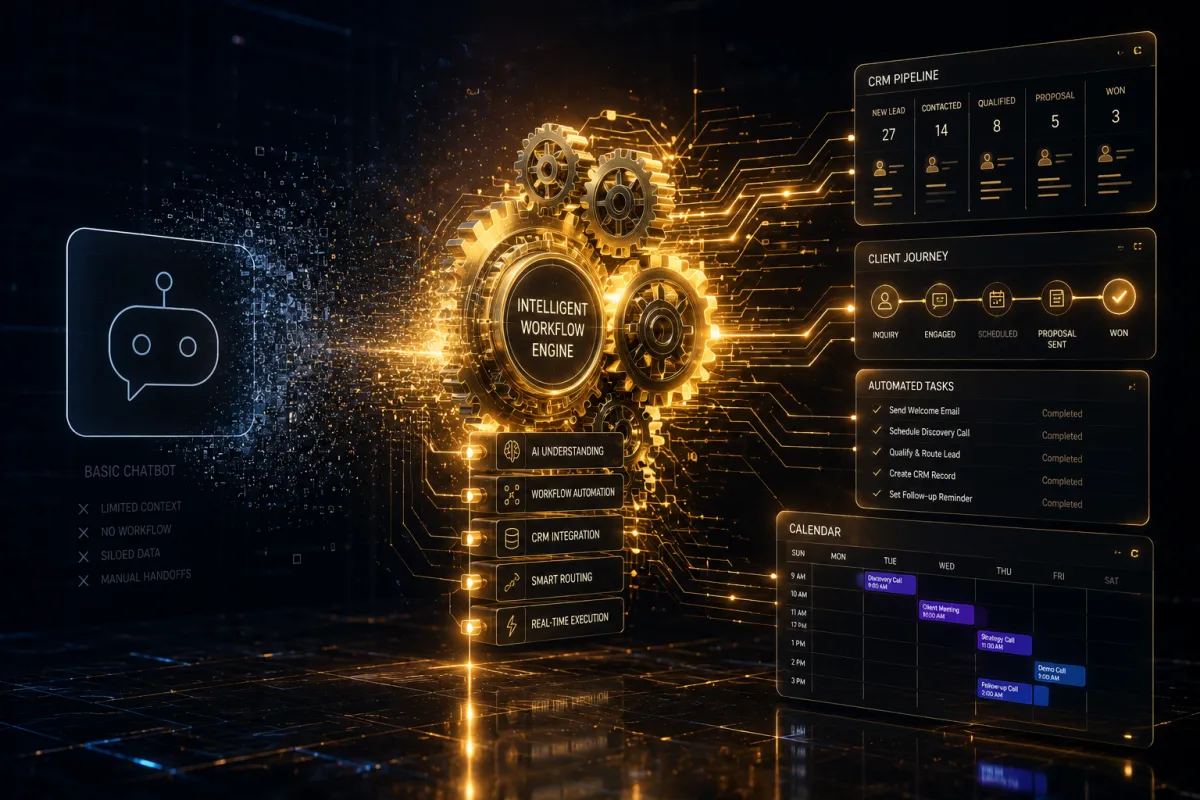
A full-workflow AI agent does something categorically different. It understands the intent behind what a user is saying not the specific words, but the meaning. And having understood that intent, it acts on it. It creates records in your CRM. It checks your live calendar and books appointments. It updates pipeline stages. It triggers follow-up sequences. It routes complex enquiries to the right team member with full context attached.
The chatbot is a conversation that goes nowhere. The full-workflow AI agent is a conversation that drives business outcomes.
What Changes Across Every Key Capability
The structural difference between the two technologies shows up across every dimension of what the system can do and mapping those differences makes the commercial case for upgrading immediately clear.
Logic and processing is where the foundation differs most. A legacy chatbot operates on rigid decision trees if the user says this, respond with that. The moment a conversation deviates from the decision tree, the system fails. A full-workflow AI agent uses natural language processing to understand context, tone, and intent which means it handles the messy, unpredictable reality of how people actually communicate, rather than only the narrow range of inputs it was explicitly programmed for.
Data access determines what the system can actually know and do. A legacy chatbot draws from a small, hardcoded FAQ list that has to be manually updated every time something changes. A full-workflow AI agent connects to your private knowledge base your specific services, pricing, procedures, and policies and queries your live CRM data in real time. It knows your business, and it knows your clients.
Operational scope defines where and how the system can engage. A legacy chatbot lives on your website chat widget and nowhere else. A full-workflow AI agent operates across every channel simultaneously voice calls, SMS, web chat, social media DMs, WhatsApp delivering the same quality of engagement regardless of where the client makes contact.
System execution is the dimension that most directly separates the two in commercial terms. A legacy chatbot cannot take any action inside any external system. It cannot book an appointment, update a CRM record, trigger a follow-up sequence, or create a contact profile. A full-workflow AI agent connects to your entire business software stack through secure integrations and when a conversation reaches a decision point, it executes the appropriate actions automatically, in real time, without any manual step required from your team.
Handling complexity reveals the robustness of each approach under real-world conditions. A legacy chatbot breaks when queries go off-script, contain unexpected phrasing, or combine multiple elements in a single message. A full-workflow AI agent navigates complexity gracefully handling multi-part questions, unexpected conversational detours, and edge cases that fall outside standard patterns, including knowing when to escalate to a human and doing so with full context intact.
The Three Integration Layers That Make It Work
A full-workflow AI agent's capability is not a product of better conversation design. It comes from three deep integration layers that connect the AI to the operational reality of your business.
The contextual intelligence layer is what allows the AI to understand the full meaning of a complex, natural-language request rather than just matching keywords. When a client says "I need to reschedule my consultation next week, but only if you have an afternoon slot available with a senior advisor" the AI processes the entire sentence, understands the conditional nature of the request, checks the relevant calendar availability, and responds with a precise, helpful answer. No keyword matching. No breaking down at the complexity. Genuine contextual understanding.
Multi-system API integration is what turns conversation into action. The AI connects directly to your CRM, your scheduling tools, your communication platforms, and any other business system that needs to reflect or respond to what happens in client conversations. When a lead is captured, a contact record is created. When an appointment is booked, the calendar is updated and the confirmation goes out. When a deal moves forward, the pipeline reflects it. All of this happens automatically, inside the conversation, without anyone on your team having to touch a keyboard.
Cross-channel continuity means the AI maintains context across channels and across time so that a client who starts a conversation on your website chat, gets distracted, and texts your business line two hours later does not have to start from scratch. The AI recognizes them, retains the context of the earlier conversation, and picks up exactly where things left off. From the client's perspective, it is a seamless, continuous interaction with a business that remembers them. From your team's perspective, it is a complete, coherent client record with no gaps.
Why This Matters Right Now for Australian Small Businesses
The legacy chatbot model was a product of what the technology was capable of a decade ago. It represented a genuine attempt to automate client communication with the tools that existed at the time. But those tools have been superseded comprehensively and definitively by a generation of AI technology that operates at a fundamentally higher level.
Continuing to rely on a legacy chatbot in 2024 is not maintaining the status quo. It is actively falling behind because the businesses you compete with for the same clients are increasingly implementing full-workflow AI agents that respond faster, engage more intelligently, execute actions automatically, and deliver a client experience that the old chatbot model simply cannot match.
The consumer expectation bar has moved. Clients who interact with a modern, intelligent AI system and then encounter a legacy chatbot on a competitor's website notice the difference immediately. And that difference influences their decision about which business to work with.
At ejnconnect.com.au, we implement full-workflow AI agents for Australian small businesses systems that go far beyond answering FAQs to actively driving lead capture, qualification, booking, and CRM management across every channel, around the clock.
Because your digital front door should open into a business that is ready to act not one that asks the caller to please try again during business hours.
