Why Australian Businesses Are Losing Tenders in the First Five Minutes And How AI Closes the Speed-to-Lead Gap for Good
Table of Contents
Why Paying People to Be Faster Is Not the Answer
How an AI Speed-to-Lead System Works in Practice
When an Australian homeowner, facility manager, or commercial enterprise submits an enquiry for a service or tender, a race begins that most business owners do not realise they are already losing.
The research on what happens in the minutes following an inbound enquiry is unambiguous and for businesses that have never looked at it closely genuinely confronting. Seventy-eight percent of buyers engage the first business that gives them a qualified, meaningful response. Not the cheapest. Not the most experienced. Not the best reviewed. The first one to respond properly.
And yet the operational reality for the majority of Australian small and medium businesses is that inbound enquiries sit in busy email inboxes for hours, reach voicemails that are not checked until the following morning, or wait while the sales rep or estimator is mid-job and unable to respond. The two-to-four-hour response window that feels reasonable from inside a busy business operation is, from the prospect's perspective, long enough to have found someone else.
The Mathematics of Lead Decay
The decline in lead conversion probability with elapsed response time is not a gradual curve. It is a cliff.
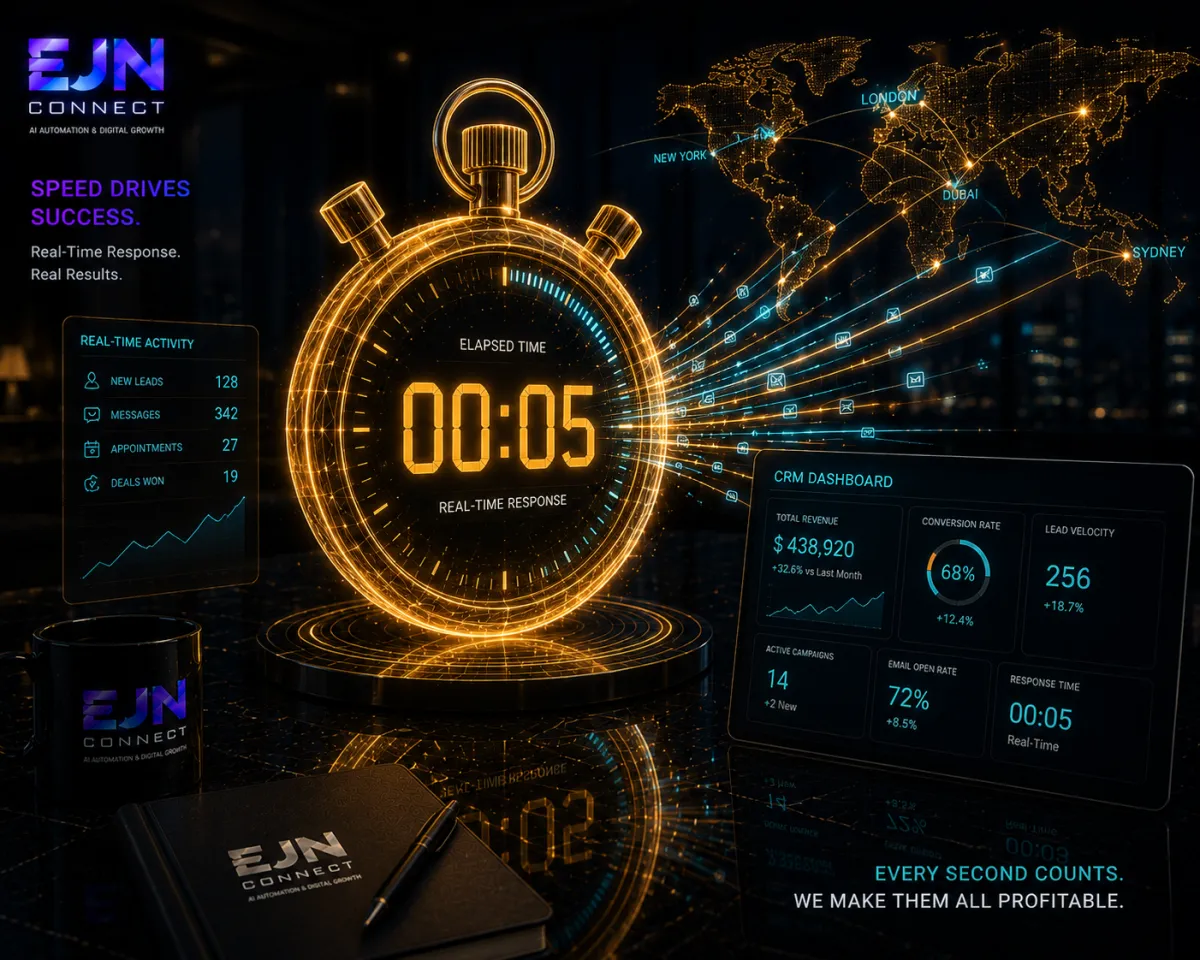
Leads contacted within five minutes of submitting an enquiry are twenty-one times more likely to enter your sales pipeline than those contacted after thirty minutes. Twenty-one times. Not marginally more likely twenty-one times more likely.
After ten minutes, the probability of successfully qualifying that lead has already dropped by eighty percent. By the time a busy business owner returns a call two or three hours later, the window of peak intent has long since closed. The prospect has moved on, found an alternative, or perhaps most commonly simply been captured by a competitor whose system responded within seconds.
The after-hours dimension compounds this significantly. Over forty percent of Australian business enquiries arrive outside standard business hours the evenings and weekends when busy homeowners, property managers, and business decision-makers finally have the time to address the problems and projects they have been putting off. If your phone goes to voicemail at five pm and your web form deposits enquiries in an inbox that nobody reads until eight-thirty the following morning, you are effectively closed for nearly sixty percent of every week during which your competitors' AI systems are actively engaging the prospects your marketing has attracted.
Why Paying People to Be Faster Is Not the Answer
The instinct when confronted with a speed-to-lead problem is to address it with people. Have someone monitor the inbox more frequently. Set up a roster for after-hours calls. Ask the team to respond to enquiries more quickly.
These approaches address the symptom without resolving the structural constraint. The challenge is not that your people are not trying hard enough. It is that the speed the market now requires sub-five-minute response, available twenty-four hours a day, seven days a week, across multiple simultaneous channels is physically impossible to maintain with a human-dependent intake process at any scale that a small business can sustain.
A person can respond to one enquiry at a time. They can work approximately eight hours in a standard day. They cannot respond in under five minutes to an enquiry that arrives at eleven pm on a Sunday while simultaneously managing their actual work obligations. The human capacity constraint is structural and no amount of effort or goodwill from your team changes the underlying mathematics.
An AI-powered speed-to-lead system resolves the structural constraint entirely. Not by making people faster, but by removing human latency from the initial response process altogether.
How an AI Speed-to-Lead System Works in Practice
Sub-second engagement across every channel
The moment an enquiry arrives through your website, a Meta or Google ad, a phone call, an SMS, or a social media message the AI engages within seconds. Not within minutes. Within seconds. Before the prospect has closed the browser tab, put down the phone, or moved on to the next result on their search page.
For phone calls, a Voice AI receptionist answers on the first ring, conducts a genuine qualification conversation in natural language, draws from your specific business knowledge to answer the prospect's questions accurately, and moves toward booking an appointment at two in the afternoon or at two in the morning, with identical quality and professionalism.
For web and social media enquiries, an automated conversational SMS is triggered immediately, personalized to the nature of the enquiry, providing immediate useful information about your services, and opening a two-way dialogue that continues the qualification process on the prospect's mobile device while they are still engaged.
Real-time qualification and scope assessment
The AI does not just acknowledge the enquiry and promise a callback. It conducts the initial qualification within the same interaction, assessing whether the enquiry matches your service scope, gathering the key information that determines whether this is a worthwhile opportunity to pursue, and filtering out poor-fit enquiries before they consume any estimator or sales team time.
For trade and contracting businesses, this means an immediate preliminary scope assessment questions about the nature of the work, the site location, the timeline, and the budget that produces a qualification outcome before any human resource is committed. High-value, well-qualified opportunities are immediately progressed to booking. Out-of-zone, out-of-scope, or budget-mismatched enquiries are handled graciously and appropriately without wasting your estimator's time.
Instant calendar lock and deposit collection
Once a qualified prospect is ready to progress, the AI accesses your live calendar, presents available appointment times, and secures the booking collecting the relevant callout fee, assessment deposit, or initial retainer upfront before the slot is confirmed.
No phone tag. No back-and-forth email exchanges trying to find a mutually available time. No site visits scheduled for prospects who were never going to proceed. A confirmed, paid, CRM-logged appointment within minutes of the initial enquiry, at any hour of the day or night.
What This Does to Your Tender and Quote Win Rate
The commercial impact of closing the speed-to-lead gap shows up most immediately and most measurably in the proportion of inbound enquiries that convert into actual engagements.
Businesses that implement AI speed-to-lead systems consistently report significant improvements in quote-to-win ratios not because they have changed their pricing, their service quality, or their marketing approach, but simply because they are now engaging prospects at the moment of peak intent rather than hours later when that intent has cooled.
In competitive markets where multiple providers receive similar enquiries from the same prospect pool residential trades, commercial services, professional services, property, the business that responds first establishes a relationship and a momentum that later-responding competitors struggle to displace. The first qualified engagement is not just a response. It is a competitive positioning action that shapes the entire subsequent decision process.
The Advertising Spend Dimension
For businesses running paid advertising on Google, Meta, or other platforms, the speed-to-lead gap has a direct and calculable impact on advertising return.
Every inbound enquiry generated by a paid campaign represents advertising spend that has done its job, the ad was seen, clicked, and acted upon. What happens in the minutes following that action determines whether the spend converts into revenue or evaporates into a missed opportunity.
Running paid advertising to a passive contact form with slow manual follow-up is, in effect, paying to generate leads and then systematically losing a proportion of them to response lag. An AI speed-to-lead system converts the advertising spend that was already generating enquiries into the revenue it was always capable of producing without any increase in the advertising budget itself.
At ejnconnect.com.au, we implement AI speed-to-lead systems for Australian small businesses voice AI receptionists, conversational SMS engagement, automated qualification, and real-time calendar booking that ensure every inbound enquiry your business generates is engaged within sixty seconds, around the clock, without any human being needed to make it happen.
Because in the Australian market, the business that responds first wins most often. And with the right system, that business is yours every time.
