What Happens When an AI Can't Answer the Question? How Smart Escalation Protects Your Business and Your Clients
Table of Contents
Why Older Automated Systems Failed at Edge Cases
Every conversation about AI in business eventually arrives at the same question and it is a good one.
What happens when something goes off-script?
A client calls in genuine distress about an urgent service failure. A high-value prospect asks a complex, specific question that sits outside the standard FAQ territory. A user sends a chaotic, multi-part message that does not follow any recognizable conversational pattern. A situation arises that requires not just information, but genuine human judgement, empathy, and authority to resolve.
These are the moments that expose the limitations of older, rule-based automated systems and they are the moments that business owners worry about most when they consider implementing AI in their customer communications. Because in those moments, a system that fails does not just fail to help. It actively damages the client relationship, undermines trust in the business, and creates exactly the kind of experience that drives negative reviews and lost clients.
The question is not whether edge cases will arise. They will. The question is whether your AI system is built to handle them gracefully or whether it collapses into an unhelpful loop that leaves a frustrated client feeling worse than if they had never reached out at all.
Modern conversational AI, built with intelligent escalation protocols, handles this problem in a way that older systems simply could not. And understanding how it works explains why a well-implemented AI does not just replace the human for routine interactions it actively protects the human relationship for the moments that matter most.
Why Older Automated Systems Failed at Edge Cases
The fundamental problem with rule-based automated systems phone menus, keyword-triggered chatbots, scripted response flows was that they were designed for a world where every customer interaction followed a predictable path. When an interaction deviated from the script, the system had no mechanism for handling the deviation gracefully.
The result was the experience that most people still associate with automated customer service: the endless loop of "I'm sorry, I didn't quite catch that. Could you repeat your question?" The incorrect answer delivered with total confidence. The complete inability to recognize that a situation had exceeded the system's scope and required human intervention.
These failures were not just frustrating they were brand-damaging. A client who reaches out in distress and is met with a robotic loop does not just fail to get help. They leave the interaction feeling worse than when they started, and they associate that experience with your business specifically.
Modern AI solves this not by trying to make the AI handle everything which is not possible and not desirable but by building intelligent systems that know precisely when they are at the edge of their scope and execute a seamless, high-quality transition to a human at exactly the right moment.
How Intelligent Escalation Actually Works
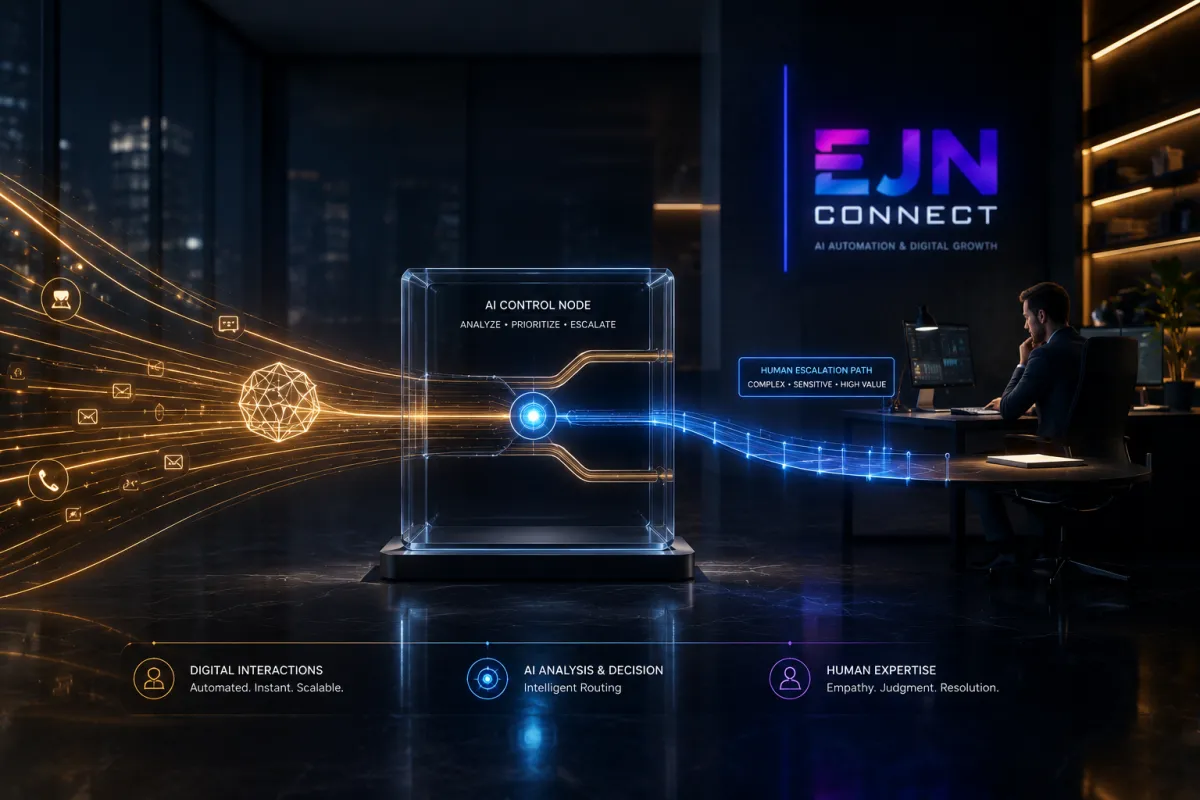
A well-designed AI escalation system operates across three interconnected detection and response mechanisms that together ensure no edge case falls through the cracks.
Intent boundary detection is the first layer. Every inbound message or call is analysed not just for its content but for whether the intent it expresses falls within the AI's authorized scope of operation. When a request enters territory that the AI is explicitly not configured to handle complex legal discussions, sensitive medical triage, custom enterprise pricing negotiations, regulatory compliance questions the system identifies this immediately and marks the interaction for escalation. The AI does not attempt to answer outside its boundaries. It recognizes the boundary and acts accordingly.
This is the guardrail system working as designed ensuring that the AI's reach never extends beyond what your business has authorized it to handle, and that anything requiring specialist human knowledge or authority is flagged before the AI has the chance to respond incorrectly.
Real-time sentiment analysis adds an additional and critically important escalation trigger. Modern conversational AI does not just process the words a client uses it reads the emotional tone behind them. When a caller or chat user exhibits elevated frustration, urgency, distress, or any other signal that suggests the interaction has moved into emotionally sensitive territory, the system detects the sentiment shift immediately.
Rather than continuing to process the interaction as a routine enquiry, the AI prioritizes that conversation and routes it directly to a senior team member before the client's frustration escalates further, before a bad experience becomes a worse one, and before the damage to the relationship extends beyond what a skilled human response can repair.
This is one of the capabilities that most surprises business owners when they first encounter it the idea that an AI can read emotional context accurately enough to know when a human needs to step in. But it is also one of the most commercially significant capabilities in the entire system, because the clients who need emotional sensitivity most urgently are often the most valuable ones to retain.
The high-context handoff is where the escalation protocol completes and where the difference between a good escalation and a great one becomes clear.
When the AI determines that a human needs to take over, it does two things simultaneously: it handles the transition to the client smoothly and professionally, ensuring they feel acknowledged and reassured rather than abandoned mid-conversation. And it immediately compiles a complete context summary for the team member who is about to step in.
That context card includes the exact nature of the issue raised, the emotional tone and urgency level of the client, their complete contact details and interaction history pulled from the CRM, and a summary of everything discussed in the conversation so far. It is delivered to the relevant team member instantly via SMS, email, or a live CRM alert so that when they join the conversation, they are fully prepared.
The client does not have to repeat themselves. The team member does not have to spend the first five minutes of the interaction establishing context that has already been captured. The handoff is seamless, informed, and fast which means the human interaction that follows it starts from the best possible position.
What This Means for Your Team
The intelligent escalation model creates a specific and valuable division of responsibility between your AI system and your human team one that protects both the quality of client experience and the wellbeing of your staff.
Your team is shielded completely from the routine, repetitive, low-complexity volume of interactions that the AI handles independently. They are not interrupted by basic FAQ questions, standard booking requests, or straightforward information enquiries. Their attention and energy are preserved for the interactions that genuinely require them.
But the moment a situation exceeds what the AI should handle the moment a client is distressed, a question is complex, or a scenario requires human authority and judgement, your team is alerted immediately, briefed fully, and positioned to step in with everything they need to deliver an excellent response.
The result is that your human team's involvement in customer communication becomes almost entirely high-value. They are not managing volume. They are managing the moments that matter armed with full context, arriving at the right time, and able to focus entirely on the quality of the interaction rather than on catching up with what happened before they joined.
The Brand Protection Dimension
There is a risk management dimension to intelligent escalation that is worth making explicit.
Every business has interactions that, if handled incorrectly, could create legal, compliance, or reputational exposure. Medical practices where clinical advice might be sought through a chat channel. Financial services firms where specific investment guidance could be inappropriately provided. Legal practices where client-specific advice should never come from an automated system. Any business where a client in genuine distress needs a human response, not an automated one.
Intelligent escalation protocols provide a systematic, reliable mechanism for ensuring these situations are always handled by the right person. The guardrails are not dependent on someone remembering to apply them. They are hardwired into the system active in every interaction, consistently enforced, and auditable.
For businesses operating in regulated industries, or any business that values the ability to demonstrate that sensitive client interactions were handled appropriately, this is not a nice-to-have feature. It is a fundamental requirement of responsible AI implementation.
At ejnconnect.com.au, we build AI systems for Australian small businesses that include intelligent escalation protocols as a core architectural feature ensuring routine interactions are handled automatically, edge cases are detected and escalated immediately, and every client receives the right response from the right source at the right moment.
Because the measure of a great AI system is not just what it handles well. It is how gracefully it hands over what it should not handle at all.
