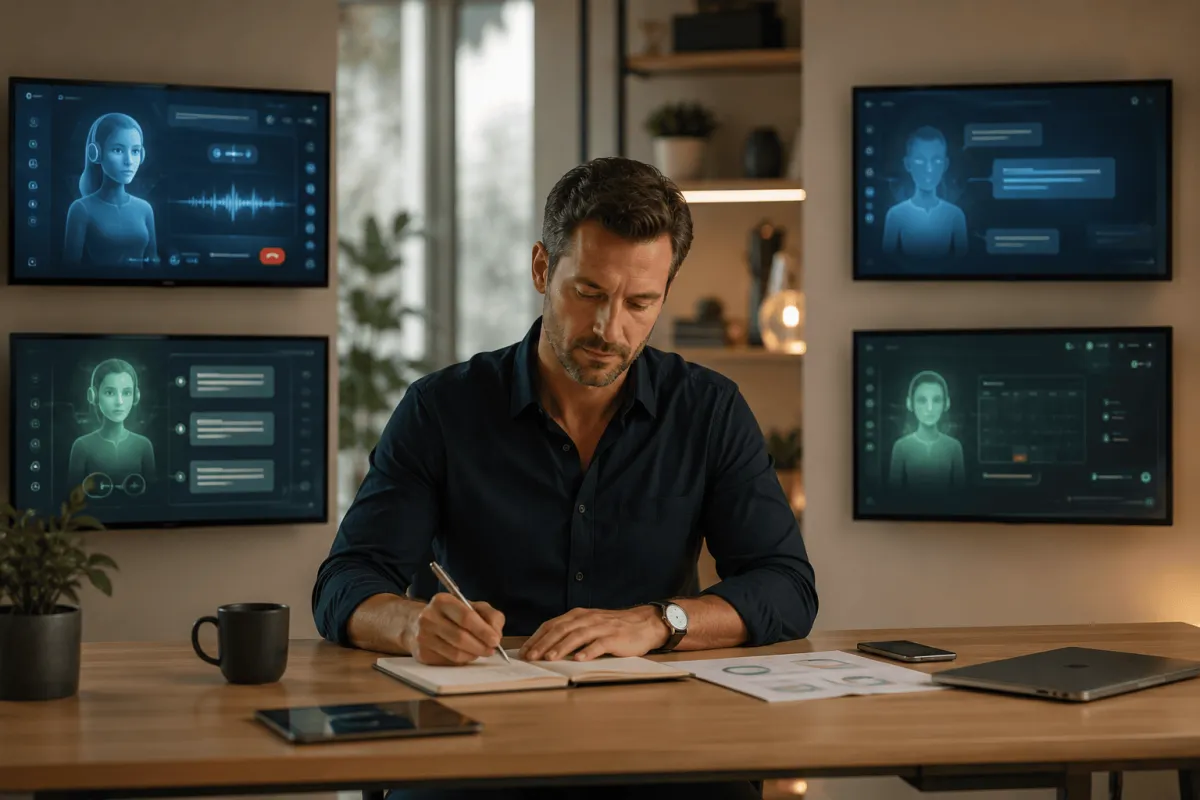
What Are AI Employees? A Small Business Guide to Digital Workers
When most small business owners hear the phrase "AI employee," one of two things happens. Either they picture something out of a science fiction film and immediately dismiss it as irrelevant to their business or they assume it's something only large corporations with large technology budgets can access.
Both reactions are understandable. And both are wrong.
An AI employee, in the practical sense that thousands of Australian small businesses are already using them, is simply a software system that performs specific, defined business tasks automatically. It answers enquiries. It follows up leads. It confirms appointments. It updates records. It handles the kind of structured, repetitive communication work that currently consumes a significant chunk of your team's time or yours every single day.
It's not a robot. It's not a replacement for your people. It's a system that works for your business around the clock, without supervision, without sick days, and without the overhead of an additional hire.
Why the Idea Is Catching On So Quickly
The reason AI employees are becoming a genuine conversation in small business circles across Australia isn't because the technology is new and exciting. It's because the problem they solve is very old and very familiar.
Small businesses have always faced a version of the same tension: the more successful you become, the more enquiries you receive, the more appointments need managing, the more follow-ups need sending and the more of your time and your team's time gets consumed by work that is important but not particularly skilled. Answering the same questions. Chasing the same leads. Sending the same confirmation messages. Updating the same records.
For a long time, the only solution was to hire more people. But hiring comes with cost, complexity, and time and for many small businesses, the volume of repetitive work doesn't justify a full additional role. It justifies a system.
That's exactly what an AI employee is. Not a replacement for a person, but a system that handles the work that doesn't need one.
The Different Types of AI Employees And What Each One Does
One of the most useful ways to think about AI employees is to think about the specific role each one plays, because they are not one-size-fits-all. Different business needs call for different types of digital workers.
AI Receptionists are perhaps the most immediately impactful for small businesses that receive a high volume of inbound calls. An AI receptionist answers every call professionally, collects the caller's details and the nature of their enquiry, handles common questions, and routes urgent requests appropriately, all without a human needing to pick up the phone. For trade businesses, clinics, real estate agencies, and professional services firms, this single capability can transform how many enquiries are captured each day.
AI Chat Agents operate on your website, engaging visitors the moment they arrive, answering questions, capturing lead information, and guiding prospects toward the next step, whether that's booking an appointment, requesting a quote, or simply staying in touch. Rather than a passive website that waits for someone to fill out a form, an AI chat agent creates an active, responsive experience at any hour of the day.
AI Follow-Up Assistants solve one of the most common and costly problems in small business sales: the lead that came in, showed interest, and then went quiet because nobody followed up consistently. An AI follow-up assistant maintains contact with every prospect through a defined sequence of messages, personalized, timely, and professional without anyone on your team having to manage it manually. Every lead gets the same attentive follow-up experience regardless of how busy your week is.
AI Administrative Assistants handle the operational layer like scheduling, reminders, record updates, internal notifications, and workflow coordination. The tasks that individually seem small but collectively consume hours of productive time every week. When these are handled automatically, that time goes back to your team.
What AI Employees Cannot and Should Not Do
This is worth being direct about, because clarity here matters.
AI employees are exceptionally good at structured, repetitive, high-frequency tasks. They are not good at and are not designed for, the work that makes a business genuinely great. Strategic decision-making requires human judgement. Building real relationships with clients requires human empathy. Navigating complex problems, leading a team, representing your brand in the community, making the calls that don't have an obvious right answer, all of these require people.
The most effective small businesses using AI employees today are not trying to automate everything. They are being deliberate about which tasks genuinely benefit from automation and protecting the time and attention of their human team for the work that only humans can do well.
Think of it this way: an AI employee handles the volume so your people can handle the value.
The Business Case for Small Businesses Specifically
For larger organizations, the efficiency gains from automation are real but incremental, they already have systems, processes, and teams in place. For small businesses, the impact is often transformative.
When a two or three person operation implements an AI receptionist, an AI follow-up assistant, and an automated scheduling system, they are effectively adding the equivalent of a part-time administrative team member, one that works every hour of every day, never misses a follow-up, and costs a fraction of an additional hire.
The results show up quickly and consistently: more enquiries captured, faster response times, more leads converted, less time lost to repetitive admin, and a business that feels more in control and less reactive. For a small business owner who has been wearing every hat simultaneously, that shift is not just operational. It's genuinely life-changing.
Where to Start
The most practical approach for most small businesses is to start with the area of highest friction, the task or process that currently consumes the most time, creates the most inconsistency, or costs the most in missed opportunities. For many businesses, that's inbound enquiry handling or lead follow-up. For others, it's scheduling or after-hours communication.
Start there. Build one system that works reliably. Then expand from there as the value becomes clear which, in most cases, it does very quickly.
AI employees are not the future of small business. For a growing number of Australian businesses, they are already the present, quietly handling the routine work in the background while the people they support focus on growing something worth building.
ejnconnect.com.au helps Australian small businesses identify where AI employees will deliver the most immediate value and implement the systems to make it happen practically, affordably, and without the technical complexity most business owners fear.
Because the best thing about a great AI employee is the same as the best thing about any great hire: once they're in place and working well, you wonder how you ever managed without them.
