
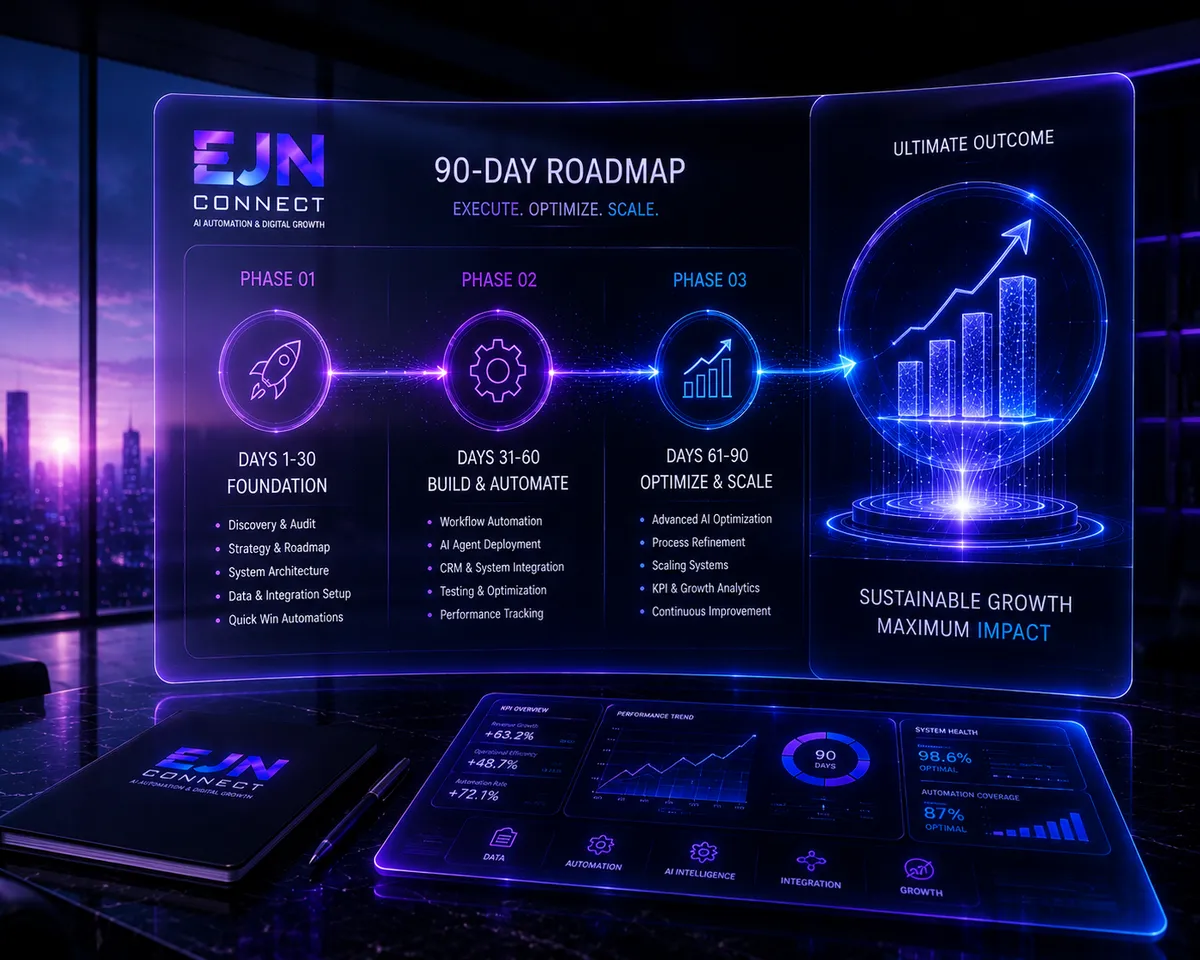
The 90-day AI implementation roadmap. How Australian small businesses can build a fully autonomous growth engine in three months
Table of Contents
Phase 1: Infrastructure Audit and Foundation (Days 1 to 30)
Phase 2: Agent Engineering and Workflow Orchestration (Days 31 to 60)
Phase 3: Live Deployment, Optimization, and Scale (Days 61 to 90)
Understanding the components of a unified AI architecture, the intake systems, the multi-agent orchestration, the CRM integration, the data governance is valuable. But understanding is not the same as implementation. And for most small business owners, the gap between knowing what they want to build and knowing how to build it is where the momentum stalls.
This article closes that gap.
What follows is a structured, phase-based 90-day implementation roadmap, the same framework used to take businesses from manual, fragmented processes to fully autonomous AI infrastructure. It is not a theoretical framework. It is a practical execution plan with specific deliverables, clear sequencing, and measurable milestones at every stage.
The approach is deliberate and phased not because AI implementation needs to be slow, but because the businesses that get the best results are the ones that build on solid foundations rather than rushing to deploy systems that are not properly configured or integrated. Each phase creates the conditions for the next to succeed.
Phase 1: Infrastructure Audit and Foundation (Days 1 to 30)
The goal of the first thirty days is not to deploy anything visible or client-facing. It is to build the foundation that everything else depends on and to build it properly.
Businesses that skip this phase and move directly to deployment almost always pay for it later, with systems that perform inconsistently, knowledge bases that are incomplete or inaccurate, and CRM architectures that require significant rework once the scale of the integration becomes clear. The first thirty days of careful foundation-building saves months of remediation later.
Week One: Process and Bottleneck Audit
Before building anything, map the current state of your business's customer communication and intake operations honestly and completely.
Identify every channel through which clients and prospects currently contact your business website, phone, SMS, social media, email, and any others and document how each is currently managed, by whom, and how consistently. Map the journey a typical inbound lead takes from first contact to confirmed booking or lost opportunity, and identify every point where friction, delay, or inconsistency occurs.
Establish your current baseline metrics: average speed-to-lead across each channel, current conversion rate from enquiry to booking, cost per acquired client, and an honest estimate of the administrative hours your team currently spends on repetitive communication tasks each week. These baseline numbers are the benchmark against which your 90-day results will be measured and you cannot measure improvement without them.
Identify your top twenty administrative bottlenecks, the specific, repetitive tasks that consume the most time, create the most inconsistency, or produce the most lead decay. These become your primary automation targets.
Week 2: Knowledge Base Construction
Your AI system is only as accurate and useful as the knowledge base it draws its answers from. Week two is dedicated to building that knowledge base properly.
Compile every piece of information your AI will need to represent your business accurately: your complete service offerings and pricing structures, your standard operating procedures, your FAQs and their approved answers, your service area and availability information, your communication guidelines and brand voice standards, your compliance boundaries and escalation rules.
Review everything for currency and accuracy removing outdated information, resolving inconsistencies, and ensuring that the knowledge base reflects how your business actually operates right now rather than how it operated when some of these documents were last updated.
Structure this information in a format that allows AI systems to query it precisely and retrieve accurate, relevant answers rapidly. This structured knowledge vault is the single source of truth that every AI agent in your system will draw from and its quality directly determines the quality of every client interaction your AI handles.
Weeks 3 and 4: CRM Architecture and Security Setup
With your knowledge base built, the third and fourth weeks focus on establishing the centralized CRM infrastructure that will serve as the operational backbone of the entire system.
For most Australian small businesses, this means consolidating any existing disconnected tools into a unified CRM platform, standardizing your pipeline stages, custom contact fields, smart lists, and calendar integration so that every component of the AI system has a clean, consistent data environment to work within.
Alongside the CRM setup, establish the security architecture that your AI deployment requires: role-based access controls that define what each system component can access, end-to-end encryption for client data in transit and at rest, and private API connections that ensure your business and client data is never processed through unsecured public systems.
At the end of Phase One, you have a complete knowledge base, a unified CRM architecture, a clear picture of your current baseline metrics, and a secure technical foundation ready to receive the AI agent layer.
Phase 2: Agent Engineering and Workflow Orchestration (Days 31 to 60)
With solid foundations in place, Phase Two deploys the AI agents themselves in a controlled environment that allows thorough testing before any client-facing activation.
Week 5: Primary Agent Configuration and Intake Deployment
The intake agent, the AI that handles first-touch client interactions across your channels is configured with your specific brand voice, communication style, qualification criteria, and boundary guardrails. It is connected to your knowledge base and your CRM, and tested across a range of typical and edge-case inbound scenarios to verify that it responds accurately, appropriately, and in a way that genuinely represents your business.
The target for this week is a primary agent that can handle sub-sixty-second first-touch responses across your primary channels, qualify inbound leads according to your specific criteria, and book appointments directly into your live calendar without human intervention.
Week 6: Multi-Agent Integration
Where your workflows require it, complex onboarding processes, compliance-sensitive interactions, multi-step document processing, the specialist child agents are deployed and integrated with the supervisor agent and the CRM execution layer.
The structured data handoffs between agents are established and tested: the JSON webhook protocols that allow the action agent to trigger CRM updates, calendar bookings, and confirmation sequences the moment a conversation reaches a decision point. Each integration point is tested specifically to verify that data passes between systems accurately and that every system action produces the correct outcome in the CRM.
Week 7: Human-in-the-Loop Setup and Staff Training
The escalation protocols that route complex, sensitive, or high-value interactions to human team members are configured and tested. The context summary that accompanies every escalation is refined to ensure your team receives the information they need to take over a conversation seamlessly.
Your team is briefed on how the system works, what their role is within it, how to handle warm handoffs from the AI, how to review automated interaction logs, and how to identify and flag performance issues that need attention. Staff buy-in and understanding at this stage directly affects how well the human-AI collaboration model functions in practice.
Week 8: Controlled Stress Testing
Before any client-facing activation, the entire system is stress-tested under simulated high-volume conditions, verifying that response latencies remain within target under load, that the CRM integration performs reliably when multiple simultaneous bookings are processed, and that the escalation protocols trigger correctly under the edge-case scenarios most likely to occur in real operation.
Any performance gaps identified during stress testing are addressed before Phase Three begins.
Phase 3: Live Deployment, Optimization, and Scale (Days 61 to 90)
Phase Three moves the system from controlled testing to live, production-grade operation and begins the continuous optimization process that compounds performance over time.
Week 9: Full Production Launch
The AI system goes live across all public-facing channels. Every inbound enquiry regardless of channel, regardless of time is now engaged immediately by the AI. Speed-to-lead performance is monitored in real time against the sub-sixty-second target. CRM pipeline updates are verified as they occur. The system is live, and the gap between how the business operated at Day Zero and how it operates now is immediately apparent.
Week 10: Evaluator Agent Activation and Quality Control
The background evaluator agent is activated, beginning the continuous quality assurance process that monitors every conversation against performance benchmarks, identifies anomalies in real time, and flags specific friction points for attention. Sentiment tracking is activated, and escalation alerts for senior staff are calibrated to trigger at the right threshold for your specific operation.
Week 11: Data Flywheel Analysis and Conversion Tuning
With three weeks of live operation producing real interaction data, the first meaningful pattern analysis becomes possible. Recurring objections are identified. Gaps in the knowledge base are flagged and filled. Qualification criteria are reviewed against actual conversion outcomes and refined where the data indicates improvement opportunities. The knowledge base is updated with the language patterns and information gaps that real conversations have revealed.
Landing page messaging and advertising copy are updated to reflect the exact language patterns your AI has identified as resonating with high-converting prospects, closing the loop between operational AI intelligence and front-end marketing effectiveness.
Week 12: ROI Review and Scaling Blueprint
The final week of the 90-day roadmap measures the distance travelled. Actual performance against the Day Zero baseline across every metric established in Week One: speed-to-lead improvement, conversion rate change, administrative hours recovered, lead volume captured after hours, client acquisition cost reduction.
For most businesses that have executed the roadmap systematically, the improvement across these metrics is significant and clearly measurable, typically producing a return that justifies the implementation investment within the first ninety days and establishing the compounding trajectory that improves performance further with every subsequent month.
The scaling blueprint for the next quarter is established: which additional workflows are ready for automation, which new channels or markets the system can now support, and how the AI infrastructure can be extended to create further operational advantage.
What Day Zero Looks Like Versus Day Ninety
The contrast between the operational state of a business at the beginning of this roadmap and the end of it is specific and measurable across every dimension that matters.
Speed-to-lead moves from an average of two to twelve hours down to sub-sixty seconds, available around the clock. After-hours enquiries move from static forms and voicemail to interactive AI consultation with live calendar booking. Software architecture moves from disconnected apps to a unified CRM with integrated multi-agent AI. Data utilization moves from discarded conversation logs to a continuously improving intelligence flywheel. Team time allocation moves from eighty percent manual administrative tasks to eighty percent high-value strategic execution and client relationship work.
Ninety days. Four phases. A fundamentally different business at the end of it.
At ejnconnect.com.au, we work with Australian small businesses to execute this roadmap from the initial audit and knowledge base construction through to live deployment, evaluator agent activation, and ongoing optimization as a managed, structured process that delivers measurable results at every phase.
If you are ready to start your 90-day journey toward autonomous business operations, we would love to map out what that looks like specifically for your business.
Because the gap between where your business is today and where a well-built AI infrastructure can take it is ninety days of structured, deliberate work. And the businesses that start that work now will be ninety days ahead of every competitor who is still deciding whether to begin.

