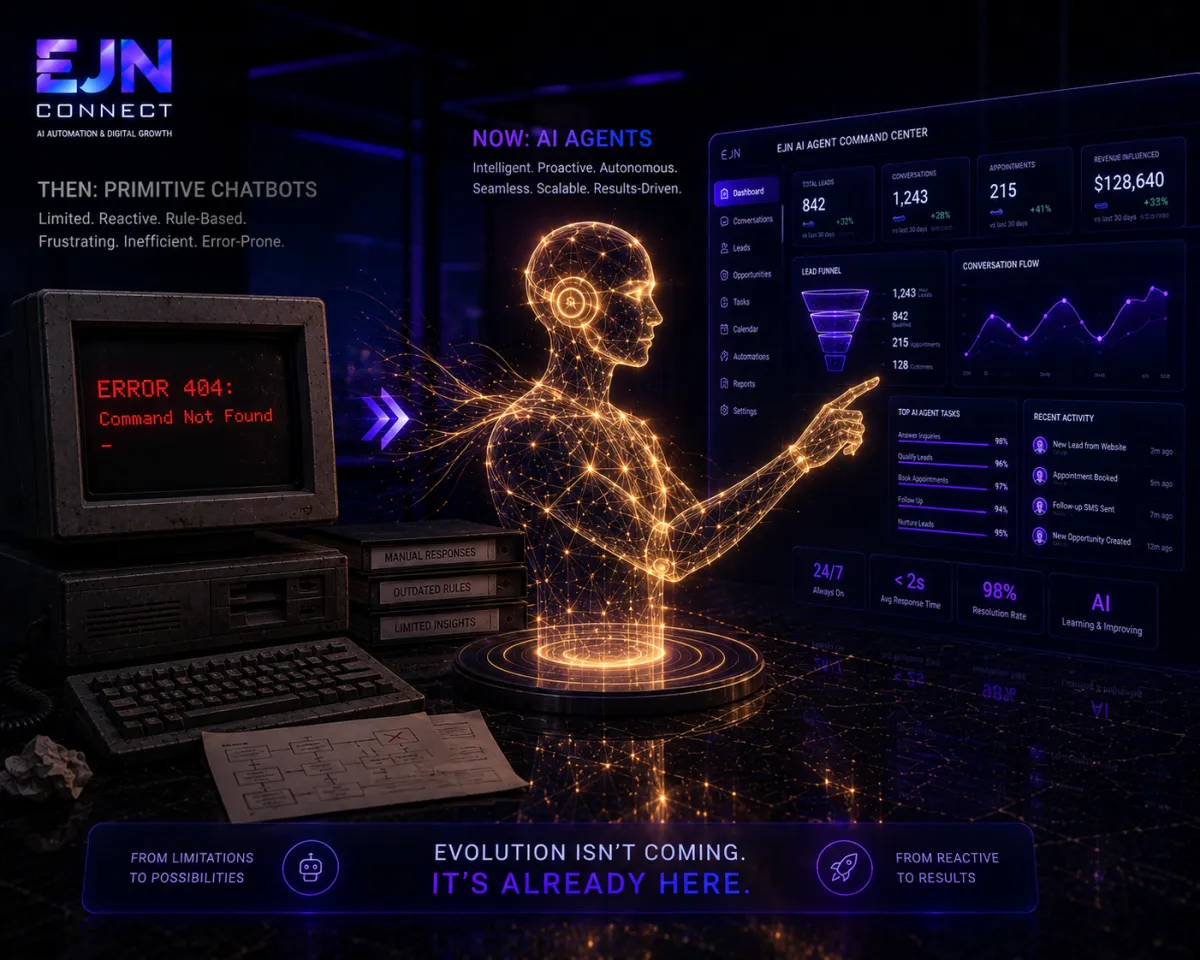
Still Using a Chatbot? Here's Why It's Damaging Your Brand and Sending Clients to Your Competitors
Table of Contents
Why Legacy Chatbots Fail in Modern Business Contexts
The Three Fundamental Differences Between Legacy Bots and Autonomous AI Agents
You have almost certainly experienced this from the other side as a customer trying to get a simple question answered on a business website.
The chat window opens. You type your question. The bot responds with a menu of pre-set options, none of which quite match what you were asking. You try rephrasing. The bot does not understand. You try clicking the closest option. The bot takes you to another menu. After two or three increasingly frustrating exchanges, you get the message you were dreading: "Sorry, I didn't understand that. Please call us during business hours."
You close the tab. You go back to Google. You find a different business. And you never return.
This is the experience that legacy rule-based chatbots deliver to a meaningful proportion of the visitors they encounter and it is an experience that is actively damaging the businesses that deploy them, in ways that show up in bounce rates, in lost leads, in wasted advertising spend, and in the quiet erosion of brand credibility that happens one frustrated visitor at a time.
The technology gap between a legacy chatbot and a modern autonomous AI agent is not a matter of degree. It is a fundamental architectural difference that produces completely different outcomes for the visitors who encounter them and for the businesses that deploy them.
Why Legacy Chatbots Fail in Modern Business Contexts
Legacy chatbots were built on a logical framework called if/then decision trees. If the user clicks this button or types this exact phrase, then respond with this pre-written script. The framework made sense when the technology had no other option and in contexts where every possible user input could be anticipated and scripted, it could work adequately.
Modern business conversation is not that context. Real customers do not ask questions the way pre-written menus expect them to. They type incomplete sentences, use industry slang, make spelling errors, phrase their questions in ways nobody anticipated when the bot was configured, and ask follow-up questions that lead the conversation in directions the decision tree was not designed to handle.
The moment a real conversation deviates from the scripted path which is constantly, the legacy chatbot breaks down. It either loops back to the same menu options, acknowledges that it did not understand and asks the user to try again, or reaches a dead end that redirects the user to a phone number or a contact form. In every one of these failure modes, the user's experience is the same: frustration, the sense that the business's digital presence is not capable of helping them, and the impulse to look elsewhere.
For businesses running paid advertising to drive traffic to their website, every visitor who bounces from a failed chatbot interaction represents advertising spend that produced no return. The marketing worked well enough to bring the visitor to the website. The chatbot destroyed the opportunity before it could convert.
The Three Fundamental Differences Between Legacy Bots and Autonomous AI Agents
Understanding why modern AI agents produce such different outcomes requires understanding the specific architectural differences that separate them from their rule-based predecessors.
Natural language understanding versus keyword matching
A legacy chatbot looks for exact keyword matches. If the system was configured to respond to the phrase "pricing" and the visitor types "how much does an emergency callout cost?" the bot fails to recognize the match and produces an error response.
An autonomous AI agent powered by a large language model understands intent rather than keywords. It processes the meaning of what the visitor said that they are asking about the cost of an emergency callout regardless of how they phrased it, regardless of typos or informal language, regardless of whether the specific words they used appear anywhere in the system's configuration. The conversation continues naturally because the AI understood what was being asked.
This single capability difference intent recognition versus keyword matching eliminates the vast majority of the failure modes that make legacy chatbots frustrating. Visitors can communicate naturally, and the AI responds to what they meant rather than what they literally typed.
Dynamic knowledge retrieval versus static hardcoded responses
A legacy chatbot can only display text that was written into it at the time of configuration. It has no ability to look anything up, check any live system, or retrieve current information. When the business's pricing changes or a service is updated, someone has to manually update the chatbot's hardcoded scripts and until they do, the bot delivers outdated information with complete confidence.
An autonomous AI agent uses retrieval-augmented generation to query your business's live knowledge base in real time. Every response draws from the current, accurate version of your business information your services, your pricing, your availability, your standard operating procedures. When something changes in your business, it is updated in the knowledge base and the AI reflects it immediately, across every conversation, without any manual reconfiguration.
Active system execution versus passive text display
A legacy chatbot is limited to displaying text on a screen. It cannot interact with any external system. It cannot check your calendar, create a CRM record, trigger a follow-up sequence, or take any action that extends beyond the chat window itself. At best, it can direct the visitor to a link where they can take those actions themselves.
An autonomous AI agent possesses functional agency. It connects to your business's operating systems through secure integrations and can take real actions on your behalf checking real-time calendar availability, creating and updating contact records in your CRM, locking in bookings, triggering confirmation sequences, and initiating follow-up workflows. The visitor's journey does not end at the chat window with a link to click. It ends with a confirmed appointment and a notification sent to your team.
The Brand Damage That Legacy Chatbots Cause
The commercial cost of deploying a legacy chatbot in a modern business context goes beyond the individual leads that are lost to frustrating interactions. It creates a brand credibility problem that affects how prospects perceive your business before they have had any substantive engagement with it.
Your website is the first impression most prospects have of your business. The quality of the experience they have there shapes their expectations for every subsequent interaction. A business whose digital front door offers a frustrated, loop-prone chatbot that cannot answer basic questions signals something specific to the prospect: this business's operations are not keeping pace with the market.
In industries where the client is making a decision about trust who to let into their home, who to engage for professional advice, who to partner with for a significant project that first impression matters. A clunky, outdated digital experience creates doubt before the business has had the opportunity to demonstrate its actual quality and capability.
An autonomous AI agent that engages immediately, responds intelligently, demonstrates genuine knowledge of the business and its services, and moves the visitor toward a booking without friction creates the opposite impression. It signals a business that is organized, attentive, and operating at a level that justifies the trust the client is being asked to place in it.
The Practical Case for Making the Switch
For any business that currently has a legacy chatbot deployed on its website, the question of whether to replace it is not primarily a technology question. It is a business performance question.
How many visitors is the current chatbot frustrating rather than converting? How much advertising spend is being wasted on traffic that the chatbot fails to engage? How much time is your team spending manually following up on conversations that should have been automated through to booking? And what would a three-to-five-fold improvement in website conversion rate mean for revenue and customer acquisition cost?
The answers to those questions, calculated honestly from your actual traffic and conversion data, make the investment case for replacing a legacy chatbot with an autonomous AI agent and in most cases, they make it compellingly.
At ejnconnect.com.au, we help Australian small businesses replace legacy chatbots with custom-trained autonomous AI agents built on your specific business knowledge, integrated with your CRM and calendar, and deployed across every channel your clients use to make contact.
Because your digital front door should make prospects more confident in your business, not less. And in 2026, a rule-based chatbot that cannot hold a natural conversation is doing exactly the opposite.
