Software vs Automation vs AI — What's Actually the Difference and What Does Your Small Business Really Need?
Table of Contents
Think of Your Business as a Physical Office
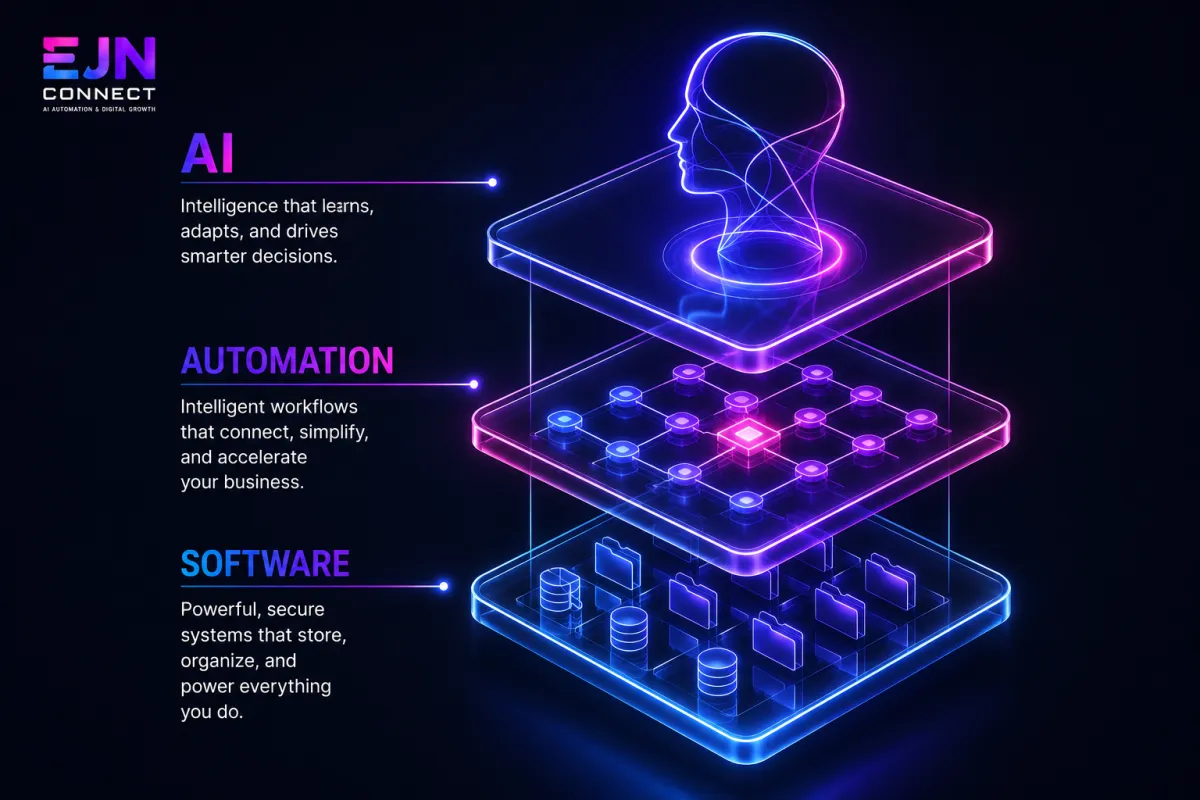
Layer One: Software — The Filing Cabinet
Layer Two: Automation — The Conveyor Belt
Layer Three: Artificial Intelligence — The Smart Assistant
If you've sat through a software sales pitch recently and walked away more confused than when you started, you are absolutely not alone. The technology industry has a remarkable talent for using three completely different concepts software, automation, and artificial intelligence as though they are interchangeable. They are not. And for a small business owner trying to make smart decisions about where to invest time and money, that confusion is genuinely expensive.
Buying complex software you never fully use. Building rigid automations that break the moment something unexpected happens. Paying for AI features your business isn't ready for yet. These are real mistakes that real businesses make every week not because the owners aren't smart, but because nobody has explained the difference clearly.
So let's do that right now. No Silicon Valley jargon. No tech industry hype. Just a straightforward explanation of what each layer actually does and a simple analogy that will make the whole thing click instantly.
Think of Your Business as a Physical Office
The clearest way to understand how software, automation, and AI relate to each other is to picture a traditional, paper-based office. Because every one of these digital tools has a direct physical equivalent that you already understand intuitively.
Layer One: Software — The Filing Cabinet
Software is the foundation. It is the digital workspace where your business data lives, your customer records, your invoices, your project notes, your communications history. Your CRM platform is software. Your accounting system is software. Your project management tool is software.
In the physical office analogy, software is the filing cabinet in the corner of the room. It holds everything safely and keeps it organized. Before you had it, your information was scattered across sticky notes, loose papers, email threads, and the memory of whichever team member happened to deal with a particular client last.
Software solves that problem. It gives your business a single, secure, organized place for your data to live.
But here's the limitation that catches most business owners out: a filing cabinet is completely static. It doesn't organize itself. It doesn't talk to other filing cabinets. It doesn't send reminders, update records, or move information from one place to another. Every single action requires a human to physically do the work. And that is precisely where automation comes in.
Layer Two: Automation — The Conveyor Belt
Automation is a rule-based system that connects your software tools together so they can share data and trigger actions without a human doing it manually. It operates entirely on "if this happens, then do that" logic.
In the physical office analogy, automation is a mechanical conveyor belt running between your filing cabinets. The moment a new folder drops into Cabinet A, the conveyor belt automatically shoots a copy straight to Cabinet B, instantly, reliably, without anyone having to carry it across the room.
What automation eliminates is the repetitive, manual administrative work that quietly consumes hours of productive time every week. Data entry that requires copying information from one system to another. Follow-up reminders that someone has to remember to set. Notifications that only go out if a team member manually triggers them. Automation handles all of this in the background, consistently and without error, every single time the predefined condition is met.
But automation has a hard limit and understanding it is critical. Automation has zero intelligence. It cannot read context. It cannot adapt. It cannot handle anything that falls outside the exact rule it was given.
If a customer sends a message saying "Hey, I need to reschedule, my car broke down and I can't make it," a traditional automation workflow will break. It doesn't know what to do with a human explanation. It only knows how to process a specific button click or a predefined trigger. The moment something unexpected happens which in real customer interactions is constantly, automation on its own is helpless.
That is exactly the gap that artificial intelligence fills.
Layer Three: Artificial Intelligence — The Smart Assistant
Artificial intelligence is the layer that brings genuine adaptability, context-reading, and conversational capability to your digital systems. It can understand what a customer actually means not just what they literally typed. It can make decisions based on context. It can communicate back and forth with real human beings in a natural, responsive way.
In the physical office analogy, AI is the brilliant assistant standing beside the conveyor belt. When a messy, ambiguous email arrives from a client, one that no automation rule could process, the AI reads it, understands the situation, checks your calendar, offers a better time, handles the rescheduling, and instructs the conveyor belt exactly where to move the file next. The conveyor belt does the mechanical work. The assistant does the thinking.
What AI brings to your business that neither software nor automation can provide is human-like adaptability at scale. The ability to handle front-line customer interactions, enquiries, lead qualification, appointment booking, after-hours communication with the kind of intelligence and responsiveness that previously required a person to be available around the clock.
How the Three Layers Work Together
Here is where the real operational power comes from, not from any one of these technologies in isolation, but from all three working together as a connected system.
Software holds your data securely in one place. Automation moves that data instantly between systems and triggers defined actions without manual input. AI sits at the front line, reading context, communicating with customers, making intelligent decisions, and directing the automation and software layers based on what it learns.
When a new lead contacts your business, the AI engages them immediately in a natural conversation, qualifies their enquiry, and books their appointment. The moment the booking is confirmed, automation fires, updating your CRM record, sending a confirmation message, notifying your team, and adding the appointment to your calendar. All of that data lives permanently in your software, accurate and accessible, without a single manual action from anyone on your team.
That is what a genuinely integrated digital infrastructure looks like. And the difference between a business running that kind of connected system versus one managing three separate, disconnected software subscriptions is not marginal. It is transformative.
What Does Your Business Actually Need Right Now?
Most small businesses don't need more software. In fact, one of the most common problems we see is business owners paying for eight or ten different platforms that don't communicate with each other, creating more administrative work, not less.
True operational efficiency starts with honest clarity about which layer your business actually needs most right now.
If your data is scattered, inaccessible, or unreliable you need better software foundations. If you're wasting hours on repetitive manual tasks that follow a predictable pattern, you need automation. If your front-line customer communication is slow, inconsistent, or dependent on your team being available at all hours... you need AI.
And if all three of those things are true, which they are for most growing small businesses, you need a connected ecosystem that integrates all three layers into a single, coherent system that works for your business around the clock.
At ejnconnect.com.au, we help Australian small businesses cut through the technology noise and build the right combination of software, automation, and AI for their specific operation without the confusion, the wasted subscriptions, or the overly complex systems that nobody actually uses.
Because the goal was never to have the most sophisticated technology. It was always to have a business that runs better and knowing the difference between your filing cabinet, your conveyor belt, and your smart assistant is exactly where that starts.
