Winning the speed-to-lead race across every channel
Here's a question worth sitting with for a second: how much money have you already spent generating a lead... that nobody contacted in time?
If you're running ad campaigns on Meta, Google, or LinkedIn, this probably stings a little. Because the uncomfortable truth in digital marketing right now isn't about getting more traffic most businesses are already pretty good at that. The real problem is what happens in the minutes after someone fills out a lead form. And for most businesses, that window is where all the money quietly leaks out.
This is where AI-driven digital marketing changes the equation entirely. Not by generating more leads, but by making sure the leads you're already paying for actually get contacted while they still care. Let's talk about why speed matters so much more than most marketers realize, and how automation closes that gap for good.
The Real Bottleneck Isn't Traffic... It's Response Time
Every marketer obsesses over ad creative, targeting, and cost-per-click. All important, sure. But here's what often gets overlooked: generating a high-intent lead is only half the job. If nobody responds to that lead quickly, all that ad spend was essentially wasted.
Traditional ad workflows weren't built for speed. A lead comes in, it sits in an inbox or a spreadsheet, a sales rep eventually gets to it maybe that afternoon, maybe the next day. By then, the prospect has usually moved on, often straight to a competitor who responded faster.
This is the gap that AI-driven digital marketing exists to close.
The Science Behind Speed-to-Lead
This isn't a hunch, it's backed by consistent industry data, and the numbers are honestly a bit eye-opening once you see them laid out.
The 5-Minute Rule. Responding to a lead within 5 minutes makes you roughly 9 times more likely to convert them compared to waiting just 30 minutes. Thirty minutes doesn't sound like a long delay until you realize it's already cutting your odds dramatically.
The 60-Second Gold Standard. Engaging a lead within 60 seconds while your brand is still fresh in their mind, can boost contact rates by as much as 391%. That's not a typo. That's the power of catching someone while their intent is still hot.
Lead Decay. After 24 hours, an uncontacted lead is essentially cold. All the customer acquisition cost (CAC) that went into generating it? Gone, with nothing to show for it.
Put simply: speed isn't a "nice to have" in lead follow-up. It's the single biggest lever most businesses aren't pulling.
How Omnichannel AI Lead Orchestration Actually Works
So how do you actually hit that 60-second window, every time, across every channel, without hiring a 24/7 call center? This is where AI-driven marketing automation takes over the parts humans simply can't do fast enough.
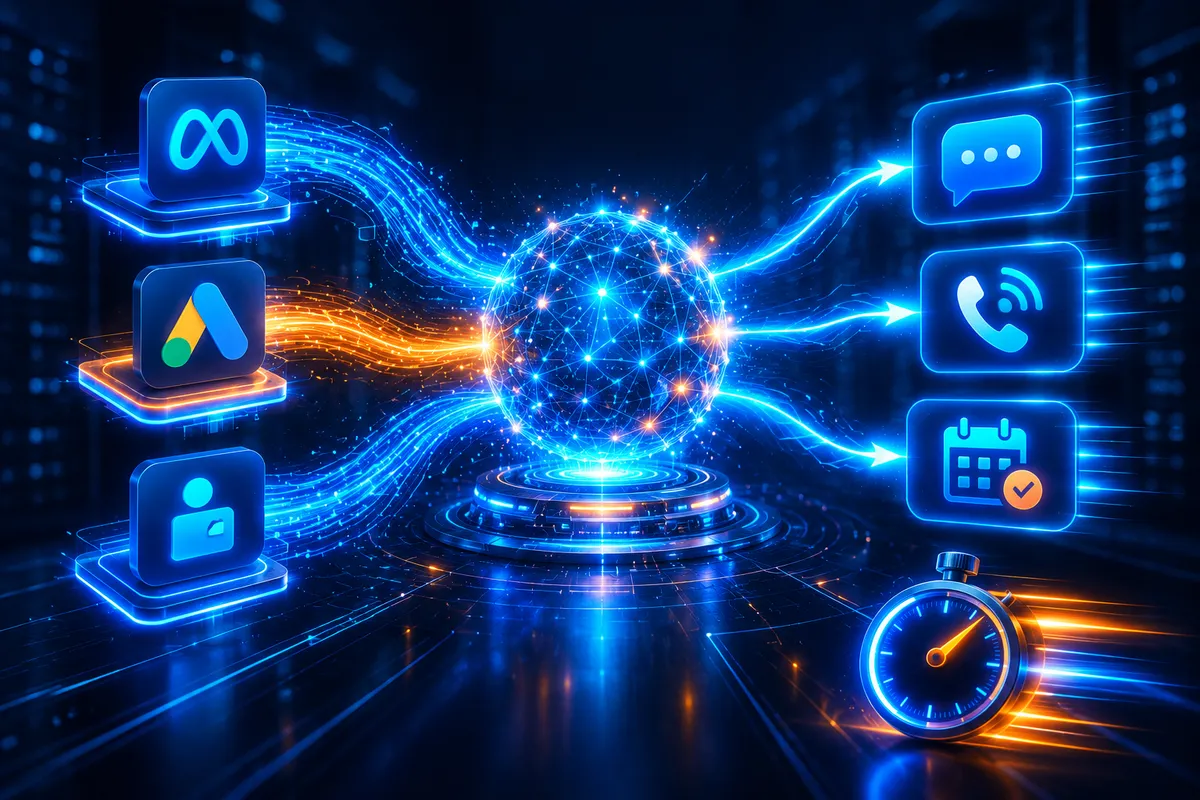
Here's how the system flows, from ad click to booked appointment:
1. Multi-platform ad campaigns. Whether a lead comes from a Meta Instant Form, a Google Search Ad, or a LinkedIn Lead Gen form, the moment they submit, that information doesn't sit and wait, it fires instantly.
2. Real-time AI routing and qualification. The lead is automatically scored for intent, then engaged immediately through an AI voice call, SMS, or chat and if appropriate, guided straight to a calendar booking.
3. Automated CRM pipeline updates. A contact record is created, the opportunity is advanced through the pipeline, and a multi-channel nurture sequence kicks off, all without a single person manually touching the lead.
No lead sits in a queue. No prospect wonders if anyone's going to call them back. The system responds while their interest is still at its peak.
The 3 Core Components of AI-Powered Digital Marketing
If you're evaluating whether your marketing stack actually supports real speed-to-lead, here's what to look for.
1. Direct API Instant Lead Ingestion
Native lead forms on platforms like Meta and LinkedIn convert better than sending traffic to an external landing page but only if you actually capture that lead the moment it's submitted. Direct API webhooks pull every lead into your CRM within milliseconds, instead of sitting in a platform's dashboard waiting for someone to manually export it.
2. Autonomous Multi-Channel Follow-Up
The second a lead form is submitted, an AI agent should already be following up via SMS, voice call, or WhatsApp, based on what the prospect actually requested. If someone asks for a phone consultation, an AI voice agent can place an outbound call within 30 seconds to confirm details and lock in a time on your team's calendar. No waiting for a rep to "get to it."
3. Smart Retargeting and Audience Suppression
Here's a detail a lot of businesses miss entirely: once a lead is qualified or has booked a meeting, they should stop seeing your top-of-funnel ads. AI-driven systems sync outcomes back to ad platforms through Conversion APIs (CAPI), automatically shifting converted leads into nurture campaigns instead. That means you're not wasting ad budget showing "book now" ads to someone who already booked which directly improves your overall return on ad spend (ROAS).
Traditional Follow-Up vs. AI-Driven Speed-to-Lead
The contrast here isn't subtle, it's the difference between leaking revenue and capturing it.
Marketing Feature | Traditional Follow-Up | AI-Driven Automated Marketing |
|---|---|---|
Response Time | 2 to 24+ hours (manual review) | Under 60 seconds, across all channels |
First Contact Method | Generic batch email | Personalized AI voice call, SMS, or WhatsApp |
Conversion Rate | Low, due to lead decay and drop-off | Maximized through instant engagement |
Data Sync | Manual CSV uploads or basic zaps | Real-time, bi-directional CRM sync |
Ad Spend Efficiency | Wasted CAC on uncontacted leads | Optimized CAPI tracking, minimal lead leakage |
Look closely at that "Ad Spend Efficiency" row. This is the part that should really grab attention because it's not about spending more on ads. It's about stopping the quiet waste that happens after the ad already did its job.
Why This Matters More Than Your Ad Creative
Here's the part that's easy to miss in all the talk about targeting and creative testing: even the best-performing ad campaign in the world can't save you if your follow-up process is slow. You can have the perfect audience, the perfect offer, and the perfect ad copy and still lose the sale simply because nobody called back in time.
AI-driven digital marketing isn't about replacing your sales team. It's about making sure every lead they eventually talk to has already been engaged, qualified, and kept warm instead of going cold while waiting in a queue.
Key Takeaways
Response time, not traffic volume, is the biggest lever in ad campaign ROI, responding within 5 minutes increases conversion odds by 9x.
The 60-second response window can boost contact rates by up to 391%, while leads left for 24+ hours are essentially wasted spend.
Effective AI-driven marketing automation relies on three pillars: instant lead ingestion, autonomous multi-channel follow-up, and smart retargeting.
Syncing outcomes back to ad platforms via Conversion APIs (CAPI) prevents wasted ad spend on already-converted leads.
The goal isn't more leads, it's making sure every lead you already paid for actually gets contacted while it still matters.
Ready to Stop Losing Leads to Slow Follow-Up?
If your ad campaigns are generating clicks but your sales team can't keep up with response times, you're leaving revenue on the table with every campaign you run.
At EJN Connect, we help businesses automate speed-to-lead across every channel, turning ad spend into predictable, trackable revenue instead of wasted CAC.
🌐 Visit us at ejnconnect.com.au
Let's make sure every lead you pay for actually gets a response.