How Multi-Agent AI Networks Are Automating Entire Business Operations End to End
Table of Contents
What a Multi-Agent AI Network Actually Is
How a Complete Multi-Agent Workflow Operates in Practice
The first wave of business automation gave most small businesses a collection of useful but isolated tools. A chatbot on the website. An automated email sequence triggered by a form submission. A scheduling link that syncs with a calendar. An automated appointment reminder. Each of these tools solved a specific, contained problem and each delivered genuine value within its narrow scope.
But they also created a new problem that most business owners did not anticipate: automation silos.
When each tool operates independently, without awareness of what the others are doing, the gaps between them have to be bridged by a human being. The chatbot captures a lead, but someone has to take that lead and enter it into the CRM. The scheduling tool books an appointment, but someone has to ensure the right team member is notified and prepared. The automated email goes out, but when the prospect responds, someone has to pick up the conversation and carry it forward.
The automation reduced some of the workload. But it did not eliminate the human coordination layer that sits between every isolated tool and that layer is where the delays, the errors, and the dropped balls live.
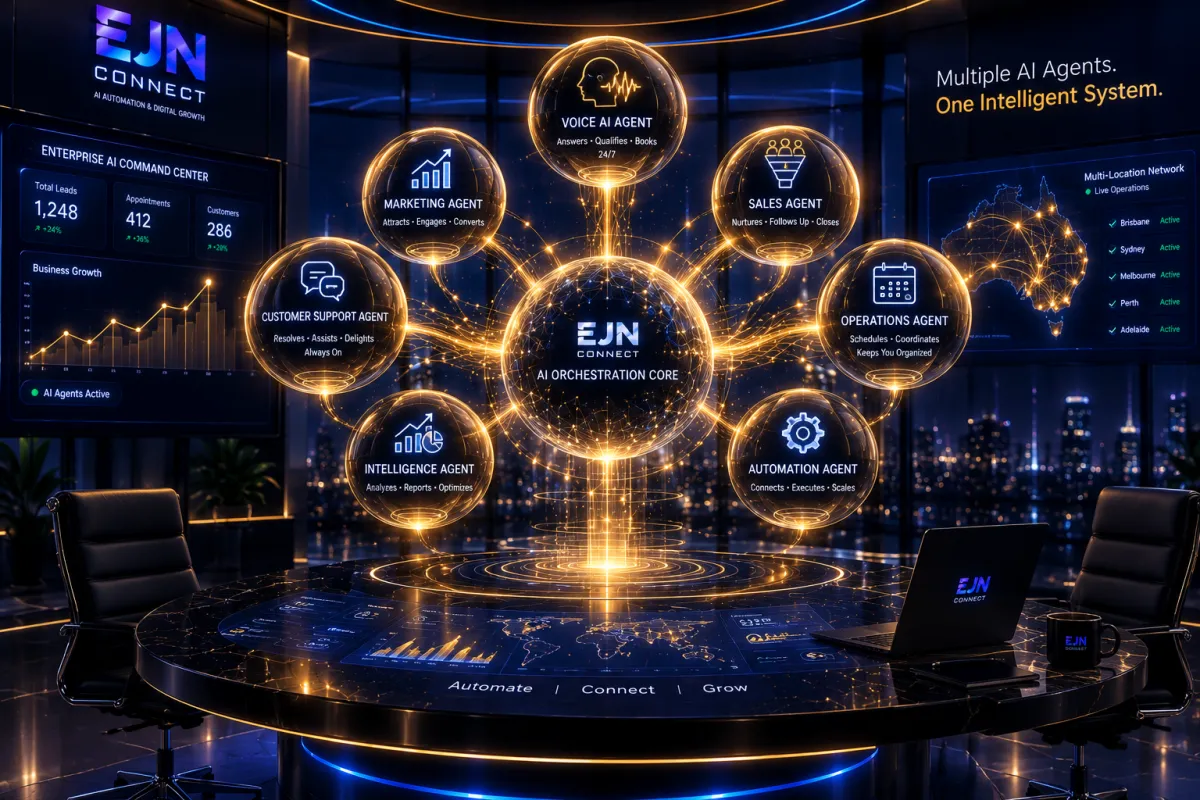
Multi-agent AI networks solve this problem at the root. Not by making any single tool smarter, but by deploying a coordinated team of specialist AI agents that communicate with each other, hand off data autonomously, and execute complex multi-step workflows end to end without a human being needed to bridge the gaps.
What a Multi-Agent AI Network Actually Is
The concept is most intuitive when you think about how a high-performing human team works because the structural logic is identical.
A well-run business does not have one person doing everything. It has specialists. A sales team handles qualification and conversion. Operations manages delivery and scheduling. Finance handles billing and payment. An account manager maintains the client relationship. Each specialist is focused on what they do best, and the work flows between them through defined handoff processes that ensure nothing is lost or duplicated in the transition.
A multi-agent AI network applies exactly this logic to automation. Rather than one AI agent attempting to handle every step of a complex workflow qualifying the lead, calculating the pricing, checking the calendar, booking the appointment, processing the deposit, sending the welcome materials, and notifying the account team, each step is handled by a specialist agent trained specifically for that function.
Each agent operates within a clearly defined scope, draws from the specific knowledge base relevant to its role, and produces a structured output that is passed automatically to the next agent in the sequence. The supervisor agent coordinates the flow, monitors the outputs, and ensures that each handoff occurs correctly and that any exception requiring human attention is escalated immediately with full context.
The result is a workflow that executes with the speed and consistency of automation and the specialized quality of a well-trained human team at any hour, at any volume, without the coordination overhead that human handoffs introduce.
How a Complete Multi-Agent Workflow Operates in Practice
The practical impact of multi-agent orchestration becomes most concrete when you trace a real business scenario through the complete sequence.
A high-value prospect calls your business at seven-thirty on a Friday evening regarding a significant B2B project. In a traditional operation, this call reaches voicemail. In a single-agent operation, the AI might answer, capture basic details, and book a callback. In a fully orchestrated multi-agent system, the following sequence executes automatically.
The intake and qualification agent answers the call immediately, conducts a natural qualification conversation, extracts the prospect's project requirements, budget range, timeline, and contact details, and structures this information into clean, accurate data passed directly to the CRM and the next agent in the sequence.
The operations and pricing agent receives the structured project data and cross-references it against your current resource availability, pricing rules, and capacity constraints. It calculates the appropriate scope and pricing for the prospect's requirements and produces a preliminary assessment that is passed forward.
The calendar and dispatch agent accesses your live scheduling system, identifies the appropriate team member or field specialist for this type of engagement, presents available appointment windows, and once the prospect confirms a time, locks the booking, triggers a deposit invoice, and sends the confirmation SMS. All of this happens while the prospect is still engaged in the initial conversation, or automatically immediately afterward.
The onboarding agent activates upon receipt of payment, automatically generating the client's portal access, dispatching the relevant welcome materials and legal agreements, and sending the account team a complete summary of the new client, their project, and everything discussed during the initial interaction.
The prospect who called at seven-thirty on Friday evening receives a professional, intelligent, informed engagement that moves them from first call to confirmed client without a single human being involved, without waiting until Monday morning, and without any of the coordination overhead that the equivalent human team process would require.
Three Principles That Make Multi-Agent Networks Work
Role specialization and context integrity
The most important architectural principle in multi-agent systems is that each agent stays within its specific domain. A qualification agent does not attempt to calculate pricing. A pricing agent does not attempt to process compliance requirements. A dispatch agent does not attempt to draft client communications.
This narrow focus is not a limitation, it is the source of the system's reliability. Each agent's context window contains only the information relevant to its specific function, which means it operates with high accuracy and without the context contamination that degrades a single agent's performance when it is asked to handle multiple domains simultaneously.
Autonomous agent-to-agent handoffs
The value of the multi-agent architecture depends entirely on the quality of the handoffs between agents and those handoffs are structured, validated, and automatic. When one agent completes its function, it produces a schema-validated output that the next agent receives and acts on immediately, without any human intervention required to transfer the information, verify its accuracy, or initiate the next step.
This eliminates the human coordination layer that sits between isolated tools, the layer where delays accumulate, errors are introduced, and information is occasionally lost in the handoff. Every transition in a multi-agent network is immediate, accurate, and verifiable.
Continuous self-auditing and quality control
A well-designed multi-agent system includes a dedicated audit agent that monitors outputs across the network in real time. When any agent produces an output that falls outside predefined parameters, a pricing calculation that exceeds margin thresholds, a qualification decision that conflicts with established criteria, a scheduling action that creates a conflict, the audit agent flags the anomaly immediately.
Depending on the nature of the deviation, the audit agent either corrects the parameter automatically within the system's authority to do so, or routes the issue to a human executive for review and approval. The human team is never buried in routine operational detail but they are immediately alerted to the exceptions that genuinely require their judgement.
Why This Matters for Growing Small Businesses
Multi-agent AI networks are not exclusively an enterprise technology. They are increasingly accessible to and increasingly important for Australian small businesses that are trying to scale beyond what a single AI agent or a collection of isolated tools can support.
As a business grows in complexity, more services, more team members, more locations, more client types, more operational nuance, the single-agent model reaches its limits. The agent that handled intake and booking adequately when the business was simpler cannot also handle pricing calculations, compliance verification, document generation, and client onboarding without performance degradation.
The multi-agent model scales with complexity rather than being limited by it. Each new domain of operational complexity is addressed by a new specialist agent without degrading the performance of the existing ones, and without adding human coordination overhead to bridge the gaps.
At ejnconnect.com.au, we design and implement multi-agent AI networks for Australian small businesses, building coordinated specialist agent teams that automate complex, multi-step workflows end to end, from first enquiry through to completed client onboarding, without human bottlenecks or coordination gaps.
Because the goal was never just to automate a single task. It was always to build an operation that runs with the speed, consistency, and intelligence of an elite team at any volume, at any hour, without the overhead that a human team of equivalent capability would require.
