Modern AI Assistants Are Nothing Like the Chatbots You Hate — Here's What's Actually Changed
Table of Contents
What Was Wrong With the Old Way
What Conversational AI Actually Does Differently
How It Handles Real Conversations
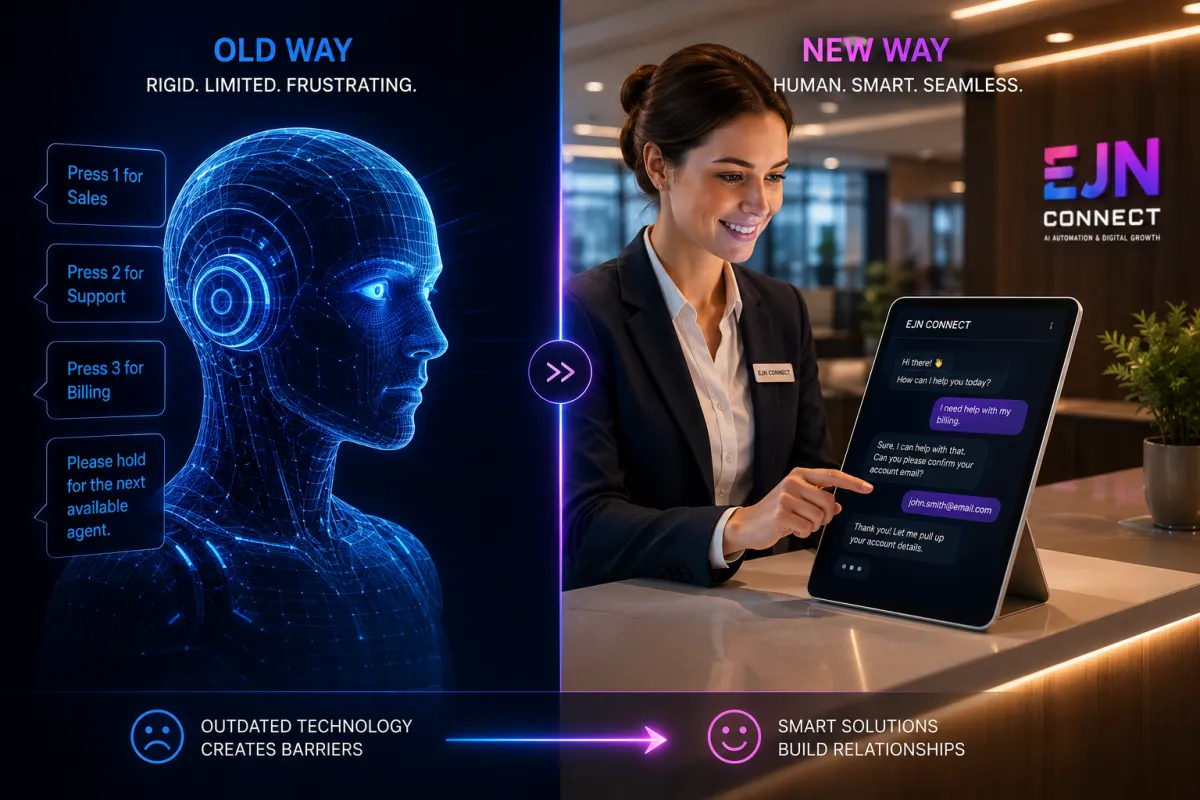
You already know exactly how this goes. You visit a website, a little chat window pops up in the corner, and you decide against your better judgement, to ask a simple question. Within seconds you are trapped in a maddening loop of pre-programmed buttons and unhelpful responses.
You type a sentence. The bot replies: "I didn't quite get that. Did you mean Option A, Option B, or Option C?"
You try rephrasing. Same result. After two or three attempts you close the tab, mildly irritated, and either find the answer somewhere else or give up entirely.
If that experience is your mental model of what a business chatbot looks like, you are not alone. And more importantly, you need to know that the technology has moved so far beyond that experience that the two things barely deserve the same name.
Modern conversational AI is not an upgraded version of those clunky scripted bots. It is an entirely different category of technology. And for small businesses, the implications of that difference are significant.
What Was Wrong With the Old Way
The frustration with traditional chatbots was not a user experience problem. It was a fundamental design problem.
Old scripted bots operated on rigid decision trees, a strict map of "if the user says this, respond with that." They were entirely keyword dependent, which meant that if a customer phrased their question in any way that deviated from the exact words the bot was programmed to recognize, the system broke down. The bot didn't understand the question. It just pattern-matched against a list.
The experience felt exactly like filling out a digital form disguised as a conversation because that is essentially what it was. A one-way process dressed up as a two-way dialogue. Customers felt it immediately, and they responded the same way they respond to any frustrating experience: they left.
For businesses that deployed these tools hoping to improve customer communication, the result was often the opposite. The bot created friction where there should have been none, and eroded trust in the very first interaction a potential customer had with the brand.
What Conversational AI Actually Does Differently
Modern conversational AI doesn't follow a script. It understands language, the way humans actually use it, with all its variation, nuance, implied meaning, and unpredictability.
The technical foundation is natural language processing, which allows the AI to analyze the intent behind what someone says rather than just scanning for specific keywords. This sounds like a subtle distinction, but in practice it changes the entire experience of interacting with the system.
Consider this: one customer might ask "what are your fees?" Another might ask "how much does a standard consult set me back?" A third might say "can you send me a quote?" Three completely different phrasings. Three completely different words. One identical underlying question.
An old scripted bot would handle each of these differently and probably fail on at least two of them. A conversational AI recognizes instantly that all three people want the same thing, pricing information and responds accordingly, without asking anyone to rephrase.
That single capability, understanding intent rather than matching keywords is what makes modern AI feel genuinely different to interact with.
How It Handles Real Conversations
Human conversations don't follow straight lines. They meander, they double back, they take unexpected detours and a system that can only handle a linear, predetermined flow will always feel robotic in a real interaction.
Here's what a real conversational AI exchange looks like when a customer goes off-script mid-conversation. A customer is partway through booking an appointment on your website when they suddenly ask: "Actually, before I choose a time is there parking outside your office?"
A scripted bot breaks here. Parking wasn't the next step in its program.
A conversational AI handles it seamlessly:
Customer: "Actually, before I choose a time is there parking outside?"
AI: "Yes, there's free client parking right at the front of the building! Now, looking back at the calendar, did Wednesday at 10am still work best for you?"
It answers the unexpected question immediately and guides the customer naturally back into the booking flow without missing a beat, without breaking down, and without the customer ever feeling like they've disrupted anything.
This is what it means for an AI to be contextually aware. It holds the thread of the conversation across unexpected detours, answers questions out of order, and adapts to wherever the customer takes the interaction, the same way a skilled human receptionist would.
It Sounds Like Your Business, Not a Generic Robot
One of the most common concerns business owners raise when they first explore conversational AI is whether it will feel generic, like a piece of off-the-shelf software that has nothing to do with their specific brand, their tone, or the way they actually talk to customers.
This concern is understandable, but it misunderstands how modern AI employees are configured.
A well-implemented AI assistant is trained on your specific business, your services, your FAQs, your pricing, your processes, and critically, your communication style. If your brand is warm, casual, and approachable, the AI reflects that. If your industry demands a more formal, structured, and precise tone, the AI adapts accordingly. The experience a customer has interacting with your AI assistant should feel like an extension of your best customer service, not a departure from it.
This matters enormously for small businesses where brand voice and personal relationship are a significant part of the competitive advantage. The AI doesn't dilute that. It extends it consistently, at every hour of the day, to every person who reaches out.
What This Means for Your Team
It is worth being clear about something, because it is a question that comes up in every conversation about AI customer communication: the goal is not to replace the people who make your business great.
The goal is to protect them.
When a conversational AI handles the front-line communication, answering the same FAQs fifty times a day, qualifying incoming leads, managing appointment bookings, engaging after-hours enquiries, your team is freed from the administrative friction that consumes their energy without requiring their skill. They are freed to do the work that genuinely needs a human: building relationships, solving complex problems, delivering exceptional service to clients who are already booked, prepared, and ready to go.
Your customers get the instant, intelligent, on-brand response they have come to expect. Your team gets their capacity back. And your business never misses an opportunity — at 2pm on a Tuesday or 9pm on a Sunday because something is always available to engage.
The chatbot you remember hating was a product of its time and its technology. What exists today is something genuinely different and for small businesses that rely on responsive, consistent, high-quality customer communication, the gap between using it and not using it is growing every month.
At ejnconnect.com.au, we help Australian small businesses implement conversational AI that actually sounds like them, works around the clock, and turns every inbound interaction into an opportunity rather than a friction point.
Because your customers deserve better than Option A, Option B, or Option C. And now, so does your business.
