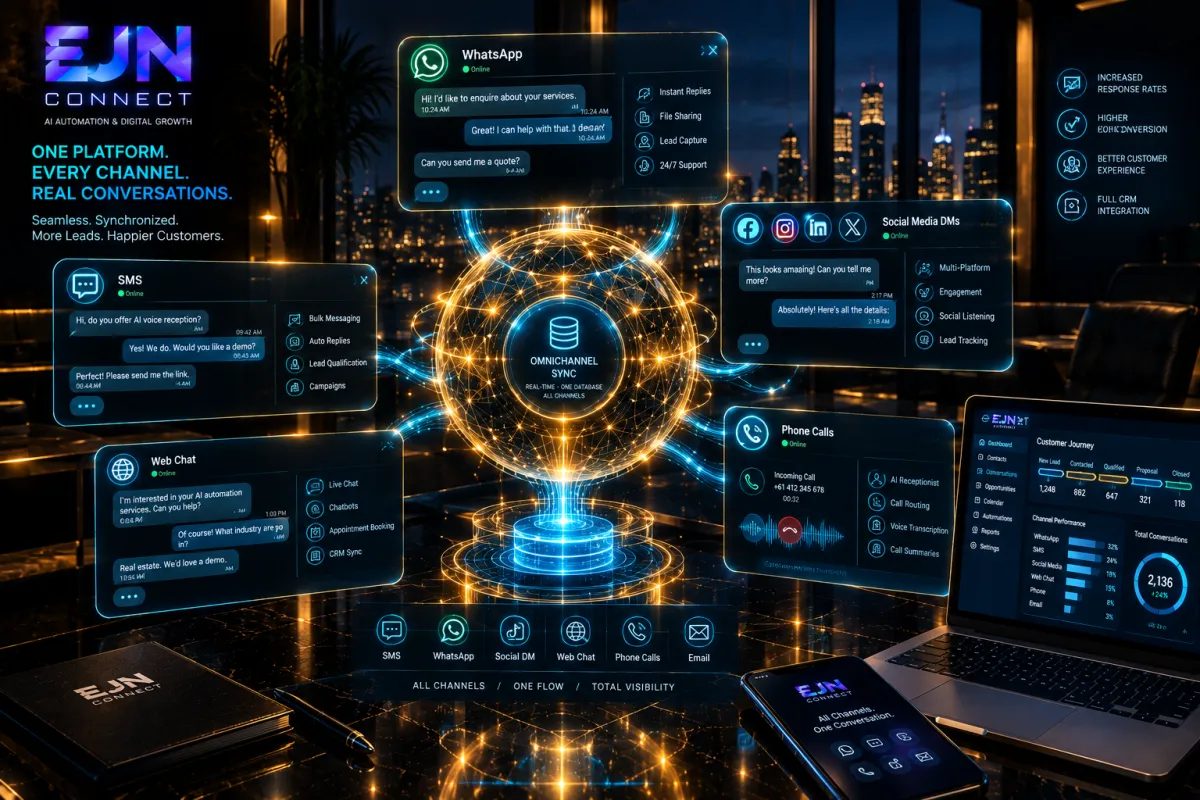
How to Unify Web Chat, SMS, WhatsApp, and Social DMs Into One Seamless Customer Experience
Table of Contents
The Architecture of True Omnichannel Synchronization
Modern buyers do not choose a single channel and stay in it. They contact businesses through whatever platform is most convenient in the moment which changes throughout the day and across different devices.
A prospect discovers your business through an Instagram ad during their lunch break and sends a direct message asking about pricing. They are at their desk in the afternoon and start a web chat on your website to get more detail. That evening, on their phone, they send an SMS with a follow-up question. Two days later they click through from an email and want to book an appointment.
Four interactions. Four different platforms. One prospect who expects your business to know who they are, remember what they have already asked, and continue the conversation rather than starting from scratch every time they switch channels.
For most businesses, this expectation is not being met. Each channel operates as an independent silo, a separate inbox, managed by different people or tools, with no shared context across platforms. When a customer service representative handles the SMS without knowing what was discussed in the web chat, they ask questions that have already been answered. When the booking request arrives through Instagram after a conversation that started on the website, the booking team has none of the context from the earlier exchange. The prospect repeats themselves. Frustration builds. And somewhere in the friction of managing a conversation across disconnected systems, a lead that was progressing toward a booking quietly disengages.
Unified omnichannel AI synchronization is the technical solution and understanding how it works helps business owners evaluate whether their current communication infrastructure is set up to meet the expectations their prospects actually have.
The Architecture of True Omnichannel Synchronization
The core technical challenge in omnichannel communication is that different messaging platforms produce data in different formats, through different API structures, with different authentication requirements and different webhook configurations. A message arriving through the Meta Graph API from an Instagram direct message looks structurally different from an SMS arriving through Twilio, which looks different from a WhatsApp message through the WhatsApp Business API, which looks different from a web chat interaction.
Without a normalization layer, these differences mean that each channel has to be handled separately which is precisely the silo problem. A unified system requires a middleware layer that receives incoming messages from every platform, normalizes them into a consistent format, and passes them to a single processing engine that can apply consistent logic regardless of where the message originated.
The three-layer architecture that makes this work is straightforward in principle and significant in impact.
Layer 1: Multi-Channel Inbound Collection and Normalization
Every incoming message regardless of whether it arrives through your website chat widget, an SMS number, WhatsApp Business, Instagram direct messages, or Facebook Messenger is received by a central API gateway and processed through a normalization layer that converts it into a consistent JSON structure.
This normalization step is what makes the rest of the system possible. Once every message is in the same format, the processing engine does not need to know or care about which platform the message came from. It receives a normalized message object containing the contact identifier, the message content, the timestamp, and the channel indicator and can apply the same logic to every message regardless of origin.
The channel indicator is preserved in the normalized object so that responses are sent back through the same platform the message arrived from, the prospect who messaged on WhatsApp receives their response on WhatsApp, not an SMS. But the processing and context management happen in a unified layer that treats all channels equivalently.
Layer 2: Unified Conversation Context and AI Processing
When a normalized message arrives at the processing layer, the first step is identity resolution matching the incoming contact to an existing record in your CRM using whatever identifier is available. A phone number from an SMS, a social handle from an Instagram DM, an email address from a web chat submission each of these can be used to look up the existing contact record and retrieve the complete history of every previous interaction, regardless of which channel those interactions occurred through.
This cross-channel context merge is the capability that eliminates the "starting from scratch" problem. When the processing engine receives a WhatsApp message from someone who had a detailed web chat conversation three days ago, it retrieves that conversation history as part of the context before formulating a response. The AI knows what was already discussed, what information was already provided, and where the prospect is in their decision journey and responds accordingly, continuing the conversation rather than restarting it.
The AI processing itself draws from both your business knowledge base, your RAG knowledge vault containing your services, pricing, and procedures and the specific conversation history of this contact across all channels. The combination ensures responses that are accurate to your business and contextually appropriate to this specific prospect's situation.
Layer 3: Unified CRM State and Pipeline Management
Every message and every AI response regardless of channel is recorded in a single, unified conversation thread in GoHighLevel. The contact record contains the complete chronological history of every interaction: the Instagram DM from Monday, the web chat from Wednesday, the SMS from Thursday, the booking inquiry from Saturday. Any team member who opens the contact record sees the full picture immediately, without having to check multiple platforms or piece together a fragmented history.
Simultaneously, the pipeline management that should happen as a result of each interaction occurs automatically. A prospect who confirms a budget figure in an SMS triggers a pipeline stage advance. A booking request received through WhatsApp creates the appointment and triggers the confirmation sequence. A qualification question answered through web chat updates the relevant custom fields in the contact record. The CRM reflects the real state of every relationship in real time, without any manual data entry required.
3 Specific Capabilities That Change the Customer Experience
Unified identity resolution
When a prospect who sent an Instagram DM on Tuesday texts an SMS on Thursday, the system matches the new contact point to the existing record using the phone number, the name, or any other identifying information available and continues the conversation in the same unified thread rather than creating a duplicate contact.
This seemingly simple capability eliminates an enormous amount of the operational friction that fragmented multi-channel communication creates. Duplicate records that confuse CRM reporting. Repeated conversations that frustrate prospects. Missed context that produces poor customer experiences. All of these arise from the inability to reliably match the same person across different channels and unified identity resolution addresses this directly.
Context-aware channel transitions
When a prospect needs to move from one channel to another because they are leaving their desktop and want to continue the conversation on their phone, or because they prefer to receive a document via SMS rather than web chat, the AI can facilitate that transition naturally within the conversation.
A simple offer "I've prepared your preliminary estimate, would you like me to send a direct link to your mobile so you have it on the go?", moves the conversation from web chat to SMS without any loss of context. The SMS thread begins with the full context of the web chat, the prospect does not have to re-explain their situation, and the conversation continues seamlessly across the channel change.
Fallback delivery across channels
When a message fails to reach a prospect on their preferred channel, an unread WhatsApp message, an Instagram DM that was not seen, the system can automatically trigger a fallback notification on an alternative channel. An important follow-up that might otherwise go unnoticed receives a second delivery attempt through the prospect's secondary contact method, maintaining engagement without requiring manual monitoring of delivery status across multiple platforms.
The Implementation Pathway for Australian Businesses
Implementing unified omnichannel synchronization on GoHighLevel requires a specific sequence of technical configuration steps, each building on the previous.
The API gateway connections come first configuring webhook endpoints that connect the Meta Graph API for Instagram and Facebook, the WhatsApp Business API, Twilio for SMS, and your web chat widget to the normalization middleware. Each connection requires platform-specific authentication configuration and webhook verification that must be completed before messages can flow through the system.
The normalization layer is configured next, defining the JSON schema that every incoming message will be converted to before processing. This schema needs to capture everything the AI processing layer requires, the contact identifier, the message content, the channel of origin, the timestamp, and any platform-specific metadata relevant to the conversation.
The cross-channel RAG configuration ensures that the AI has access to both your business knowledge base and the contact's full conversation history when formulating each response. This requires the conversation history storage to be structured in a format that the RAG retrieval system can query efficiently alongside the business knowledge vault.
Channel preference fallbacks are defined and tested last mapping which alternative channels should receive fallback notifications for each primary channel, and under what conditions the fallback should trigger.
At ejnconnect.com.au, we implement unified omnichannel AI synchronization systems for Australian businesses, connecting every messaging channel your prospects use into a single, context-aware conversation engine anchored to your GoHighLevel CRM, so that every prospect receives a seamless, continuous experience regardless of how many channels they move through.
Because your prospects are not going to stay in one channel. The question is whether your business is built to follow them without losing context, creating friction, or missing the conversation that converts them into a client.
