How to Scale Across Multiple Locations Without Losing Control of Your Pipeline. The Multi-Location CRM Framework for Australian Service Businesses
There is a specific and frustrating irony that catches many growing local service businesses by surprise at exactly the moment things should be going well.
The business has built a strong reputation in its original market. Revenue is growing. Demand is exceeding what the current team and territory can service. The natural next step, expanding into new suburbs, opening a second location, growing the service radius feels like the obvious expression of a business that has done things right.
And then the complexity hits.
Leads start arriving from multiple areas and getting assigned to the wrong team. A commercial client with properties across different suburbs ends up with scattered records across different branch systems that cannot talk to each other. Regional managers adopt the tools that work for them locally, creating software silos that leadership cannot see across. Performance reports require someone to manually consolidate data from multiple disconnected systems before anyone can understand what is actually happening across the business. The customer experience that was consistent and excellent in the original location becomes inconsistent across branches, because different teams are handling things differently.
Geographic expansion was supposed to multiply the business. Instead, it has multiplied the administrative complexity and revenue growth is being partially consumed by the operational friction that fragmentation creates.
This is the multi-location scaling problem. And it is almost universal for local service businesses that grow beyond a single territory without building the right operational infrastructure before they expand.
Why Fragmentation Happens and What It Costs
The fragmentation that creates these problems is not the result of poor decisions. It is the natural consequence of solving individual local problems with individual local tools without a centralized architecture that brings everything together.
A new branch manager, dealing with the immediate operational demands of getting a new territory running, implements the scheduling tool they know. The central team builds a web funnel that routes all enquiries to a single inbox rather than filtering by territory. Phone numbers for the new location are set up independently of the existing system. Before long, every branch is operating its own version of the business with its own tools, its own processes, and its own data and the executive team has lost the visibility and control that a single-location operation made straightforward.
The specific operational problems this creates are predictable and costly.
Territory misrouting means that leads from digital advertising, web enquiries, and phone calls frequently reach the wrong branch, creating delays while the enquiry is manually redirected, and a poor first experience for the prospect who has to repeat their details once they finally reach the right team.
Duplicate contact records accumulate across branch systems, making it impossible to manage client relationships that span multiple territories, a commercial property client with sites in different areas exists as separate, disconnected records in different branch systems rather than as a unified client profile with a complete cross-territory history.
Inconsistent client experience emerges as different branches default to different follow-up speeds, different pricing explanations, and different intake protocols eroding the brand consistency that made the original location successful and making it impossible to deliver the same quality of experience across the enterprise.
Executive blind spots develop as aggregating meaningful performance data across isolated systems requires manual consolidation work which means leadership is always working from information that is delayed, incomplete, or both.
The Architecture That Solves It
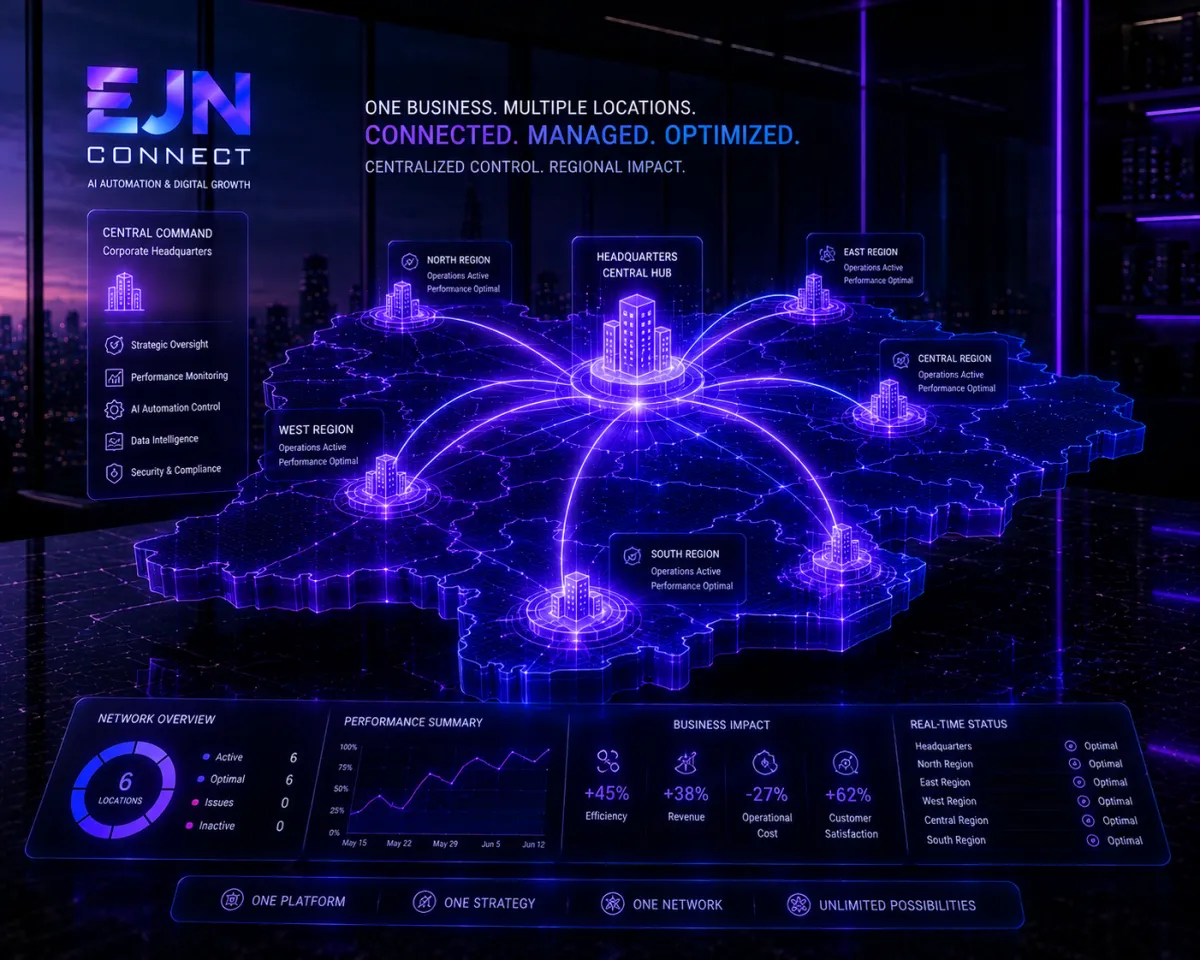
A unified multi-location CRM architecture does not just solve these problems. It converts geographic expansion from a source of complexity into a genuine operational advantage because the same centralized intelligence that manages one territory can manage ten, with the same consistency and the same quality of oversight.
The architecture operates across four integrated layers.
Centralized multi-channel intake ensures that regardless of whether an enquiry arrives through a national advertising campaign, a local Google Business Profile phone number, a web chat on a territory-specific landing page, or an SMS to a branch-specific number, every inbound contact enters the same underlying system. There are no separate inboxes to monitor, no channel silos to reconcile, no leads falling through the gap between platforms.
Geo-smart routing and territory assignment automatically determines where every inbound lead belongs the moment it arrives. The system analyses the postcode data in the enquiry, the area code of the calling number, or the geographic parameters of the web session and assigns the lead to the correct territory pipeline without any human intervention. The right branch team receives the lead immediately, with the appropriate context, ready for immediate engagement. Wrong-territory assignments and the delays and frustration they create disappear entirely.
Branch-level pipeline execution maintains local operational specificity within the unified framework. Each branch operates its own calendar, its own team scheduling, and its own field dispatch but all of these operate within the centralized system rather than in separate tools. A client in a specific suburb books from the availability of the team that services their area. Double-bookings across branches are eliminated. Workload is balanced across regional teams automatically.
The customer-facing AI agents that handle each branch's enquiries maintain hyper-local awareness even though they operate from the same underlying infrastructure. An AI handling enquiries for your western suburbs branch references that branch's specific pricing, that team's actual availability, and the logistical details relevant to that territory, delivering an authentic local experience that feels specific and knowledgeable, backed by enterprise-grade centralized infrastructure.
Executive dashboard and cross-branch reporting gives leadership the real-time visibility across the entire operation that fragmented systems make impossible. Every performance metric, speed-to-lead across territories, after-hours capture rates, lead-to-booking conversion by branch, revenue by territory, campaign performance by area is available in a single, unified dashboard without manual consolidation. Branches can be benchmarked against each other. Performance gaps can be identified and addressed before they compound. Resource allocation decisions can be made from accurate, current data rather than delayed manual reports.
What This Enables That Fragmentation Prevents
The practical difference between a fragmented multi-branch operation and a unified one shows up most clearly in three specific capabilities.
Consistent client experience across every territory because the intake protocols, the qualification criteria, the follow-up sequences, and the communication standards are set once in the centralized system and applied consistently across every branch. A client in your newest territory receives exactly the same quality of first experience as a client in your most established one.
Cross-territory client relationship management because a commercial client with properties across multiple suburbs exists as a single, unified record with a complete cross-territory history, rather than as disconnected entries in separate branch systems. Your team can manage the full relationship from one place, regardless of which territories are involved.
Genuine operational scalability because adding a new territory to a unified system is a configuration task, not an infrastructure rebuild. The tenth territory is added to the same system that manages the second and the fifth. The complexity of expansion does not compound with each new location, it stays manageable because the architecture was designed for scale from the beginning.
When to Build the Architecture
The most common mistake growing local service businesses make is waiting until the fragmentation problem is already causing serious operational pain before addressing it. By that point, untangling multiple disconnected systems, migrating data from separate platforms, and standardizing processes across established branches is a significantly larger and more disruptive project than building the right architecture before expansion begins.
The right time to implement a unified multi-location CRM architecture is before the second location opens when the opportunity exists to establish the centralized foundation that every subsequent location can be built on, rather than retrofitting a unified system onto a collection of independently established branch operations.
For businesses that have already expanded and are already experiencing fragmentation, the remediation is achievable but it requires a structured migration plan and a period of transition that is substantially more complex than building it right from the start.
At ejnconnect.com.au, we design and implement unified multi-location CRM architectures for Australian service businesses, building the centralized intake, routing, dispatch, and reporting infrastructure that allows geographic expansion to accelerate growth without multiplying operational complexity.
If you are planning your next location or if you are already managing multiple territories and feeling the friction of fragmentation, we would love to show you what a unified architecture looks like for your specific operation.
Because geographic expansion should be the reward for building something excellent. With the right infrastructure, it can be exactly that.
