How to Orchestrate Complex Lead Workflows Without Logic Drop-Offs or Execution Errors
Table of Contents
The Router-Worker Architecture
The 3 Core Worker Agents in an Enterprise Lead Workflow
There is a ceiling to what a single AI agent can reliably execute and for growing businesses with complex lead management workflows, that ceiling becomes apparent relatively quickly.
A single AI agent handling a simple, well-defined task performs with high reliability. Answer this question. Book this appointment. Update this CRM field. The task is contained, the context is manageable, and the output is predictable.
But as workflows become more complex involving sequential qualification steps, conditional routing based on lead characteristics, real-time pricing calculations, multi-calendar scheduling across different team members or territories, and CRM pipeline updates that must occur in a specific order, the demands on a single agent's context window begin to compound. Processing speed degrades. Logic errors emerge at the boundaries between steps. The agent that performed reliably on simple tasks becomes unreliable on the complex, multi-variable workflow the business actually needs.
This is not a failure of AI capability in general. It is a consequence of asking one system to do too many different things simultaneously, the same structural problem that arises when a single human employee is asked to be the sales rep, the estimator, the scheduler, and the account manager at the same time.
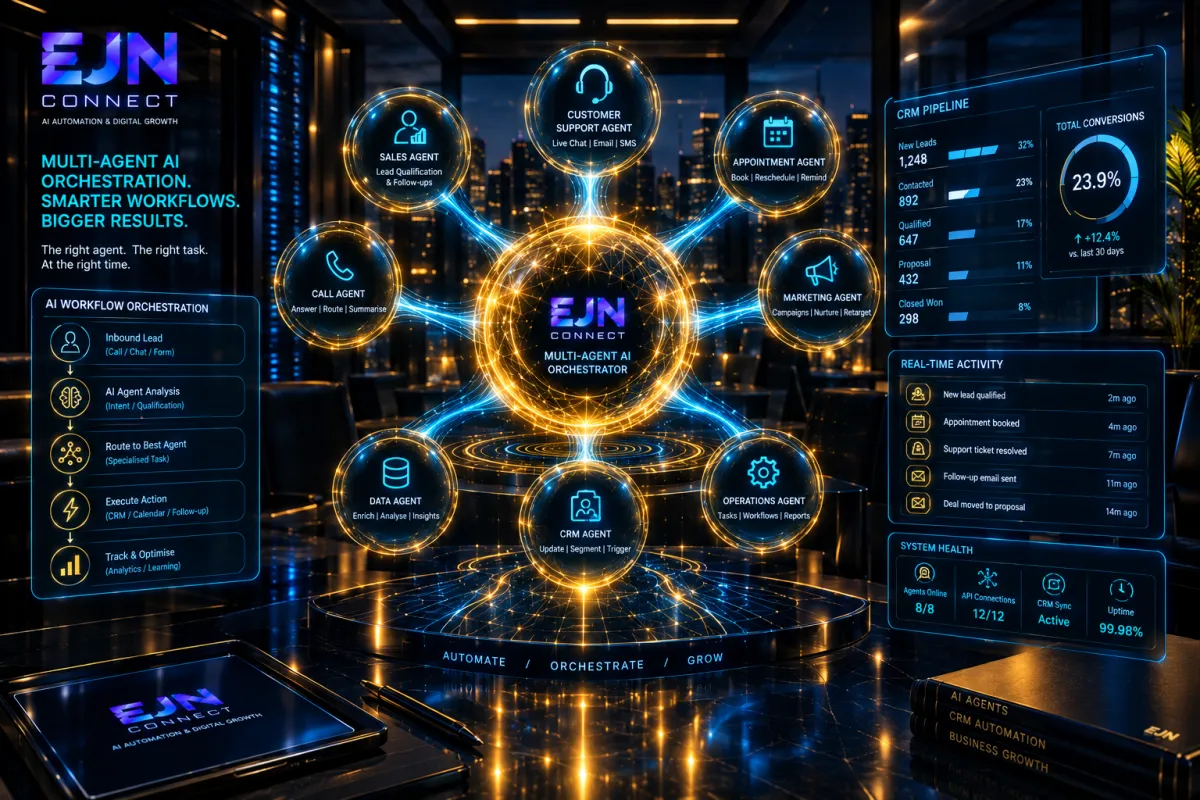
Multi-agent orchestration solves this by applying the same division-of-labor logic that makes high-performing human teams effective, breaking complex workflows into discrete steps, assigning each step to a specialist agent configured specifically for that function, and coordinating the handoffs between them through a central orchestrator.
The Router-Worker Architecture
The foundational structure of a multi-agent CRM workflow is the router-worker model, a design pattern that separates the coordination function from the execution function, allowing each to be optimized independently.
The orchestrator agent sits at the center of the system. It receives every inbound lead event from a GoHighLevel webhook triggered by a web form submission, a new contact created from an inbound call, a pipeline stage change, or any other configured trigger and makes a single, focused decision: what type of lead is this, and which worker agent should handle it?
The orchestrator does not execute complex business logic. Its job is pattern recognition and routing, evaluating the incoming data against defined criteria and directing the workflow to the appropriate specialist. This narrow focus keeps the orchestrator's context window small and its decisions fast and reliable.
The worker agents receive routing decisions from the orchestrator and execute the specific, bounded task they were designed for. Each worker operates with a system prompt and toolset configured specifically for its function, a context window that contains only the information relevant to its step, and a defined output schema that structures its results for the next stage of the workflow.
The 3 Core Worker Agents in an Enterprise Lead Workflow
The Triage and Qualification Agent
The first worker in the sequence handles the initial assessment of every inbound lead, extracting the key parameters that determine whether the lead is a strong fit, what category of opportunity it represents, and what information needs to be gathered before the workflow can progress.
Its inputs are the raw data from the inbound event, the form submission, the call transcript, the chat conversation and its output is a structured JSON payload that captures the lead's intent, budget indication, geographic location, service requirements, urgency, and any other parameters your qualification criteria require.
This structured output is both the result of the triage agent's work and the input that the next stage of the workflow receives. The consistency of the JSON schema ensures that downstream agents receive complete, accurately formatted information regardless of how varied or unstructured the original inbound data was.
Simultaneously, the triage agent triggers the appropriate CRM updates in GoHighLevel — applying the relevant pipeline tags, moving the contact to the correct stage, and setting any custom fields that reflect the lead's qualification status.
The Scope and Quoting Agent
For businesses where the complexity of the enquiry requires a pricing assessment before a booking can be offered, trades and contracting businesses, professional services firms, specialist consultancies, the quoting agent handles the transition from qualified lead to preliminary proposal.
It receives the structured qualification data from the triage agent and queries your pricing matrix and knowledge vault to compute a cost estimate based on the specific parameters of this lead's situation. The estimate is generated from your actual pricing logic, not from general AI knowledge because the quoting agent's knowledge base contains your specific rates, your scope calculation methodology, and the conditions and exceptions that affect pricing for different types of engagements.
The output is a structured proposal summary that is posted to the contact record in GoHighLevel and delivered to the prospect via the appropriate channel SMS, email, or the conversation thread where the initial enquiry originated. The quoting agent simultaneously triggers the workflow that moves the lead to the appropriate next stage awaiting quote acceptance, or proceeding directly to booking for leads where the preliminary estimate has been confirmed as acceptable.
The Dispatch and Calendar Booking Agent
The booking agent manages the scheduling logic that converts a qualified, ready-to-proceed lead into a confirmed appointment handling the complexity of multi-calendar availability, territory-based routing, and service-type matching that makes scheduling genuinely difficult to manage manually at scale.
It receives the qualified and scoped lead data, queries your GoHighLevel calendar infrastructure to identify available slots based on the relevant team member, territory, or service department, and presents options to the prospect. When a slot is confirmed, it executes the booking, locking the calendar slot, triggering the deposit or booking fee collection via payment integration, sending the confirmation communications to the prospect, and creating the internal notification for your team.
The booking agent's output is a complete, confirmed appointment with the contact record updated, the pipeline stage advanced, the payment collected, and the team notified. all triggered by a single structured input from the upstream workflow.
Why This Architecture Outperforms Single-Agent Approaches
The performance differences between a single-agent system attempting to handle complex multi-step workflows and a properly orchestrated multi-agent architecture are specific and significant.
Logic reliability improves because each agent handles a task whose complexity is appropriate to its design. The triage agent does not have to also calculate pricing and check calendar availability while simultaneously maintaining the context of a qualification conversation. It does one thing well, produces a clean structured output, and passes it on. The reduction in context window complexity at each step directly reduces the probability of logic errors and dropped workflow steps.
Latency decreases because targeted micro-prompts process faster than massive context windows. A single agent processing qualification, quoting, and booking in sequence must maintain the accumulated context of every previous step which grows the processing load and slows response times. Specialist agents process only what they need for their specific step, completing each stage faster.
Error isolation means that when an issue occurs in one step of the workflow, it affects only that step rather than the entire pipeline. A quoting calculation that produces an unexpected result can be identified, corrected, and reprocessed without affecting the qualification data that preceded it or the booking process that follows it. In a single-agent system, an error at any point in a complex workflow typically corrupts the entire conversation thread.
CRM integration quality improves because each agent's CRM interactions are defined by a specific, validated schema for its particular function rather than a single agent attempting to handle all CRM operations with a general-purpose toolset that may not enforce appropriate data quality for each specific action.
The GoHighLevel Implementation Pathway
For businesses building multi-agent workflows on GoHighLevel, the most widely used CRM platform for Australian small business AI automation, the implementation follows a specific sequence.
The pipeline stages in GoHighLevel are mapped to agent handoff triggers first defining which stage changes, tag updates, or inbound message events activate which agents in the sequence. This mapping is the conceptual blueprint that the technical implementation follows.
Outbound webhook triggers are configured in GoHighLevel workflows to fire API requests to the orchestration middleware whenever the defined trigger conditions are met. The middleware receives these webhooks, routes them to the appropriate agent, and returns structured payloads that GoHighLevel uses to execute the corresponding CRM actions.
JSON schema enforcement is established for every agent-to-agent handoff ensuring that the output of each agent is validated against a defined structure before it is accepted as the input for the next. Schema violations are caught and handled at the handoff point rather than propagating errors through subsequent steps.
Human escalation pathways are defined and tested ensuring that edge cases, high-value exceptions, and complex situations that fall outside the automated workflow's defined parameters are routed immediately to the appropriate human with a complete context brief, rather than being mishandled by an agent operating outside its configured scope.
At ejnconnect.com.au, we design and implement multi-agent CRM orchestration architectures for Australian businesses building the router-worker systems, agent configurations, GoHighLevel integrations, and schema-validated handoff protocols that handle complex lead workflows reliably at scale.
Because the complexity of your sales process should not be a constraint on what your automation can handle. With the right architecture, every step of your lead workflow can be executed accurately, automatically, and at any volume.
