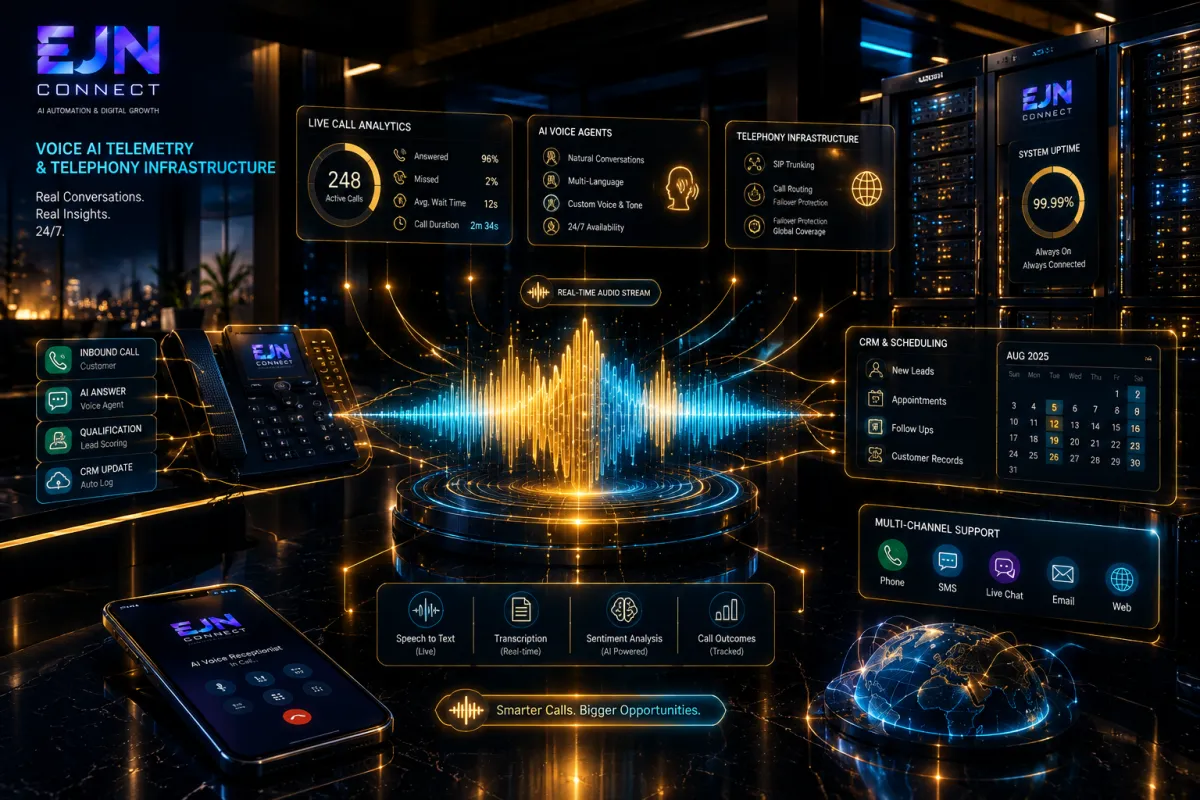
How to Build a Zero-Latency Voice AI Receptionist... The Technical Architecture Behind Instant AI Phone Answering
Table of Contents
Why Latency Is the Core Technical Challenge
What This Means for the Business Owner Evaluating Implementation
For Australian businesses that receive meaningful inbound call volume, the phone line remains one of the most commercially significant and most technically underserved channels in their entire operation.
Web chat, SMS, and social media enquiries have attracted significant automation investment over the past several years. But voice calls which consistently convert at higher rates than any other inbound channel for most local service businesses are still being handled by systems that were designed for a fundamentally different era: traditional human receptionists constrained by bandwidth and availability, third-party answering services that lack the specific business knowledge to qualify leads accurately, or IVR systems whose rigid menus frustrate callers into hanging up.
The technology that closes this gap, a Voice AI receptionist that answers every call instantly in natural language, qualifies callers using your specific business knowledge, and books appointments directly into your CRM is not experimental. It is deployed and operational in businesses across Australia right now. And understanding the technical architecture that makes it work helps business owners evaluate implementations intelligently and have more productive conversations with the people building these systems for them.
This article explains the architecture clearly not at the level of a developer writing the code, but at the level of a business owner who wants to understand what they are building and why each component matters.
Why Latency Is the Core Technical Challenge
The single most important performance metric in a Voice AI system, the one that determines whether the experience feels natural or robotic to the caller is latency: the time between when the caller finishes speaking and when the AI begins its response.
Human conversation operates with a natural back-and-forth rhythm where pauses between exchanges are measured in fractions of a second. When an automated system introduces a noticeable delay even a delay of one to two seconds, the conversation starts to feel unnatural. The caller loses confidence that the system is actually understanding them, and the experience degrades toward the robotic, frustrating quality that defined first-generation IVR systems.
A well-architected Voice AI system achieves end-to-end response latency below 800 milliseconds, fast enough that the conversation flows at a natural human pace and the caller's experience is of a responsive, attentive interaction rather than a system processing their words.
Achieving this latency requires specific architectural choices at every layer of the system. Understanding those choices is what separates a well-built Voice AI implementation from one that works in a demo but degrades under real-world conditions.
The Three-Layer Architecture
A production-grade Voice AI receptionist operates across three distinct but tightly integrated layers, each with a specific and non-negotiable function.
Layer 1: The Telephony and Media Streaming Layer
This is the infrastructure that connects the phone carrier to the AI processing system and the specific technology choices made here determine whether sub-800-millisecond latency is achievable.
Traditional phone system integrations use HTTP polling, the system periodically checks for new audio data rather than receiving it as a continuous stream. This introduces inherent latency that makes fast conversational AI impossible. A properly architected system uses WebSocket connections instead, which maintain a persistent, bidirectional channel between the phone carrier and the AI engine. Audio streams continuously in both directions, the caller's voice arriving at the AI for processing while the AI's synthesized voice is simultaneously streamed back to the caller without the latency overhead that polling introduces.
The telephony platform that manages this connection Twilio being the most established option for Australian deployments, receives inbound calls on your business number, converts the audio to a digital stream format, and routes it to your AI processing endpoint via the WebSocket connection. Simultaneously, it maintains fallback routing rules that escalate to a human team member or a different handling pathway when the AI determines that a conversation has exceeded its scope.
SIP trucking, the protocol that connects your existing business phone numbers to the Voice AI system allows the implementation to work with your current phone infrastructure rather than requiring a complete replacement of your phone system.
Layer 2: The Conversational AI Processing Layer
Once the audio stream arrives at the processing layer, three sequential operations must complete in total within the sub-800-millisecond target.
Speech-to-text transcription converts the caller's audio to text in real time. Modern transcription models, Whisper, Deep gram, and similar tools, achieve this in under two hundred milliseconds with high accuracy across Australian accents and speaking styles, including the casual speech patterns, colloquialisms, and occasional background noise that real phone calls produce.
The transcribed text is then processed by the language model, which analyses the intent behind what the caller said and formulates an appropriate response. Critically, this is not a general-purpose language model guessing at answers. It is a model operating within a Retrieval-Augmented Generation framework that queries your specific business knowledge base before formulating each response ensuring that every answer about your services, your pricing, your availability, and your operating procedures is accurate and specifically relevant to your business, rather than generically plausible.
The guardrails that define what the AI will and will not discuss are embedded in the system prompt that governs every response. The AI does not speculate about things it does not know. It does not make commitments your business cannot keep. When a caller asks something outside the AI's configured scope, it acknowledges the question professionally and routes to the appropriate human resource.
Text-to-speech synthesis converts the AI's formulated response back into natural-sounding audio, which is streamed back to the caller through the WebSocket connection. Modern synthesis models, ElevenLabs, OpenAI Realtime produce voice quality that is functionally indistinguishable from a human voice in most listening conditions, with the natural pacing, inflection, and conversational rhythm that make the interaction feel genuine rather than synthetic.
One specific and important technical requirement at this layer is barge-in handling, the ability for the AI to immediately stop speaking when the caller interrupts. Natural conversation includes frequent interruptions and overlaps, and a system that cannot handle being interrupted mid-sentence produces an experience that feels robotic and unresponsive. Properly implemented stream cancellation protocols ensure the AI pauses the moment the caller speaks, regardless of where it is in its response.
Layer 3: The CRM and Action Execution Layer
The third layer is what transforms a Voice AI from a sophisticated conversational tool into an operational business asset, he integration that connects the conversation to real business actions in your systems.
When a caller confirms a booking, the Voice AI does not just acknowledge the request and promise a follow-up. It executes the booking in real time. A structured data payload containing the caller's contact details, the service requested, the appointment details confirmed during the conversation, and any qualification data gathered is sent via webhook to your CRM platform the moment the booking is confirmed.
Your CRM, GoHighLevel being the most commonly used platform for Australian small business AI deployments receives this payload, checks live calendar availability, creates or updates the contact record, locks the appointment slot, and triggers the confirmation SMS to the caller's mobile device. All of this happens before the call ends often while the conversation is still in its final exchange of pleasantries.
The JSON schema that structures the data payload is defined in advance, ensuring that every booking produced by the Voice AI creates a consistently structured, accurately populated CRM record without the data quality variation that manual entry introduces. Field mappings, pipeline stage assignments, and tag structures are all predefined, so the records that appear in your CRM from AI-handled calls are clean, complete, and immediately actionable.
What This Means for the Business Owner Evaluating Implementation
The technical detail above matters for a specific practical reason: it gives you the vocabulary and conceptual framework to evaluate Voice AI implementations critically rather than accepting vendor claims at face value.
The questions worth asking any provider are direct and specific. What is your measured end-to-end response latency under realistic call conditions? How is the knowledge base structured and what prevents the AI from providing inaccurate information? How does the system handle barge-in and interruption? What does the CRM integration look like at the data schema level, and how are edge cases and escalations handled? Is the telephony infrastructure using WebSocket streaming or HTTP polling?
A provider who can answer these questions specifically and clearly has built the system properly. A provider who responds with marketing language and avoids technical specificity has not.
At ejnconnect.com.au, we design and implement production-grade Voice AI receptionist systems for Australian businesses built on properly architected telephony infrastructure, accurate RAG knowledge bases, and direct CRM integration, that answer every call in under 800 milliseconds and convert qualified callers into confirmed bookings without human involvement.
Because the phone line is still where your highest-intent leads arrive. And with the right architecture, it is also where they convert at any hour, at any volume, without exception.
