
How teams of AI agents handle work one bot never could
Here's something most businesses learn the hard way after their first AI rollout: a single chatbot, no matter how well-built, eventually hits a wall. It works great for answering simple questions. But ask it to qualify a lead, calculate accurate pricing, check a real calendar, and update your CRM correctly, all in one conversation and things start to fall apart.
That's not a flaw in the technology. It's a mismatch in expectations. Asking one generalist AI agent to handle every department's job simultaneously is a bit like hiring one employee and expecting them to be your receptionist, accountant, scheduler, and compliance officer, all at once, with zero training gaps. It doesn't work for humans, and it doesn't really work for AI either.
The solution enterprises are turning to is multi-agent orchestration instead of one bot trying to do everything, you build a coordinated team of specialized AI agents, each handling exactly what it's good at, working together automatically. Let's walk through why this matters and how it actually works under the hood.
Why Single-Agent Systems Hit a Ceiling
Most businesses start their AI journey with one agent, a digital receptionist answering calls, or a chat widget handling website questions. And honestly, for simple, front-line tasks, that works fine.
The problem shows up when business processes get more complex. Real operations involve multiple distinct steps: qualifying a lead, checking pricing or inventory, drafting a custom proposal, securing a signature, updating the pipeline. Asking a single generalist agent to juggle all of that at once creates exactly the kind of pressure that leads to mistakes.
Here's the honest comparison:
A single-agent bot takes an inbound prospect and tries to answer, qualify, price, schedule, and update the CRM, all through one generalist system which significantly increases the risk of errors and hallucination.
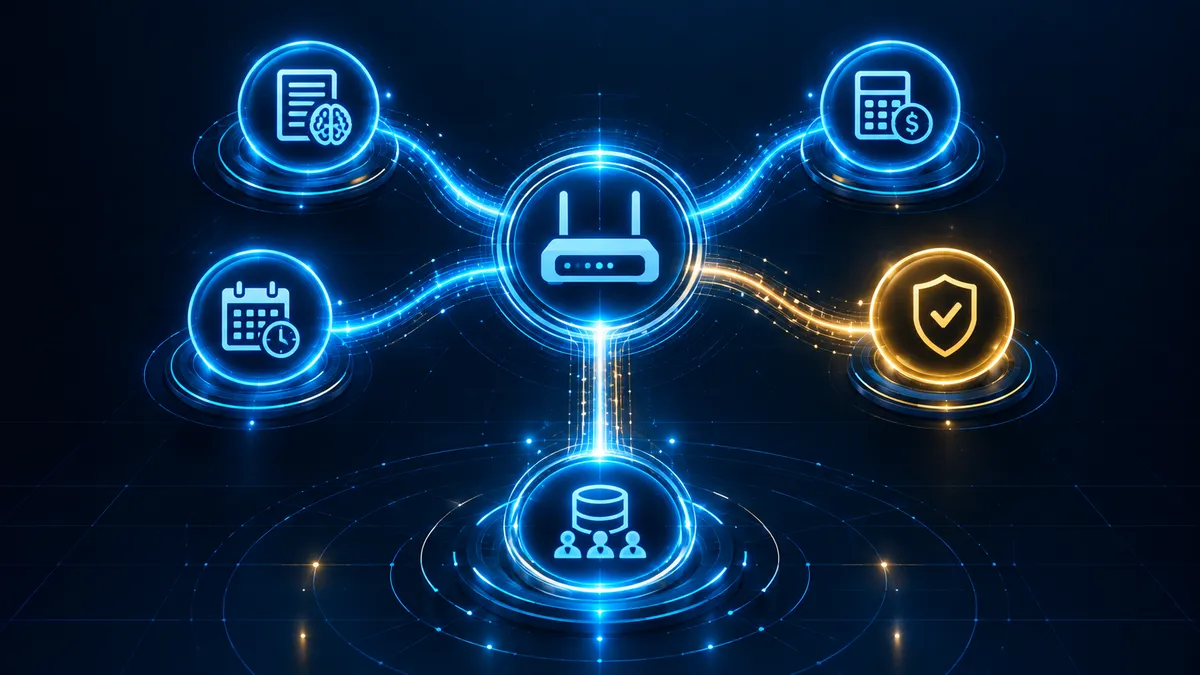
Multi-agent orchestration takes that same inbound prospect, routes it through a dedicated router agent, and hands specific pieces of the task off to specialists: one for knowledge lookup, one for pricing, one for CRM execution.
The difference isn't about intelligence. It's about focus. A specialist agent with one clear job, a narrow knowledge base, and limited permissions is simply far more reliable than a generalist trying to do it all.
The Architecture: 4 Layers Working Together
A well-built multi-agent system isn't chaos, it's a structured, layered process. Here's how it actually flows.
Layer 1: The Router Agent
Think of this as the front desk of the whole operation. When an inquiry comes in through voice, SMS, or web chat, the router agent's only job is to figure out what the person actually needs, pull out key details like industry, urgency, or budget, and hand the conversation off to the right specialist. It doesn't try to answer the question itself. It just makes sure the right expert gets involved immediately.
Layer 2: Domain Specialist Agents
This is where the real work happens, and each agent here has a narrow, well-defined job:
The RAG Knowledge Agent answers technical, legal, or product-specific questions by strictly querying your verified knowledge base not by guessing or generating plausible-sounding answers.
The Pricing and Quoting Agent pulls live fee schedules to generate accurate estimates on the spot, instead of relying on static, outdated pricing.
The Scheduling Agent interfaces directly with your actual team calendars, securing meeting slots without the double-booking headaches manual scheduling creates.
Each specialist has restricted access to only the tools and data relevant to its job which isn't just about accuracy, it's a real security benefit too.
Layer 3: The Supervisor and Guardrail Agent
This is the layer most single-agent systems simply don't have, and it's arguably the most important one. Before anything gets sent to a client or executed in your CRM, the supervisor agent reviews it checking for compliance, confidence thresholds, and brand voice, acting essentially as an internal quality auditor that never gets tired or skips a step.
Layer 4: CRM Orchestration
Once the agent team reaches agreement on the right response, structured data gets dispatched to your CRM, updating contact records, advancing pipeline stages, and triggering the appropriate follow-up sequences automatically.
Single-Agent vs. Multi-Agent: A Direct Comparison
Seeing this laid out side by side makes the practical difference clear:
Dimension | Single-Agent Deployment | Multi-Agent Orchestration |
|---|---|---|
Task Complexity | Linear FAQs, basic booking | Complex, multi-step workflows across systems |
Prompt Design | One overloaded prompt trying to do everything | Focused, modular prompts per specialist |
Security | Broad access across all operations | Strictly partitioned permissions per agent |
Error Handling | Fails or hallucinates on ambiguous input | Router and supervisor catch errors early |
Scalability | Hard to expand without breaking existing logic | New specialists can be added easily |
That "Scalability" row deserves a second look. A single-agent system tends to get more fragile the more you ask of it, every new capability risks breaking something that used to work. A multi-agent system scales the opposite way: adding a new specialist (say, a billing agent or a support agent) doesn't threaten what's already working.
A Real Example: Handling a High-Value Commercial Inquiry
Let's make this concrete with a scenario that shows exactly why this architecture matters, a complex, high-value commercial property inquiry that comes in outside business hours.
The router agent identifies this as a commercial property acquisition inquiry, with an estimated budget over $2 million, clearly not a routine question.
The RAG knowledge agent references zoning regulations, lease guidelines, and compliance documentation to accurately answer the client's initial technical questions.
The pricing and quoting agent calculates preliminary retainer fees based on the actual property valuation bracket.
The scheduling agent accesses the senior partner's calendar and locks in a priority consultation slot.
The supervisor agent reviews the entire interaction, confirms no unauthorized promises were made, and pushes the finalized data into the CRM creating a high-priority deal card and immediately alerting the managing partner via SMS.
A single generalist agent handling this alone would likely have struggled with at least one of these steps, probably the pricing, or worse, made an unauthorized commitment on the client's behalf. A coordinated team, each doing what it's actually built for, handles the entire thing correctly, in minutes, with zero human involvement until the partner reviews the alert.
Bringing Multi-Agent Systems Into Your CRM
Multi-agent orchestration only delivers real value when it's properly wired into your operational systems, not running as a standalone experiment. In practice, this means:
Modular webhook routing using custom webhooks and fields to pass context back and forth between your AI orchestration layer and your CRM pipelines.
Automated tagging assigning specific tags based on which specialist resolved an inquiry (for example, "Agent-Qualified-Commercial" or "Requires-Partner-Review"), triggering the right internal workflow instantly.
Unified audit trails storing full multi-agent conversation transcripts and supervisor review logs directly in the contact's record, so every decision is fully transparent and traceable.
This is what turns a CRM from a passive filing system into something closer to an active operations center, one that's actually doing work, not just storing it.
Why This Matters for Growing Businesses
Here's the honest reality: businesses that stop at a single chatbot often hit a frustrating plateau. It handles the easy stuff fine, but every complex inquiry still needs a human to step in and clean things up which defeats a lot of the point of automating in the first place.
Multi-agent orchestration is what lets automation actually scale into the complicated, multi-step parts of your business, the parts that were always too risky to hand to a single generalist bot. It's not about replacing more people. It's about handling genuine complexity reliably, at any hour, without sacrificing accuracy.
Key Takeaways
Single-agent AI systems hit real limitations when handling complex, multi-step business workflows, increasing the risk of errors and hallucination.
Multi-agent orchestration splits responsibilities across specialized agents, a router, domain specialists, and a supervisor, each with narrow, focused expertise.
The supervisor and guardrail agent is a critical safety layer most single-agent systems lack, reviewing outputs before they reach a client or your CRM.
Multi-agent systems scale more easily than single agents, since new specialists can be added without breaking existing logic.
Full integration with your CRM through webhooks, tagging, and audit trails is what turns multi-agent AI into a genuine operational advantage.
Ready to Build Your First Multi-Agent System?
If your current AI setup is a single overworked chatbot trying to handle everything and still falling short on the complex stuff, it's time to consider a coordinated approach.
At EJN Connect, our enterprise automation architects design collaborative multi-agent systems tailored to your business, fully integrated for complete operational precision.
🌐 Visit us at ejnconnect.com.au