How RAG Knowledge Vaults Eliminate AI Hallucinations And Why Your Business Data Needs to Be Engineered, Not Just Uploaded
Table of Contents
What RAG Actually Does and Why It Matters
Why Basic RAG Implementations Fall Short
The Three Engineering Pillars of a Zero-Hallucination RAG System
Of all the concerns that business owners and executives raise when seriously evaluating AI for customer-facing roles, one surfaces more consistently than any other and it is a legitimate one.
What happens when the AI gets something wrong?
Not a minor misunderstanding that a human would naturally clarify. But a confident, specific error, a pricing figure that does not match your actual rates, a service commitment that your business cannot deliver, a response to a compliance-sensitive question that creates legal exposure. The kind of mistake that, if made by a human team member, would require an immediate conversation and possibly damage a client relationship.
This category of AI error has a technical name: hallucination. And it occurs when an AI system, lacking access to the specific and current information it needs to answer a question accurately, fills the gap by generating a plausible-sounding response from its general training knowledge which may have no relationship to the actual facts of your business.
For general-purpose AI tasks drafting a document, summarizing a brief, brainstorming ideas, hallucination is a manageable annoyance. For AI deployed in customer-facing roles where accuracy about your specific pricing, availability, services, and compliance requirements is non-negotiable, it is a genuine business risk.
Retrieval-Augmented Generation, RAG is the technical solution. When implemented correctly, it transforms an AI agent from a system that generates plausible responses from general training data into one that retrieves verified answers from your specific business knowledge before generating any response. Understanding how it works, and what distinguishes a properly engineered RAG system from a basic implementation, is essential knowledge for any business deploying AI in customer-facing roles.
What RAG Actually Does and Why It Matters
The fundamental problem that RAG solves is the gap between what an AI's training data contains and what it needs to know to accurately represent your business.
A large language model is trained on an enormous corpus of general text websites, articles, books, code, and countless other sources. This training gives it impressive general language capability and broad world knowledge. But it does not contain your specific service offerings, your current pricing, your standard operating procedures, your geographic coverage area, your team's availability, or any of the other specific and constantly evolving details that define how your business actually operates.
When a customer asks a general AI system a question about your business that it cannot answer from its training data, it faces a choice: acknowledge that it does not know, or generate a plausible-sounding response based on what similar businesses typically do. The second option, hallucination is the default behavior of most AI systems without RAG, because the training process rewards fluent, confident-sounding responses.
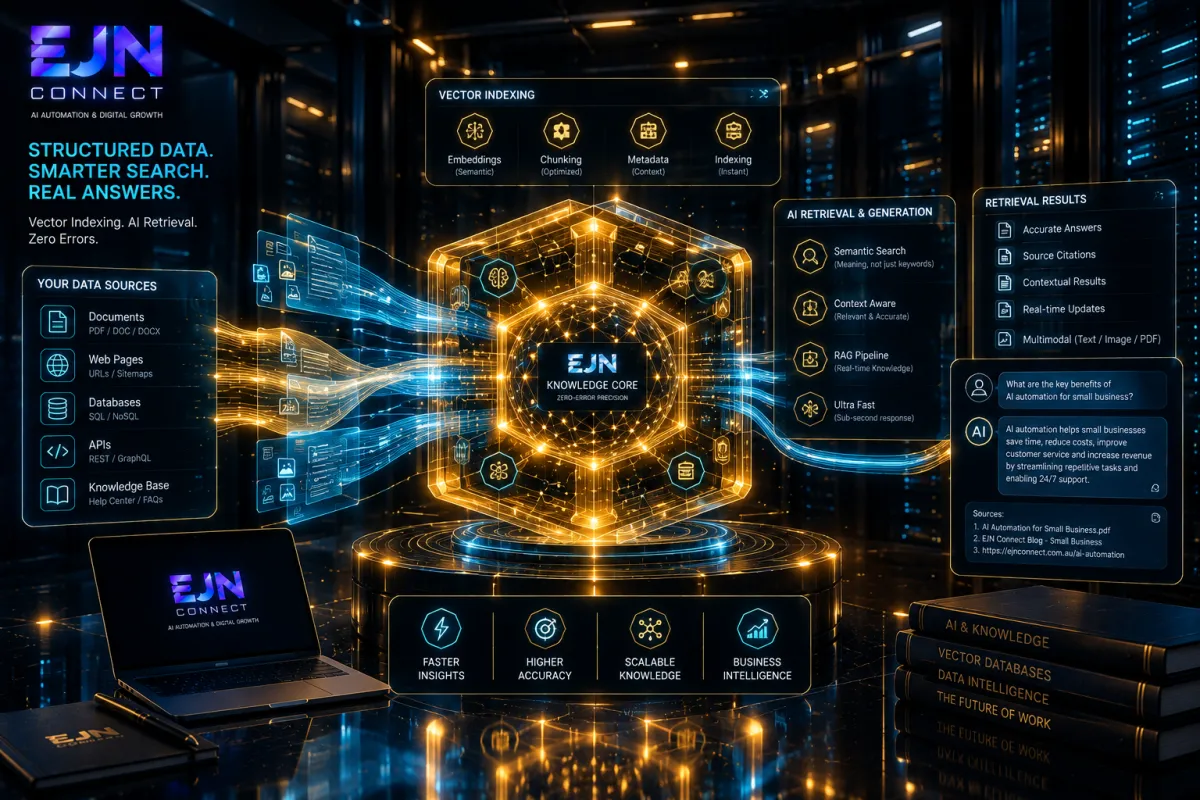
RAG eliminates this by inserting a mandatory retrieval step before any response is generated. When a question arrives, the system first searches your business's specific knowledge base a structured database containing your verified, current business information and retrieves the relevant sections before the language model formulates its response. The model is then explicitly instructed to answer only from what it retrieved, and to acknowledge when the retrieved context does not contain the information needed rather than inferring or guessing.
The result is an AI that answers questions about your business from your actual business information accurately, consistently, and without the creative liberty that produces hallucinations.
Why Basic RAG Implementations Fall Short
Understanding that RAG is the right approach is only part of the picture. How the knowledge base is engineered determines whether the RAG system performs with the accuracy that customer-facing deployment requires and the gap between a well-engineered RAG system and a basic one is significant.
The most common failure mode in basic RAG implementations is naive document ingestion taking existing business documents and loading them into a vector database as large, undifferentiated blocks of text. When a query arrives, the system retrieves the most semantically similar text block, which may be a paragraph that happens to be near the relevant information rather than the relevant information itself. Pricing tables become separated from the service categories they apply to. Procedures lose their sequential context. Exceptions and conditions get detached from the rules they modify.
The result is a system that retrieves plausible context but not always the right context which produces responses that sound informed but may be subtly or significantly inaccurate in ways that are difficult to detect until a client interaction goes wrong.
The Three Engineering Pillars of a Zero-Hallucination RAG System
A production-grade RAG knowledge vault addresses the shortcomings of basic implementations through three specific engineering choices.
Semantic chunking with metadata enrichment
Rather than loading documents as undifferentiated text blocks, a properly engineered RAG system breaks documents into semantically coherent chunks sections that correspond to logical units of meaning rather than arbitrary size limits. A pricing section stays together with the service category it describes. A procedure is chunked as a sequential unit rather than split across multiple disconnected fragments. A set of conditions or exceptions remains attached to the rule it modifies.
Each chunk is also enriched with metadata structured attributes that describe the content beyond its text. A pricing chunk is tagged with the relevant service category, the geographic region it applies to, and the effective date from which it is current. A compliance procedure is tagged with the regulatory framework it addresses and the business function it governs.
This metadata enables ultra-precise filtering during retrieval when a caller asks about pricing for a specific service in a specific location, the system retrieves the chunk that is tagged for that exact combination of attributes rather than returning the most generally similar text.
Hybrid search combining semantic and keyword matching
Pure semantic vector search which finds content based on meaning similarity works well for conceptual queries but can fail for specific factual queries. A caller asking for a specific product code, a precise fee amount, or a specific staff member's name may not get accurate retrieval from semantic search alone if those specific terms do not appear in the most semantically similar chunk.
A robust RAG system uses hybrid search combining semantic vector matching with keyword-based search, to ensure that both conceptually similar content and exactly matching terms are retrieved accurately. The combination covers the full range of query types that real customer conversations produce.
Strict system prompt guardrails and fallback protocols
The final and arguably most important layer of a zero-hallucination RAG system is the instruction framework that governs how the language model uses retrieved content.
A properly written system prompt explicitly instructs the model to answer only from the retrieved context, never to infer or estimate information not explicitly present in that context, and to respond with a specific defined phrase when the retrieved context does not contain the information needed to answer accurately.
The fallback response is not a failure. It is a feature. An AI that says "I don't have access to that specific detail, let me connect you with a specialist who can help" is performing correctly and protecting your business. An AI that guesses confidently is the one creating liability.
The Practical Implementation Pathway
For businesses building or evaluating a RAG-based AI system, the implementation pathway follows a specific sequence that determines the quality of the resulting knowledge vault.
The starting point is an audit and restructuring of your existing business documentation, your service descriptions, pricing structures, standard operating procedures, FAQs, and compliance guidelines. These documents typically exist in formats that are not optimized for AI retrieval: PDFs with complex formatting, internal memos with inconsistent structure, pricing spreadsheets that mix multiple categories. The audit process converts these into clean, consistently structured documents that the chunking and embedding process can work with effectively.
The structured documents are then processed through an embedding model that converts their content into vector representations and loads them into the knowledge base with appropriate metadata tags. The embedding model selection matters different models have different strengths in semantic understanding and the choice should reflect the specific types of queries the system will be asked to handle.
The knowledge base is connected to the AI system's processing layer and the system prompt guardrails are implemented and tested. Testing is not optional automated evaluation frameworks can run hundreds of edge-case queries to verify that the system retrieves accurately, responds only from retrieved context, and triggers appropriate fallbacks when information is not available.
Once deployed, the knowledge vault requires ongoing maintenance, updates when pricing changes, when new services are added, when procedures are modified, when coverage areas expand. The system that accurately reflects your business on day one will drift from accuracy over time if the knowledge base is not kept current. This maintenance process is the ongoing operational responsibility that determines whether the accuracy the system delivers at launch is maintained as the business evolves.
At ejnconnect.com.au, we design and build production-grade RAG knowledge vaults for Australian businesses, engineering your specific business SOPs, pricing, and operational documentation into structured, metadata-enriched, hybrid-search-enabled knowledge bases that power AI agents capable of representing your business with complete factual accuracy.
Because the value of an AI system in customer-facing roles is entirely dependent on the accuracy of what it says. And accuracy is not a feature of the AI model, it is an outcome of how the knowledge that model draws from is engineered.
