
How every piece of your AI infrastructure connects into one unified growth engine
Table of Con
The Four-Layer Architecture of a Unified AI Business System
What Happens When a Real Enquiry Moves Through the System
Throughout this series, we have explored the individual components of modern business AI infrastructure, speed-to-lead systems, 24/7 autonomous intake, conversational AI agents, multi-agent orchestration, data governance frameworks, self-healing pipelines, and conversational intelligence flywheels.
Each of these components delivers genuine value in isolation. But understanding them individually is only half the picture and arguably the less important half.
The businesses that are building truly significant and defensible competitive advantage with AI are not the ones that have implemented the most individual tools. They are the ones that have achieved architectural synthesis, the integration of every component into a single, unified, end-to-end system where each layer connects seamlessly to the next, where data flows without friction from first customer contact through to operational insight, and where the collective performance of the integrated system far exceeds the sum of what any individual component could produce alone.
This article is about what that unified architecture actually looks like and what becomes possible for your business when it is built properly.
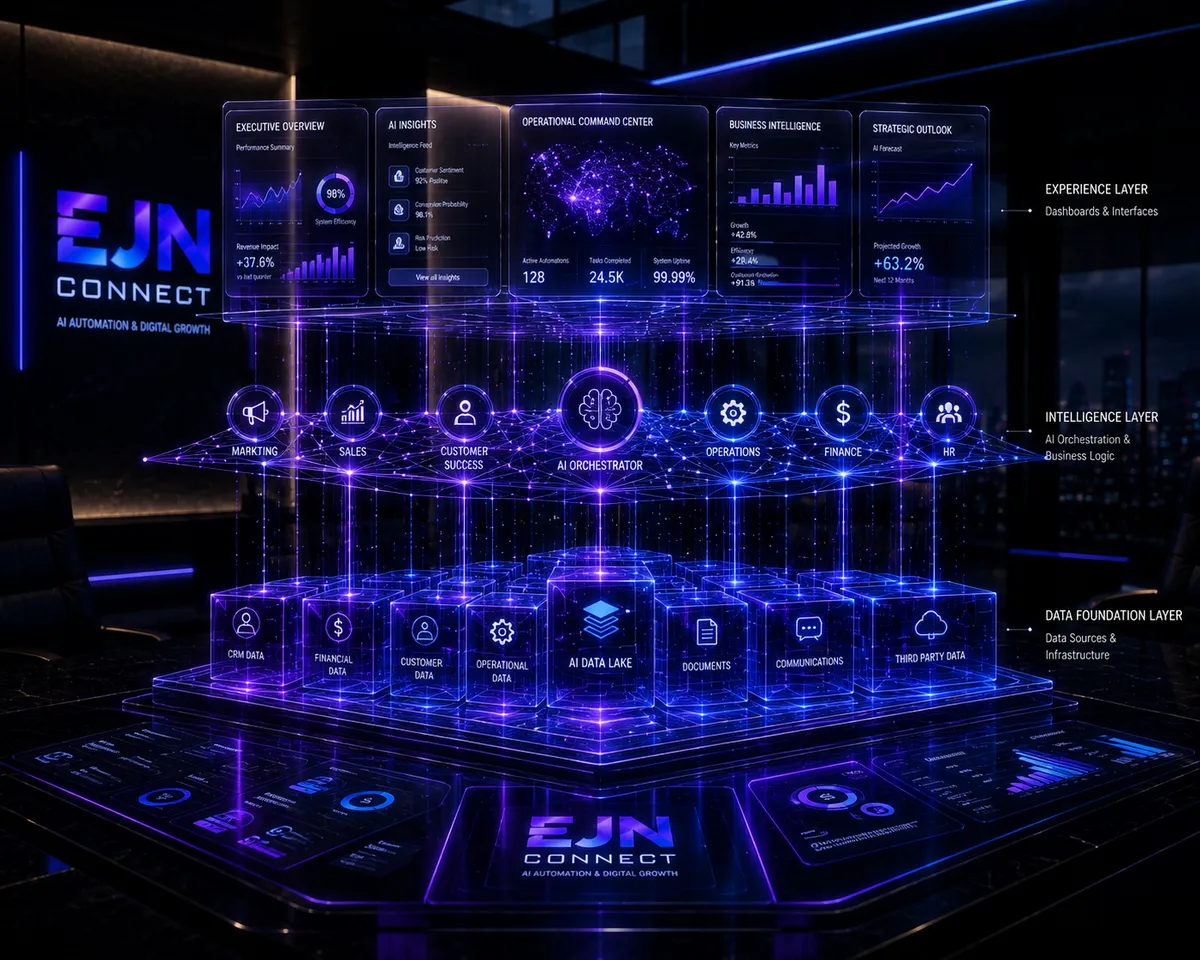
The Four-Layer Architecture of a Unified AI Business System
A genuinely integrated AI business infrastructure operates across four distinct but interconnected layers, each with a specific function and each dependent on seamless data exchange with the layers above and below it.
Layer 1: The Front-End Intake Layer
This is where your business meets the world, the collection of digital touchpoints through which clients and prospects first make contact. Web chat on your website. SMS and WhatsApp messaging. AI voice systems on your business phone line. Direct messages across social media platforms.
In a unified architecture, these are not separate, independently managed channels. They are unified entry points that all feed into the same underlying system through a secure API gateway. Every inbound message, regardless of channel, is immediately passed into the orchestration layer for processing with the same speed, the same intelligence, and the same quality of response regardless of how or where the contact was made.
The experience for the prospect is immediate and seamless. The experience for your team is a single, unified view of every inbound interaction across every channel rather than multiple platforms to monitor and manage separately.
Layer 2: The Multi-Agent Orchestration and Reasoning Layer
This is the intelligence layer where incoming messages are understood, responses are formulated, and decisions are made about what happens next.
The supervisor agent receives every inbound message from the intake layer and coordinates the response. It queries the enterprise knowledge vault, the structured, private database of your business's specific information, SOPs, pricing, service details, and communication guidelines, to retrieve the accurate, authorized information relevant to the enquiry. Where necessary, it instructs specialist agents, compliance agents that verify the response against relevant guardrails, evaluator agents that assess the quality and accuracy of the formulated response before the reply is finalized.
The entire reasoning cycle from receiving the inbound message to formulating an accurate, compliant, contextually appropriate response, completes in under a second. The prospect has a near-instantaneous experience of a business that is attentive, knowledgeable, and professional. The processing that produced that experience is invisible to them entirely.
Layer 3: The CRM and Workflow Execution Layer
This is where intelligence becomes action where the decisions made in the reasoning layer translate into real operational outcomes in your business systems.
The action agent takes the structured output from the orchestration layer and triggers the appropriate system actions through your CRM in most cases GoHighLevel or an equivalent centralized CRM platform. Contact records are created or updated. Pipeline stages are assigned. Calendar availability is checked and appointments are booked. Confirmation messages are triggered. Follow-up sequences are initiated. Tags are applied that allow your team to understand the context and history of every contact at a glance.
All of this happens in the same interaction where the prospect first made contact. By the time the conversation concludes, the operational machinery of your business has already processed the interaction completely, not when someone on your team gets around to it, but in the seconds following the AI's response.
Layer 4: The Backend Data and Governance Layer
This is the foundation that makes the entire architecture trustworthy, auditable, and compliant, the layer that most business owners do not think about until something goes wrong, and the layer that determines whether your AI infrastructure can be used with confidence in regulated environments or for sensitive client data.
Every interaction, every decision, every system action, and every data access event is logged immutably at this layer, creating a complete, verifiable record of everything the system has done. Role-based access controls ensure that every component of the system can only access the data it is authorized to use. Encryption protects client data both in transit and at rest.
For businesses operating under Australian privacy legislation, industry-specific compliance requirements, or the expectations of enterprise clients with their own data governance standards, this layer is what makes the AI infrastructure defensible not just functionally capable, but provably trustworthy.
What Happens When a Real Enquiry Moves Through the System
The architecture becomes most tangible when you trace a single interaction through every layer because it reveals how quickly and completely the system processes what would previously have required multiple people, multiple steps, and multiple hours.
A high-value prospect sends a web chat enquiry at 11:15pm on a Thursday. In a traditional business, this enquiry sits unread until Friday morning at the earliest by which point the prospect's urgency has had twelve hours to cool and their options have had twelve hours to multiply.
In a unified AI architecture, the following happens in under one second.
The message arrives at the intake layer and is immediately passed to the orchestration layer via secure API connection. The supervisor agent receives it, queries the knowledge vault for relevant information, instructs the compliance agent to verify that the proposed response meets all required guardrails, and formulates an accurate, warm, and contextually appropriate reply. The response reaches the prospect within 800 milliseconds of their message arriving.
The conversation continues. The AI qualifies the prospect through natural dialogue, identifies them as a strong fit, and presents available appointment slots from the live calendar. The prospect selects a time. The action agent immediately creates their contact record in the CRM, applies the relevant pipeline tags, locks the calendar booking, sends the confirmation message, and initiates the pre-appointment preparation sequence. The entire process from first message to confirmed, CRM-logged, calendar-booked appointment has taken under four minutes.
At the governance layer, the complete interaction transcript, confidence scores, and executed actions are committed to the immutable audit log. The evaluator agent assesses the interaction against performance benchmarks and flags any refinement opportunities for the next optimization cycle.
By 11:20pm on Thursday night, your business has a new confirmed appointment, a complete CRM record, and an audit trail, all generated autonomously while you slept.
What Architectural Synthesis Actually Unlocks
The performance characteristics that emerge from a fully unified architecture are qualitatively different from what individual tools can produce and they matter commercially in specific and significant ways.
Zero administrative lag means that leads move from first contact to booked calendar to updated CRM pipeline in seconds, not days. The gap between marketing activity and sales outcome, the gap where leads currently cool, get lost, or choose competitors effectively disappears.
Complete operational visibility means that leadership has real-time insight into marketing performance, conversion rates, pipeline velocity, and customer sentiment across every channel simultaneously from a single dashboard, rather than pieced together from multiple disconnected reporting tools. Decisions get made faster and with better information.
Uncapped operational elasticity means that whether your marketing generates ten leads or ten thousand leads in a single day, your infrastructure handles the volume identically with the same speed, the same quality, and the same conversion performance. Growth in lead volume does not require proportional growth in operational overhead.
Building the Architecture
The most important thing to understand about the unified architecture described in this article is that it does not have to be built all at once. Most businesses approach it incrementally, establishing the intake and CRM integration first, adding the multi-agent orchestration layer as complexity demands it, and building toward the full governance and self-healing infrastructure as the system matures and the investment becomes clearly justified by the returns.
What matters is that each component is built with the full architecture in mind, so that the pieces connect cleanly when the time comes to integrate them, rather than requiring significant rework to join together systems that were built independently without integration as a design principle.
At ejnconnect.com.au, we design and build unified AI infrastructure for Australian businesses from the first intake touchpoint through to CRM execution, multi-agent orchestration, governance compliance, and self-healing optimization as a single, cohesive system engineered for the specific requirements of your business.
If you are ready to move from individual AI tools to a unified growth architecture or to understand what that would look like for your specific operation, we would love to have that conversation.
Because individual tools create incremental improvements. A unified architecture creates something genuinely different: a business that operates at a level of speed, consistency, and intelligence that manual processes simply cannot match and that compounds in your favor every single day it runs.

