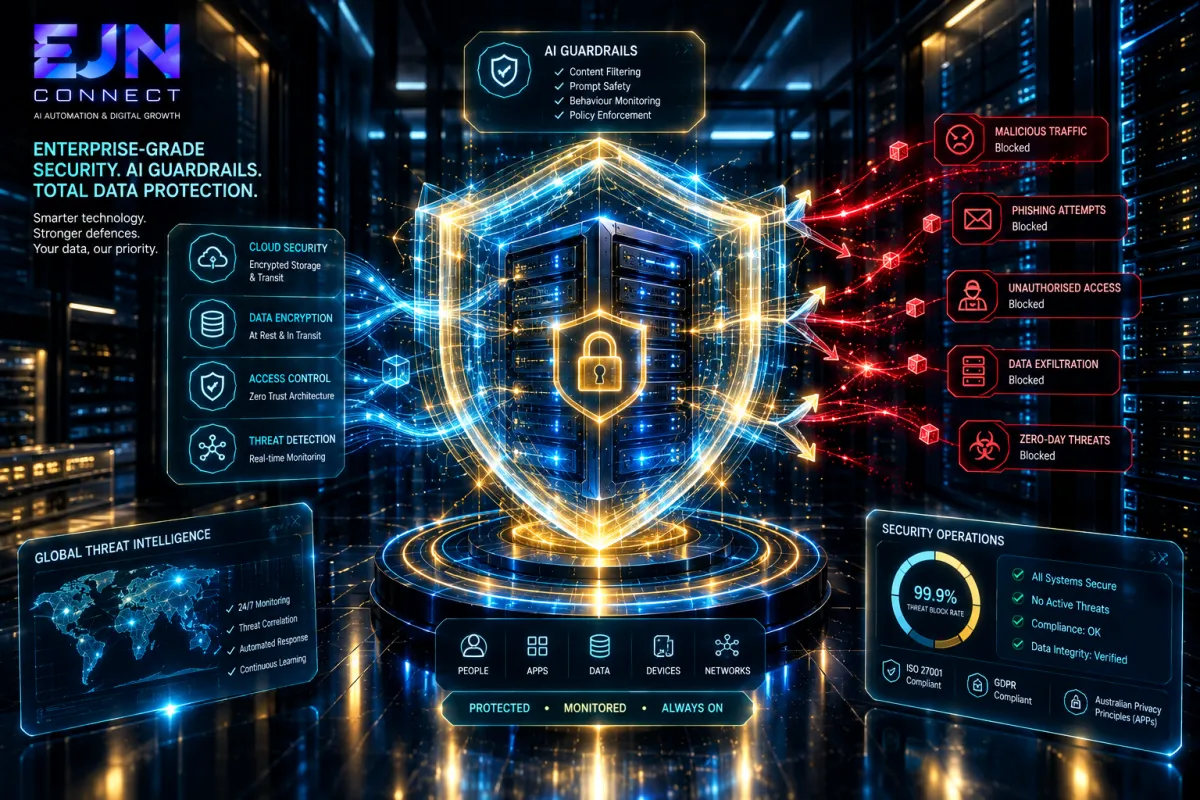
How Australian Businesses Can Protect Their IP, Prevent Prompt Injection, and Eliminate Shadow AI
Most conversations about AI and business risk in Australia are currently focused on Privacy Act compliance and that focus is appropriate, given the significance of the changes coming into effect in December 2026. But regulatory compliance addresses only one dimension of AI risk, and it is not the dimension that is most likely to affect your business in the near term.
The more immediate and operationally significant risks come from inside the organization, from the AI tools employees are using without IT oversight, from the ways that malicious actors can manipulate AI systems into taking unintended actions, and from the probabilistic nature of AI outputs that can produce convincing but factually wrong results in ways that create commercial and legal liability.
These risks do not wait for a regulatory deadline. They are present right now, in businesses that have deployed AI and in businesses where employees have started using AI tools informally, without governance frameworks or security controls in place.
Understanding the three primary risk vectors, and the technical architecture that addresses them, is essential knowledge for any Australian business leader who is serious about deploying AI responsibly.
The 3 Operational Risk Vectors
Shadow AI and intellectual property leakage
Shadow AI refers to the use of unapproved, consumer-grade AI tools by employees to process corporate work without the knowledge or oversight of IT, management, or the people responsible for data governance.
The scale of shadow AI in Australian businesses is almost certainly larger than most leadership teams realise. When employees discover that a publicly available AI tool can help them draft documents faster, summarize lengthy reports, or generate content on demand, they use it because it makes their work easier and nobody has told them not to. The security implications of this behavior are not on their radar.
The specific risk is data retention. Consumer-grade AI tools, public web interfaces for major AI platforms, typically include terms of service that permit user input to be used for model training purposes. When an employee pastes a confidential client email, a proprietary pricing model, internal financial projections, strategic planning documents, or any other sensitive business information into one of these tools, that information potentially enters a public training dataset, effectively converting confidential corporate intellectual property into data that could, theoretically, surface in responses to other users of the same platform.
This is not a theoretical risk. The terms of service that govern consumer AI tools are specific about data retention, and the organizations deploying these tools have financial incentives to use training data to improve their models. The only reliable protection is ensuring that employees use enterprise AI tools with contractually guaranteed zero-data-retention terms and that the existence of unapproved tools in use across the organization is identified and addressed.
Prompt injection and context contamination
Prompt injection is a category of attack specific to AI systems and one that is not well understood outside technical circles, despite representing a genuine operational risk for businesses using AI in customer-facing or data-processing roles.
A direct prompt injection occurs when a user deliberately crafts input to override the AI system's configured instructions. The classic example is a message that tells the AI to disregard its previous instructions and follow new ones, a technique that, if the system is not properly hardened, can cause an AI agent to act outside its intended scope, reveal information it should not, or take actions that were not authorized.
An indirect prompt injection is more subtle and potentially more dangerous. It occurs when malicious instructions are embedded in content that the AI is asked to process, a document it is reading, an email it is summarizing, a webpage it is analyzing. When the AI's retrieval process encounters the hidden instruction, it may execute it as if it were a legitimate system command, potentially causing the AI to exfiltrate information, modify database records, or send unauthorized communications without any direct human involvement in the attack.
For businesses using AI agents that have access to CRM systems, communication platforms, or any other operational infrastructure, prompt injection represents a specific and non-trivial attack surface that requires deliberate technical countermeasures.
Model hallucination and action drift
The third risk vector is internal to how AI language models work and it is the one that most directly affects the accuracy and reliability of AI outputs in customer-facing roles.
Large language models generate responses by predicting the most statistically likely continuation of a given text not by retrieving verified facts or executing deterministic logic. When an AI system is asked a question that its knowledge base does not contain a clear answer to, it does not acknowledge the gap and stop. It generates a plausible-sounding response based on statistical patterns in its training data which may be factually wrong, commercially incorrect, or legally problematic.
In a customer-facing context, this means an AI that confidently quotes a pricing structure that does not match your actual rates, makes a service commitment your business cannot fulfil, or provides information about a product or procedure that is inaccurate in ways that create client expectation problems or liability exposure.
When AI systems are also connected to operational infrastructure, CRM updates, email sending, calendar management, hallucinated outputs can translate into real-world actions: incorrect records created, emails sent with wrong information, commitments made that the business did not authorize.
The Technical Defense Architecture
Addressing these three risk vectors requires a specific technical architecture, not just policy documentation, but hardened infrastructure that enforces security controls at every point in the AI processing pipeline.
Input validation and injection filtering
Every input that enters an AI processing system should pass through a validation layer before it reaches the AI model. This layer performs several functions simultaneously.
Regex sanitization identifies and strips patterns associated with common prompt injection techniques instruction override syntax, system prompt manipulation attempts, and other known attack patterns. Semantic boundary checking assesses whether the intent of an input appears to be manipulating the AI's behavior rather than asking a genuine question. Token threshold controls limit the length and complexity of inputs in ways that constrain the attack surface for injection attempts.
The validation layer does not block legitimate inputs, it filters inputs that match known attack patterns and flags unusual inputs for review. Legitimate customer enquiries pass through cleanly. Attempted manipulations are caught before they reach the AI.
Deterministic evaluation and schema validation
The AI's outputs should not flow directly into downstream systems and actions. Every output must pass through a deterministic validation layer that checks whether the response conforms to the expected format and content parameters before any action is taken.
For AI systems that trigger CRM updates, send communications, or execute any operational action, structured output schemas define exactly what a valid output looks like what fields are required, what data types are expected, what value ranges are acceptable. An AI output that does not conform to the schema is flagged and held for human review rather than executed automatically.
This layer is the primary defense against hallucination-driven action drift, the AI may generate an output that contains a pricing error, but that output will not trigger an incorrect CRM update or an unauthorized customer communication if the schema validation layer is functioning correctly.
Human-in-the-loop thresholds for high-impact actions
For the category of actions that carry the highest commercial or operational risk, high-value contract generation, mass communication campaigns, significant CRM modifications, financial transactions, the architecture should require explicit human approval before execution, regardless of whether the AI's output has passed schema validation.
These thresholds are defined in terms of the specific action types and value parameters that require human sign-off, and they are enforced at the action execution layer rather than relying on the AI to self-identify when human oversight is needed. The human review queue receives a complete brief of the proposed action, the context that generated it, and the information needed to approve, modify, or reject it, allowing a decision in seconds rather than requiring the reviewer to reconstruct the full context.
Operationalizing IP Protection Across Your Organization
The technical architecture described above addresses the security risks in your deployed AI systems. But shadow AI, employees using unapproved tools requires an additional organizational response.
The most effective approach is not prohibition, banning AI tools rarely works, and it drives usage underground rather than eliminating it. The effective approach is replacement: providing employees with an approved, enterprise-grade internal AI workspace that meets their productivity needs without the security risks of consumer tools.
When employees have access to a secure internal AI environment that operates under zero-data-retention terms, that integrates with the company's approved knowledge bases, and that provides the same productivity benefits as the consumer tools they were using informally, the motivation to use unsanctioned external tools largely disappears.
This requires maintaining a current register of all AI tools in use across the organization, conducting formal vendor risk assessments for every third-party AI tool that processes company data, and implementing role-based access controls in RAG knowledge vaults that ensure employees can only access information their authorization level permits.
At ejnconnect.com.au, we design and implement hardened AI infrastructure for Australian businesses, including input validation and injection filtering, deterministic schema validation layers, human-in-the-loop approval workflows, enterprise API configurations with zero-data-retention guarantees, and role-based RAG access controls built specifically for the governance and security requirements of Australian business environments.
Because the competitive advantage of AI automation is only realized when the systems delivering it are secure enough to trust with the information and actions your business depends on.
