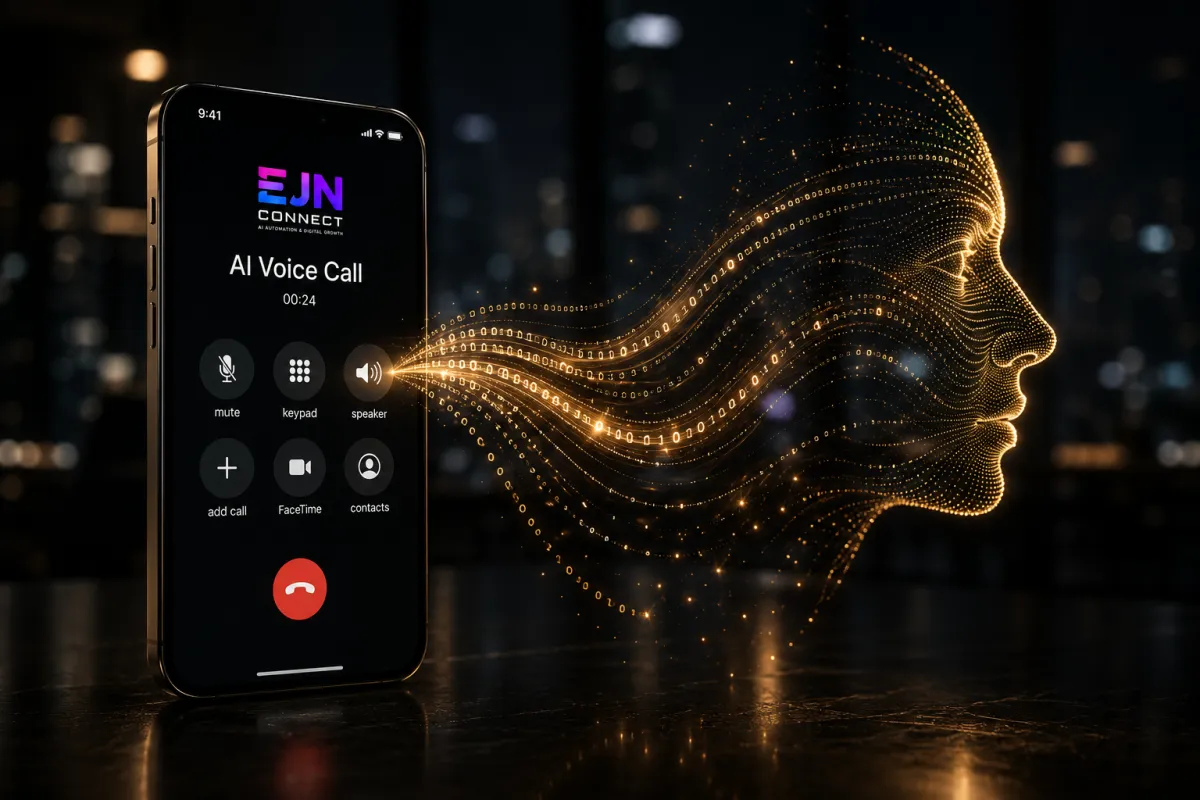
How an AI Voice Assistant Actually Works
Table of Contents
The Four-Step Lifecycle of an AI Phone Conversation
Step One: Speech to Text — Transcribing the Audio
Step Two: NLP Engine — Understanding the Meaning
Step Three: Knowledge Base Lookup — Checking the Facts and the Calendar
Step Four: Text to Speech — The Human-Like Response
How It Handles the Messy Reality of Human Conversation
When most people hear the phrase "AI answering your business phone," one image comes to mind immediately and it is not a good one.
The robotic automated menu. The rigid list of numbered options that never quite match what you actually need. The experience of saying "representative" clearly and confidently into your phone, five times, with increasing desperation, before eventually giving up and trying to find an email address instead.
If that is your mental model of what an AI phone system looks like, it is completely understandable. And it is also about a decade out of date.
Modern AI voice assistants operate on an entirely different level to those old, script-based phone trees. When a customer calls your business number and an AI agent answers, they are not navigating a menu. They are having a genuine, flowing, two-way conversation with a system that understands what they are saying not just the words, but the intent behind them and responds with human-like naturalness and intelligence.
Here is exactly how it works, step by step, under the hood.
The Four-Step Lifecycle of an AI Phone Conversation
Every time a customer speaks a sentence to an AI voice assistant, a highly complex four-step process executes in the background in less than a second. Understanding this process is what makes the technology's capability tangible and what explains why callers so often don't realize they are talking to an AI at all.
Step One: Speech to Text — Transcribing the Audio
The moment the caller speaks, the AI converts the raw audio of their voice into clean digital text in real time. A customer might say: "Hey, I'm looking to get a technician out to look at my solar panels next Monday afternoon."
Modern speech-to-text technology has advanced to the point where it handles this accurately across a wide range of accents, speech patterns, background noise levels, and conversational styles including the kind of casual, colloquial Australian speech that older systems struggled with entirely. The audio becomes text, instantly and accurately, and the next step begins immediately.
Step Two: NLP Engine — Understanding the Meaning
This is the step that separates modern conversational AI from everything that came before it and it is worth understanding clearly because it is where the real intelligence sits.
Once the sentence is converted to text, the Natural Language Processing engine analyses it not for keywords, but for meaning. It breaks the sentence into two critical components: the intent and the entities.
The intent is what the caller is trying to achieve. In this case: book a service appointment. The entities are the specific details embedded in the sentence: the asset is solar panels, the day is next Monday, and the preferred timeframe is the afternoon.
The crucial point is that the caller did not have to use specific trigger words or phrase their request in a particular way for the AI to understand it. They spoke naturally, the way anyone would speak to a receptionist they had called and the AI extracted the meaning accurately regardless of how the sentence was constructed. This is what makes the experience feel human rather than robotic.
Step Three: Knowledge Base Lookup — Checking the Facts and the Calendar
Now that the AI understands precisely what the caller wants, it queries your business infrastructure simultaneously across two sources.
It checks your business knowledge base to verify that you do indeed service solar panels, to confirm the relevant details about your service in that area, and to retrieve any pricing or process information that might be relevant to the conversation. At exactly the same moment, it pings your live CRM calendar to identify which technician slots are actually available next Monday afternoon.
This all happens in the background, invisibly, in a fraction of a second, so that by the time the AI responds, it is responding with accurate, real-time information rather than a generic holding statement.
Step Four: Text to Speech — The Human-Like Response
The AI formulates its response in text, then converts it back into spoken audio using ultra-realistic voice synthesis technology that produces natural pacing, appropriate inflections, and the kind of conversational cadence that makes the interaction feel like talking to a person rather than a machine.
The response sounds like this: "I can certainly help with that. We have an open slot for a solar diagnostic next Monday the 13th at 2pm. Would that time work for you, or would you prefer something closer to 4pm?"
Clear. Natural. Helpful. Specific. And delivered without the robotic delay or stilted phrasing that made old automated systems so frustrating to deal with.
The entire four-step cycle from the customer finishing their sentence to the AI delivering its response takes between 500 and 800 milliseconds. There is no awkward pause. No obvious processing lag. Just a fluid, natural conversation that feels, to the caller, like talking to a sharp and capable front-desk operator.
How It Handles the Messy Reality of Human Conversation
Real phone conversations are not clean and linear. People change their minds mid-sentence. They ask tangential questions in the middle of a booking process. They stumble over their words, interrupt, go back and clarify something they said earlier, or suddenly remember a related question they wanted to ask.
Old automated systems broke the moment a conversation deviated from the script. Modern AI voice assistants are designed specifically to handle these deviations because handling them is fundamental to making the experience feel genuinely human.
If a caller is partway through confirming a Monday afternoon appointment and suddenly asks "Wait, how much is the call-out fee?" the AI doesn't freeze, loop back to the start, or offer an irrelevant menu option. It answers the pricing question immediately and naturally, then steers the conversation smoothly back to the booking confirmation without the caller ever feeling like anything unusual happened.
This conversational flexibility is what keeps callers engaged rather than frustrated. And it is what makes the AI effective not just as a message-taking system, but as a genuine booking and qualification tool.
What Happens When the Call Ends
The conversation closes when the caller confirms their booking. But the AI's work doesn't stop there, it immediately executes the administrative tasks that would otherwise require a team member to handle manually.
The caller's contact details, phone number, and a complete summary of the call including the service requested, the time confirmed, and any relevant details that came up during the conversation are pushed directly into your CRM in real time. A confirmation SMS goes to the caller's mobile immediately. An internal notification alerts your team. The calendar slot is blocked. The record is created and complete.
By the time your team sees the new booking, everything they need is already there. No follow-up required. No manual data entry. No risk of details being lost or misremembered from a handwritten note.
What This Means for Your Business
Phone tag — the exhausting cycle of missed calls, voicemails, callbacks, and more missed calls is one of the most persistent and costly inefficiencies in small business operations. It wastes time, frustrates clients, and costs leads that were warm when they first called and cold by the time contact is finally established.
An AI voice assistant eliminates it entirely. Every call is answered. Every caller gets an immediate, intelligent, personalized response. Every qualified booking is locked into your calendar in real time. And every piece of relevant information is captured and organized before anyone on your team has to think about it.
Your phone line becomes what it should have always been, a seamless, always-open entry point into your business that converts enquiries into appointments without friction, without delay, and without depending on someone being available to answer.
At ejnconnect.com.au, we implement AI voice assistants for Australian small businesses that answer every call, handle every conversation naturally, and book every appointment automatically so your business is always professionally reachable, regardless of what your team is doing or what time it is.
Because every call is a potential client. And with the right system, not one of them goes unanswered.
