How AI Voice Receptionists Work for Small Businesses (Complete Guide)
For decades, the front desk has been one of the hidden engines of small business growth.
A phone call comes in.
Someone answers.
An enquiry becomes a customer.
But modern business operations have changed. Teams are leaner, customer expectations are faster, and enquiries arrive at all hours of the day. For many small businesses, keeping up with inbound communication has become increasingly difficult.
This is one reason AI voice receptionists are spreading rapidly across industries where phone enquiries still drive a large share of new business.
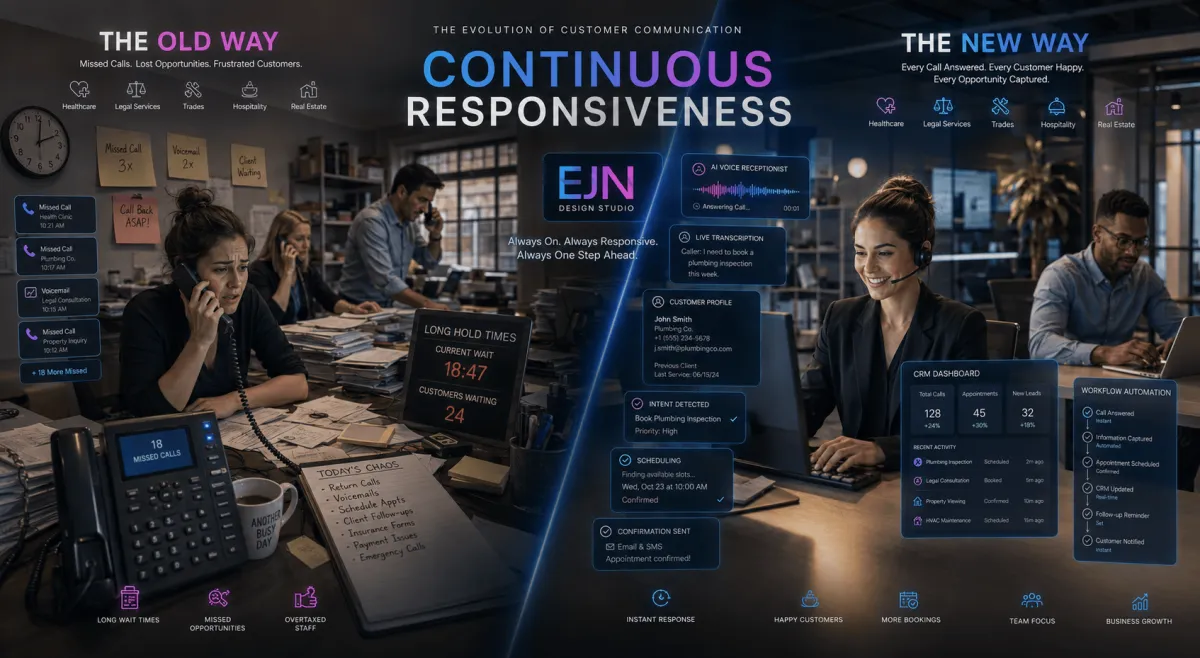
What makes the technology interesting is not simply automation. It is the shift toward continuous responsiveness.
Businesses are beginning to realize that customers no longer compare service only on quality or price. They compare speed, availability, and ease of communication.
And increasingly, the first interaction happens with AI.
What an AI Voice Receptionist Actually Does
At its core, an AI voice receptionist performs a relatively simple role:
answer incoming calls
speak with customers conversationally
collect information
route enquiries appropriately
trigger follow-up actions
But the difference between modern AI systems and traditional phone menus is significant.
Older systems forced callers through rigid options:
“Press 1 for sales. Press 2 for support.”
Modern voice AI is designed to handle natural conversation.
Customers can explain why they are calling in plain language, and the system responds dynamically based on the enquiry.
That changes the experience entirely.
What Happens When a Customer Calls
The process itself is surprisingly straightforward.
1. The Call Is Answered Immediately
The AI system picks up instantly.
There are no hold queues, missed calls, or delays waiting for staff availability.
For customers, this creates immediate engagement.
And in customer communication, the first few seconds matter more than most businesses realize.
2. The AI Engages the Caller
The system begins a conversation based on the business type and enquiry.
For example, a plumbing business may ask:
What issue are you experiencing?
Is this an emergency?
What is your location?
A medical clinic may ask:
Are you an existing patient?
What type of appointment do you need?
The interaction is designed to feel conversational rather than scripted.
3. Information Is Captured Automatically
As the conversation continues, the system records details such as:
customer name
contact information
enquiry type
booking preferences
urgency level
This removes the need for manual note-taking while creating more structured customer records.
4. The Enquiry Is Routed or Logged
Once the call is complete, the AI can:
transfer urgent calls
notify staff
create CRM records
trigger follow-up workflows
send confirmations or reminders
The phone system becomes part of a larger operational workflow rather than an isolated communication channel.
Why Businesses Are Paying Attention
The rise of AI voice receptionists reflects a broader shift happening across small business operations.
Businesses are under pressure from several directions at once:
rising customer expectations
limited staffing capacity
increasing enquiry volume
growing administrative workload
At the same time, customers increasingly expect immediate responses.
Waiting hours for a callback now feels slow.
Waiting until the next business day often feels unacceptable.
AI systems help close that gap.
The Real Value Is Consistency
One of the biggest operational challenges for small businesses is maintaining consistent communication during busy periods.
Calls arrive unpredictably.
Teams become overloaded.
Enquiries slip through gaps.
AI receptionists create consistency by ensuring:
every call is answered
information is captured accurately
after-hours enquiries are handled
repetitive tasks are automated
For many businesses, this is less about replacing staff and more about removing communication bottlenecks.
Where Voice AI Is Being Used Most
The strongest adoption is happening in industries where:
phone calls drive lead generation
response speed matters
administrative capacity is limited
This includes:
trades businesses
healthcare clinics
legal services
real estate
home services
hospitality
automotive services
In these industries, missed calls often translate directly into lost revenue opportunities.
Beyond Call Answering
The technology becomes far more powerful when integrated with other systems.
Modern AI voice receptionists can connect with:
CRM platforms
booking systems
automation tools
customer communication software
This allows businesses to create a continuous workflow from the first phone call through to booking, follow-up, and ongoing communication.
The result is not simply better phone handling.
It is a more structured customer acquisition system.
A Shift in Customer Expectations
The larger story here is not really about AI.
It is about responsiveness.
Customers increasingly expect businesses to be available instantly, regardless of business size or operating hours.
That expectation used to require large support teams.
Now it can increasingly be handled through automation.
For small businesses, this changes the economics of customer communication.
The businesses that respond fastest are often the businesses that grow fastest.
And AI voice receptionists are becoming one of the tools helping make that possible.
