How AI Protects Your Business During a Lead Surge
Table of Contents
Why Traditional Scaling Fails in the Moment That Matters Most
What Elastic Capacity Actually Means
How AI Manages a Surge in Practice
You have worked hard to build your marketing. You have optimized your campaigns, built your reputation, and invested consistently in your online presence. And then one day a highly targeted ad hits perfectly, a local media outlet features your business, or a piece of content goes unexpectedly viral and the marketing engine that you built works better than you have ever seen it work.
Your inbox fills with hundreds of notifications. Your phone rings continuously. Your web chat lights up with simultaneous conversations. The volume of inbound enquiries is three times, four times, five times what your team normally handles in a day.
This should be the moment everything clicks. The marketing investment paying off. The proof that the business is ready to grow.
And then the operational reality sets in.
Your team is fielding the same basic introductory questions on repeat, checking calendar availability manually for every enquiry, logging data by hand, and trying to keep up with a volume of communication that has outpaced their capacity before the morning is half over. Response times slow. Hot leads that arrived at 9am are still waiting at noon. Some fall through entirely. By the time the surge passes, you have captured a fraction of what the opportunity was worth and your team is exhausted.
This is the hidden vulnerability of a business that has built excellent marketing but has not yet built the operational infrastructure to match it. And it is far more common than most business owners realise until the surge actually hits.
Why Traditional Scaling Fails in the Moment That Matters Most
The conventional response to a sudden spike in enquiry volume is to add people hire temporary administrative staff, bring in a customer service agency, ask the existing team to work overtime. And while these options can provide some relief, they all share a fundamental problem: they are slow, expensive, and imprecise.
The onboarding drag means that even if you make the decision to hire immediately, you are looking at weeks of recruitment, interviews, offers, and training before a new team member can independently handle your client communications to the standard your business expects. By the time they are ready, the marketing surge that created the demand has passed and you are left with a permanent overhead commitment that no longer matches your volume.
The variable overhead trap compounds the financial risk. Adding staff means adding salaries, superannuation, payroll taxes, and additional software licenses fixed costs that remain regardless of whether the enquiry volume stays elevated or drops back to normal levels. You are making a long-term financial commitment to address what may be a short-term peak.
And the efficiency drop that comes from pushing an already stretched team through a volume surge creates its own costs. When human teams are flooded with communication, cognitive fatigue sets in quickly. Typos appear in responses. Follow-ups get missed. Qualification standards slip as the priority shifts from doing things well to simply clearing the queue. Errors that would never happen on a normal day become inevitable under that kind of sustained pressure.
The result is that your best marketing moment the one you worked and waited for gets partially squandered by operational infrastructure that was never designed to scale instantly.
What Elastic Capacity Actually Means
AI infrastructure operates according to a fundamentally different set of rules than a human team and the most commercially significant of those differences is what software architects call elastic capacity.
A human team has a fixed bandwidth. They can handle a certain number of conversations simultaneously, and when that limit is reached, the excess creates a queue and everything in the queue goes cold while it waits. There is no way around this. It is simply the reality of human cognitive capacity.
An AI employee has no such limit. Whether five enquiries arrive today or five thousand arrive in the same minute, every single one receives an immediate, personalized, intelligent response simultaneously, without delay, without any one enquiry being deprioritized because another arrived at the same moment. The capacity expands automatically to meet the demand, at the same speed and the same quality, regardless of volume.
In practical terms, this means that the ceiling on what your business can capture during a marketing surge is no longer determined by how many people are available to respond. It is determined entirely by how many people are genuinely interested which is exactly the ceiling it should be.
How AI Manages a Surge in Practice
When a volume spike hits a business with AI-powered front-line infrastructure, the experience from the outside is seamless and from the inside, it looks remarkably different from the chaos that a manual operation would produce.
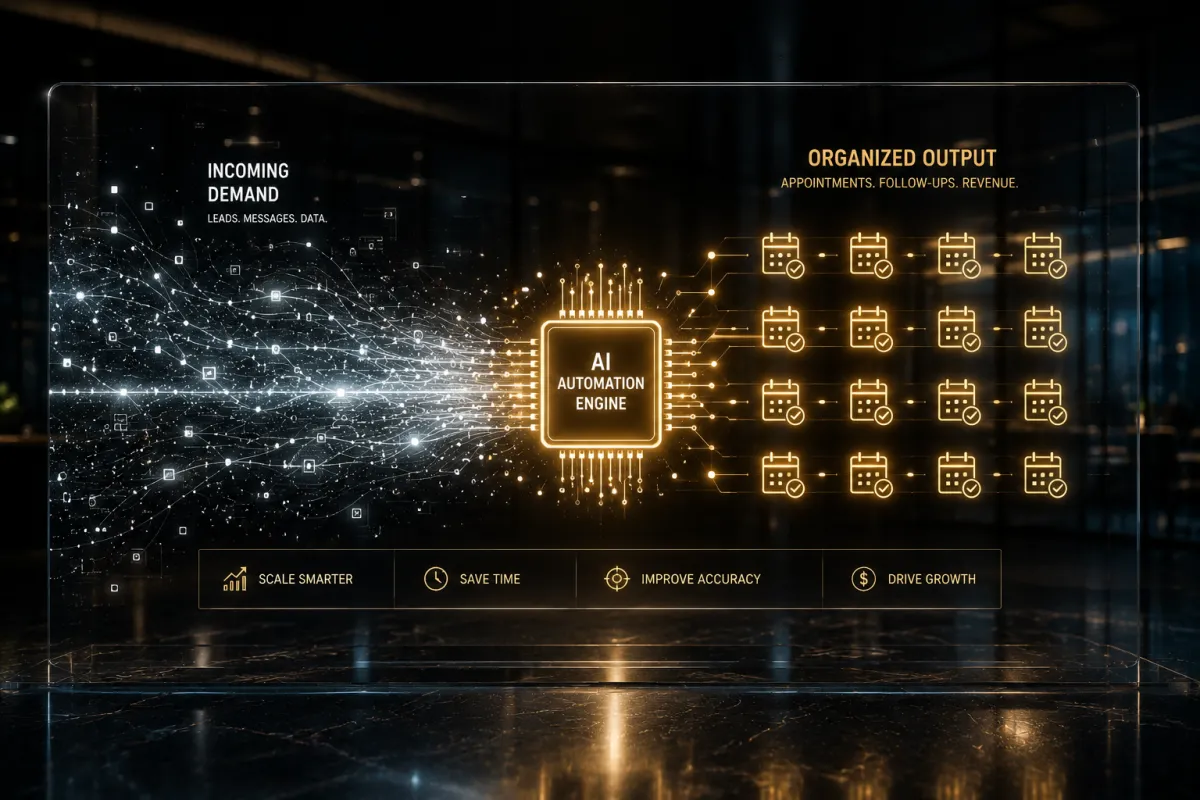
Every person who contacts your business during the surge through web chat, SMS, phone, or online form receives an immediate, individual, personalized response within seconds of making contact. Not a generic acknowledgement. Not an auto-reply that says you will be in touch. A genuine, contextual, intelligent response that engages them in a real conversation and begins moving them toward a qualification and booking outcome.
The AI applies your qualification criteria consistently across every single conversation simultaneously separating the high-intent, ready-to-book prospects from the casual browsers, the wrong-fit enquiries, and the people who are still at the research stage. Each gets handled appropriately qualified leads move directly toward a booking, lower-intent contacts are entered into a nurture sequence for later engagement.
Only the prospects who have been qualified and have successfully locked in a booking slot are passed through to your team as clean, organized, pre-briefed calendar appointments, with complete conversation summaries and contact details already captured in your CRM. Your team does not experience the surge as chaos. They experience it as a full, well-organized calendar of high-quality appointments, ready to convert.
The Financial Logic of Building This Infrastructure
Here is the commercial argument that makes AI infrastructure genuinely compelling for growth-focused small businesses and it goes beyond the immediate benefit of handling a surge.
When your front-line intake is powered by AI, your revenue potential is decoupled from your staff overhead. You can triple your lead volume without tripling your administrative costs. You can run a highly successful campaign without the fear that it will overwhelm your team and erode the experience for the very clients it was designed to attract. You can scale marketing investment aggressively, confident that the operational infrastructure behind it will absorb whatever volume it generates.
This is a fundamentally different financial model for growth. Instead of revenue and overhead scaling in lockstep every new client requiring proportionally more staff time and cost revenue scales while overhead stays largely flat. The margin improvement that comes from that decoupling compounds over time into a significantly more profitable and resilient business.
Building for the Surge Before It Arrives
The businesses that benefit most from AI capacity are not the ones that implement it after a surge has already exposed the limitations of their manual infrastructure. They are the ones that build it before so that when the marketing moment arrives, the system is already in place to capture every opportunity it creates.
Because the worst version of a marketing success is one where the leads arrive and the operation cannot keep up. And the best version is one where a surge in demand is met with a surge in capacity that costs nothing extra and captures everything.
At ejnconnect.com.au, we help Australian small businesses build AI-powered front-line infrastructure that scales instantly with demand so that when your marketing works, your operations work just as hard to convert every opportunity it generates.
Because growth that your business cannot operationally handle is not really growth. It is a preview of what is possible and a reminder to build the systems that make it sustainable.
