How AI-Powered Local Businesses Are Building Geographic Dominance And Leaving Traditional Competitors Behind
For decades, building a dominant local service business followed a recognizable and largely reliable path. Establish a visible presence in the market. Run local advertising. Build word-of-mouth referrals through excellent work. Hire a capable front desk team to manage the phones and bookings during business hours. Grow steadily through reputation and relationships.
This model built many excellent businesses. And the fundamentals it rests on quality service, community trust, professional presentation remain as important as they ever were.
But the model has developed a structural vulnerability that is becoming increasingly costly in today's market. And the businesses that do not address it are losing ground to competitors who have not because those competitors are better at their craft, but because they are better at capturing the clients who are ready to act right now.
The vulnerability is response friction. And in a market where a potential client will contact two or three providers simultaneously and choose the first one that engages them meaningfully, every minute of delay between an inbound enquiry and a genuine response is a minute in which a client can be lost.
The Structural Problem With Traditional Local Business Intake
The traditional local business intake model has a flow that most business owners know intimately: a potential client finds you through an ad, a search, or a referral. They visit your website or call your number. If they call during business hours, they reach someone. If they call outside hours, they reach voicemail. If they submit a web form, they wait for someone to see it and respond. And somewhere in the gap between their moment of intent and your response, a proportion of them, research suggests a substantial proportion move on.
The businesses building genuine geographic dominance in Australian local markets right now are not doing so by outspending their competitors on advertising. They are doing it by eliminating that gap entirely replacing the passive intake model with an active, autonomous conversion system that engages every inbound enquiry the moment it arrives, at any hour, with the speed and intelligence that modern local clients expect.
3 Reasons the AI-Powered Local Business Model Wins
The death of the static landing page
Traditional local SEO strategy focused heavily on driving traffic to optimized landing pages pages built around local keywords, designed to attract search traffic and convert it through a contact form or a phone number.
This strategy still has value for generating traffic. But it has a fundamental conversion problem: a page that offers only a generic contact form and a promise that someone will be in touch is a passive endpoint in a market that increasingly expects an active, immediate experience.
A modern local client who finds your business through a search at 8pm on a Sunday and wants to know whether you service their area, what your pricing looks like for their specific situation, and whether you have availability this week does not want to fill out a form and wait until Monday morning. They want that conversation to happen right now. The business that can have that conversation immediately through an AI agent that knows your service area, your pricing, and your availability in real time converts that prospect. The business that offers a form loses them.
The 24/7 geographic footprint
A physical office or a human front desk team operates within defined hours. The local consumer demand your business serves does not.
Research consistently shows that over forty percent of local service enquiries arrive outside standard business hours in the evenings, on weekends, and during the public holidays when urgent problems do not pause for business convenience. The homeowner who discovers a plumbing issue on Saturday afternoon, the property manager who needs an emergency HVAC quote on Sunday morning, the small business owner who wants to arrange a consultation after their own working day is done, all of these are high-intent, ready-to-act prospects who are reaching out at a time when most of your competitors are offline.
An AI employee that operates around the clock gives your business a geographic footprint that extends to every hour of the week. While your competitors' phones ring to voicemail and their web forms accumulate unanswered submissions, your AI is engaging every enquiry immediately, qualifying the prospect, and securing the booking. By Monday morning, you have a full calendar of confirmed appointments from the weekend's demand that your competitors missed entirely.
Hyper-local contextual intelligence
Generic AI tools fail in local service contexts because they lack the specific local knowledge that local clients expect when they make contact. A client asking whether you service their suburb, what your callout fee is in their area, or whether you have availability in their preferred time window does not want a generic response about your general service offerings. They want a specific, informed answer that demonstrates your business knows their local market and can serve them specifically.
An AI employee trained on your business's specific data your service radius, your pricing structure by area or service type, your team's actual availability in real time, the regional specifics of how your service is delivered can provide exactly this level of local specificity. The response feels like talking to someone who knows the local market, because the AI has been built with that local knowledge embedded in its knowledge base.
The interaction that results immediate, specific, locally contextualized, and immediately actionable is qualitatively different from what a generic chatbot or a delayed human response can produce. And in a local market where the client is making a decision about which business to trust with their home, their health, their property, or their business, that quality of first impression matters significantly.
The 3 Operational Layers of an AI-Powered Local Enterprise
Building the AI-powered local presence that produces genuine geographic dominance requires three integrated operational layers working in sequence.
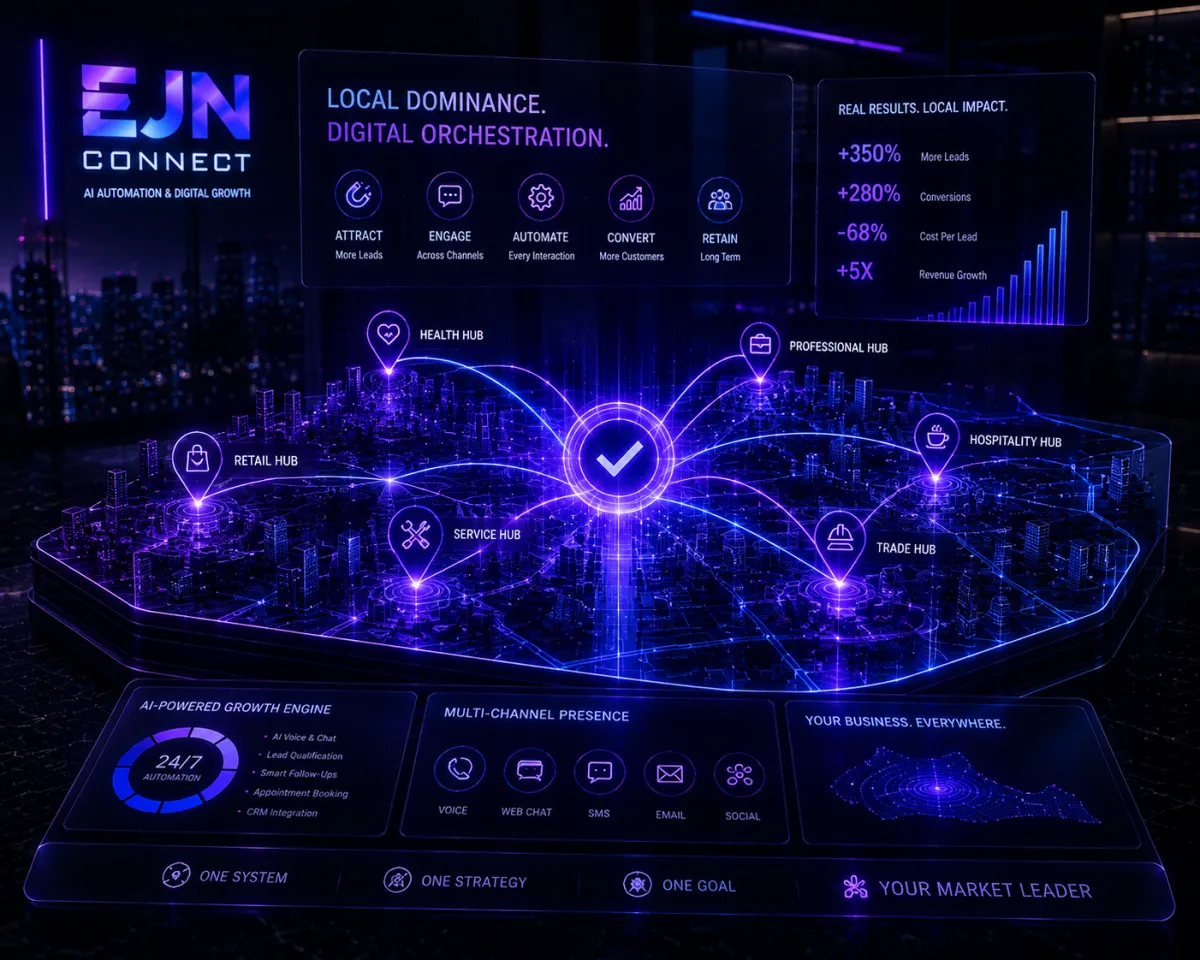
Multi-channel local intake ensures that wherever a local prospect makes contact Google Business Chat, your website, SMS, phone, social media, the enquiry is captured immediately and passed to the same underlying AI system for processing. No channel is unmonitored. No enquiry sits in a platform silo waiting for someone to check it. Every first touch triggers an immediate, intelligent response within seconds.
Hyper-local reasoning and qualification is where the AI demonstrates the local knowledge that converts a casual enquirer into a committed prospect. The AI verifies that the client's location falls within your service area, applies the correct pricing logic for their situation, assesses the nature and urgency of their need, and qualifies them according to your specific criteria, all within the natural flow of the initial conversation. By the time the booking is offered, both parties know that the client is a genuine fit and the service can genuinely be delivered.
Automated calendar and dispatch integration closes the loop. The moment a qualified local prospect is ready to commit, the AI accesses your live calendar, presents available appointment windows, and secures the booking directly, sending an immediate SMS confirmation to the client and creating a complete record in your CRM. The entire journey from first contact to confirmed appointment takes minutes, not hours or days.
What Local Market Dominance Actually Looks Like
Local market dominance has traditionally been understood in terms of brand recognition, advertising reach, and reputation built over years. These things still matter but they are increasingly insufficient on their own in a market where response speed has become a primary decision factor.
The local business that responds to every enquiry within sixty seconds, books appointments at any hour, provides specific and accurate local information immediately, and maintains consistent professional communication throughout the client journey has a structural advantage that reputation and advertising alone cannot overcome. Not because the other businesses are less skilled or less reputable but because they are losing clients in the gap between enquiry and response that their manual intake process creates.
For Australian local service businesses operating in competitive markets trades, professional services, healthcare, real estate, and any other category where multiple providers are a search click away closing that gap is not a marketing strategy. It is a survival and growth strategy. And AI-powered autonomous intake is how it gets closed.
At ejnconnect.com.au, we help Australian local service businesses build the AI-powered intake infrastructure that converts local demand into confirmed bookings around the clock, giving you the geographic footprint, the response speed, and the local intelligence that builds genuine market dominance in your area.
Because the local clients who need what you offer are searching right now. The question is whether your business is ready to capture them the moment they find you or whether you are sending them to a competitor who is.
