
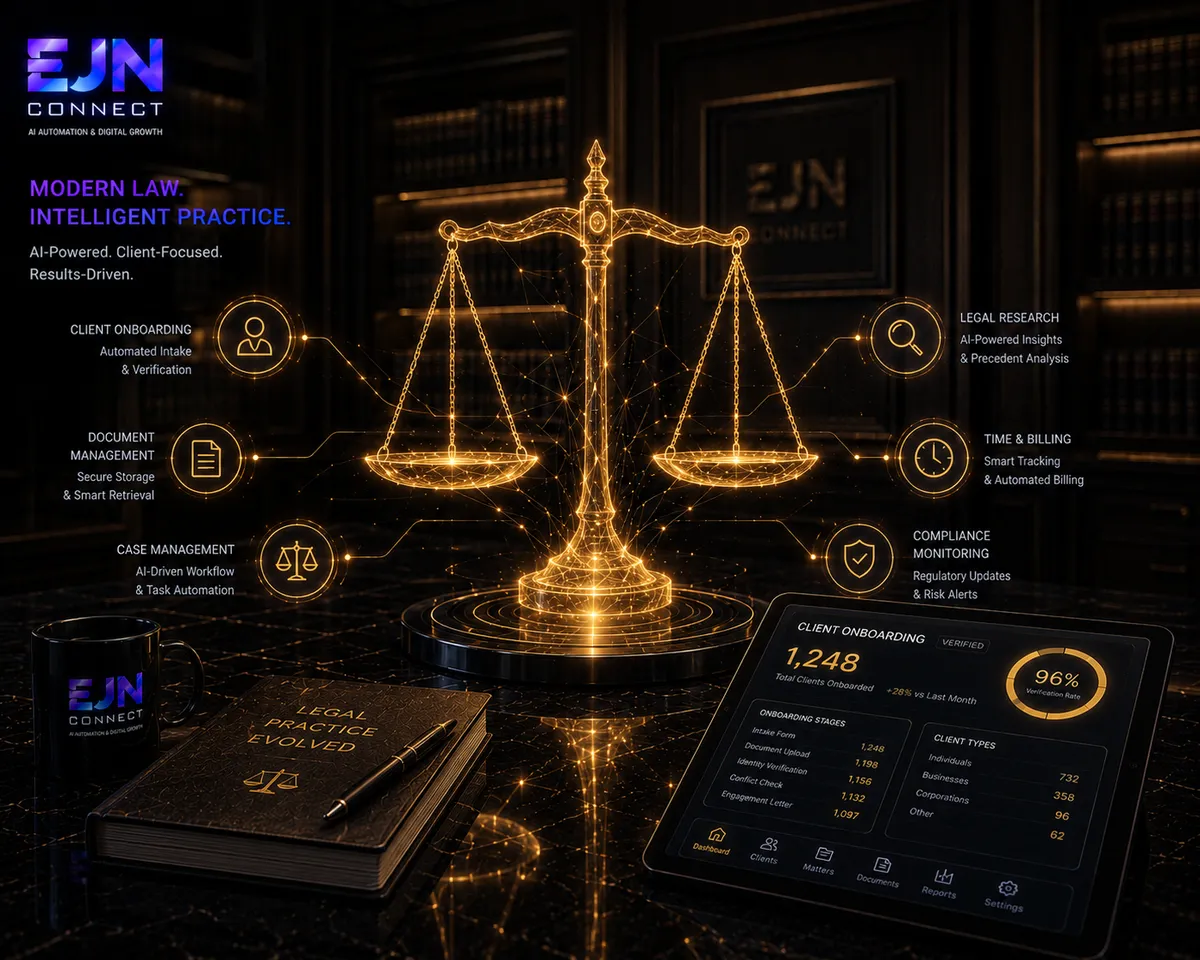
How AI automation is modernizing legal practice intake and protecting the billable hours that manual processes are quietly destroying
Table of Contents
The Three Specific Ways Manual Legal Intake Costs Your Practice
How an AI-Powered Legal Intake System Works
In legal practice, the intake process is not just an administrative function. It is the gateway through which every new client relationship and every new revenue engagement begins. And for most Australian law firms, particularly small to mid-sized practices, it is also one of the most consistently inefficient and revenue-leaking parts of the entire operation.
The inefficiency is understandable. Legal intake is genuinely complex. It requires collecting sensitive information with precision, screening for conflicts of interest, verifying jurisdictional relevance, assessing case viability, and capturing retainers, all before a fee-earner has invested any billable time in the matter. When this process is managed manually, across a practice that receives enquiries through multiple channels at unpredictable hours, the result is predictable: delays, data quality issues, missed after-hours enquiries, and fee-earners spending significant non-billable time on work that a well-designed automated system could handle more accurately and more efficiently.
For firms serious about growth and profitability, fixing the intake process is one of the highest-return operational investments available. And AI automation is how modern Australian practices are doing it.
The Three Specific Ways Manual Legal Intake Costs Your Practice
The after-hours consultation leak
Legal triggers do not respect business hours. A prospective client dealing with an urgent commercial dispute, a family law emergency, or a time-sensitive property matter is not going to wait until nine am Monday to research their options. They research in the evening, when their own professional day is done and the urgency of their situation has the space to surface.
When they find your firm's website at seven-thirty pm on a Thursday and the only available action is a generic contact form or a phone number that rings to voicemail, a proportion of them and research suggests a significant proportion do not wait. They keep searching until they find a practice that engages them immediately. The retainer that your firm was positioned to capture walks straight to a competitor who had the infrastructure to receive it.
For practices in competitive practice areas where multiple firms are competing for the same pool of high-value enquiries, the after-hours availability gap is a consistent and compounding competitive disadvantage.
Unbillable administrative drain on fee-earners
The administrative overhead of manual intake does not stay with support staff. In most smaller practices, it migrates to the people least able to afford spending time on it, the fee-earners themselves.
Senior attorneys conducting basic preliminary interviews that could have been handled by a structured intake process. Partners reviewing unqualified enquiries that a well-configured AI system could have pre-screened and triaged before they ever reached a human. Fee-earners following up on unsigned retainer agreements and missing documents rather than focusing on billable client work.
Research across professional services firms consistently shows that fee-earners in practices with manual intake processes spend between twenty and thirty percent of their time on administrative functions that do not generate direct revenue. For a senior lawyer billing at four hundred dollars per hour, that represents between eighty and one hundred and twenty dollars per hour of lost billable capacity compounding across every working day, every fee-earner, every month.
Data quality and compliance risk
Manual intake processes introduce data quality problems that create both operational inefficiencies and compliance exposure. Client names misspelled. Opposing party information recorded imprecisely. Corporate entity details captured incompletely. Conflict check information collected inconsistently across different intake staff.
These data quality issues create immediate downstream problems, conflict checks that miss relevant parties because the information was not captured accurately at intake, client records that require significant correction before they can be used effectively, and compliance documentation that is incomplete or unreliable under scrutiny.
How an AI-Powered Legal Intake System Works
A well-designed AI intake system for a legal practice is not a generic chatbot that asks basic questions and promises a callback. It is a practice-specific, intelligent qualification and conversion system that understands the nuances of your practice areas, operates within carefully defined compliance boundaries, and converts qualified enquiries into paid retainers with minimum friction and maximum accuracy.
24/7 multi-channel engagement
Every inbound enquiry through your website, your practice's SMS line, your Google Business profile, or a direct phone call is engaged immediately by the AI, at any hour. The prospective client who reaches out at seven-thirty pm Thursday receives the same quality of immediate, professional, informed response as one who calls at ten am Tuesday.
The AI's initial engagement is warm, professional, and immediately assuring, establishing that the enquiry has been received, that the practice takes their matter seriously, and that the conversation is being handled with appropriate discretion.
Natural language case triage and qualification
The AI conducts the preliminary qualification conversation that would otherwise require paralegal or fee-earner time. Powered by a knowledge base built specifically for your practice's areas of work, it assesses the enquiry against the criteria that determine whether it is a viable matter for the firm jurisdiction, applicable limitation periods, dispute value thresholds, the nature of the legal issue, and any other factors specific to your practice's intake criteria.
This qualification conversation is conducted naturally and empathetically not as a questionnaire, but as the kind of informed, attentive initial engagement that a skilled intake paralegal would conduct. The prospect feels heard and professionally handled. The firm receives structured, accurate qualification data before any fee-earner time has been invested.
Conflict pre-screening data collection
Before any consultation is booked, the AI collects the information required for a preliminary conflict check, the client's full legal name, the opposing party's details, any relevant corporate entities, and the nature of the matter. This information is structured and logged directly into the CRM in a consistent, searchable format, enabling support staff to run conflict checks immediately and accurately rather than working from incomplete or inconsistently formatted manual notes.
Automated retainer collection and calendar booking
Once a matter is qualified and the conflict pre-screen is clear, the AI books the consultation directly into the responsible attorney's calendar presenting available windows and locking the slot the moment the prospect confirms. Simultaneously, a secure payment link is dispatched for the initial consultation fee or retainer deposit. The calendar slot is confirmed only upon verified payment settlement, eliminating the scenario of an attorney blocking time for a consultation that the prospect never formally committed to.
The entire process from first contact to booked, paid, conflict-screened consultation, completes automatically, without any paralegal or fee-earner involvement, at any hour, with complete data accuracy.
What Changes for Your Fee-Earners
The transformation in how fee-earners experience their working day is one of the most immediately felt benefits of AI legal intake automation.
The administrative burden of preliminary intake work disappears from their plates. When a consultation appears on their calendar, the matter has already been pre-qualified, the conflict check has already been prepared for review, the retainer has already been paid, and a complete intake summary is already in the CRM. The attorney walks into the consultation with everything they need to begin substantive work, not having spent any non-billable time getting to that point.
Their capacity for billable work increases proportionally to the administrative time that has been removed. For a practice with three to five fee-earners each recovering two to three hours per week from intake administration, the annual billable capacity recovered runs to hundreds of hours each billable at the practice's standard rates.
The Compliance Architecture That Makes It Safe
For legal practices, the compliance dimension of AI automation requires specific attention and a well-designed system addresses it directly.
The AI operates within strict, explicitly defined boundaries. It does not provide legal advice. It does not make representations about case outcomes. It does not engage with substantive legal questions that require attorney judgement. When an enquiry approaches territory that requires a qualified practitioner which is any substantive legal question, the AI acknowledges the enquiry professionally and routes it to the appropriate team member immediately with full context.
These boundaries are hardwired into the system's knowledge base and guardrail configuration, not dependent on the AI making good judgements in the moment. Every interaction is logged completely and immutably, providing a verifiable record of what was communicated at intake — which is valuable not just for operational management but for professional compliance purposes.
At ejnconnect.com.au, we build AI intake automation systems for Australian legal practices, custom-configured for your specific practice areas, your retainer structures, your conflict check requirements, and your compliance obligations, so that every qualified enquiry your firm receives becomes a paid, calendar-booked consultation without manual overhead or after-hours gaps.
Because every retainer your practice fails to capture is a matter that becomes someone else's. And with the right intake infrastructure, that does not have to happen.

