
How AI automation is helping Australian trade and contracting businesses win more jobs before competitors even open their inboxes
Table of Contents
The Three Specific Ways Manual Trade Intake Costs Contracts
How an AI-Powered Trade Intake System Works
In commercial contracting and high-end trade services, the contract is often won or lost before the first site visit ever takes place. The decisive variable is not always technical capability, pricing competitiveness, or reputation though all of these matter. It is frequently something more immediate and more operational: who responded first, who provided useful preliminary information fastest, and who made the process of progressing to the next step easiest for the client.
A facility manager dealing with an urgent commercial HVAC breakdown does not have three to seven days to wait for a manual quote. A property developer issuing a request for tender on a significant project is forming impressions of which contractors are organized and responsive from the very first interaction. A homeowner commissioning a high-end architectural renovation is making judgements about who they want managing their project based on how professionally and promptly they are engaged before a single conversation has happened.
For Australian trade businesses and commercial contractors still relying on manual inbox management, delayed quote preparation, and business-hours-only phone availability, these are the moments in which significant revenue is quietly and consistently lost to competitors who have built the infrastructure to respond at the speed the market now expects.
The Three Specific Ways Manual Trade Intake Costs Contracts
Wasted estimator capacity on unqualified enquiries
Senior estimators are among the most commercially valuable people in a contracting business and one of the most consistently misused. Research across commercial contracting firms shows that experienced estimators spend as much as forty percent of their working hours reviewing enquiries that were never going to become profitable contracts: projects outside the firm's geographic coverage zone, budgets that do not align with the scope, timelines that the business cannot accommodate, or job types outside the firm's area of specialization.
Every hour an estimator spends on an unqualified enquiry is an hour not available for the high-value commercial tenders that the business actually wants to win. The misallocation is not the estimator's fault, it is a structural consequence of having no qualification layer between the inbound enquiry and the estimator's desk.
Slow response on urgent commercial breakdowns
In commercial maintenance and emergency trade services, the urgency dynamic is acute. When a facility manager is dealing with a system failure that is costing their business thousands of dollars per hour in downtime, their decision about which contractor to engage is made within minutes based almost entirely on who they can reach and who can commit to a dispatch timeline immediately.
A contracting business that cannot provide an immediate, confident response to an emergency enquiry confirming service area coverage, providing an estimated response time, and locking in the callout within the same phone call loses that contract to the next business on the list regardless of its technical capability or pricing. The response infrastructure determines the outcome, not the trade skill.
Inconsistent quoting and manual friction
Manual quote generation introduces inconsistency that affects both the quality of estimates and the speed at which they reach the client. Labor rate calculations that vary between estimators. Line items that are included in some quotes and missed in others. Follow-up timelines that depend on individual workflow rather than systematic process. Each of these inconsistencies erodes the professional impression that the business is trying to create and in a market where clients are evaluating multiple contractors simultaneously, professionalism and reliability in the quoting process are themselves competitive factors.
How an AI-Powered Trade Intake System Works
Instant preliminary quote calculation
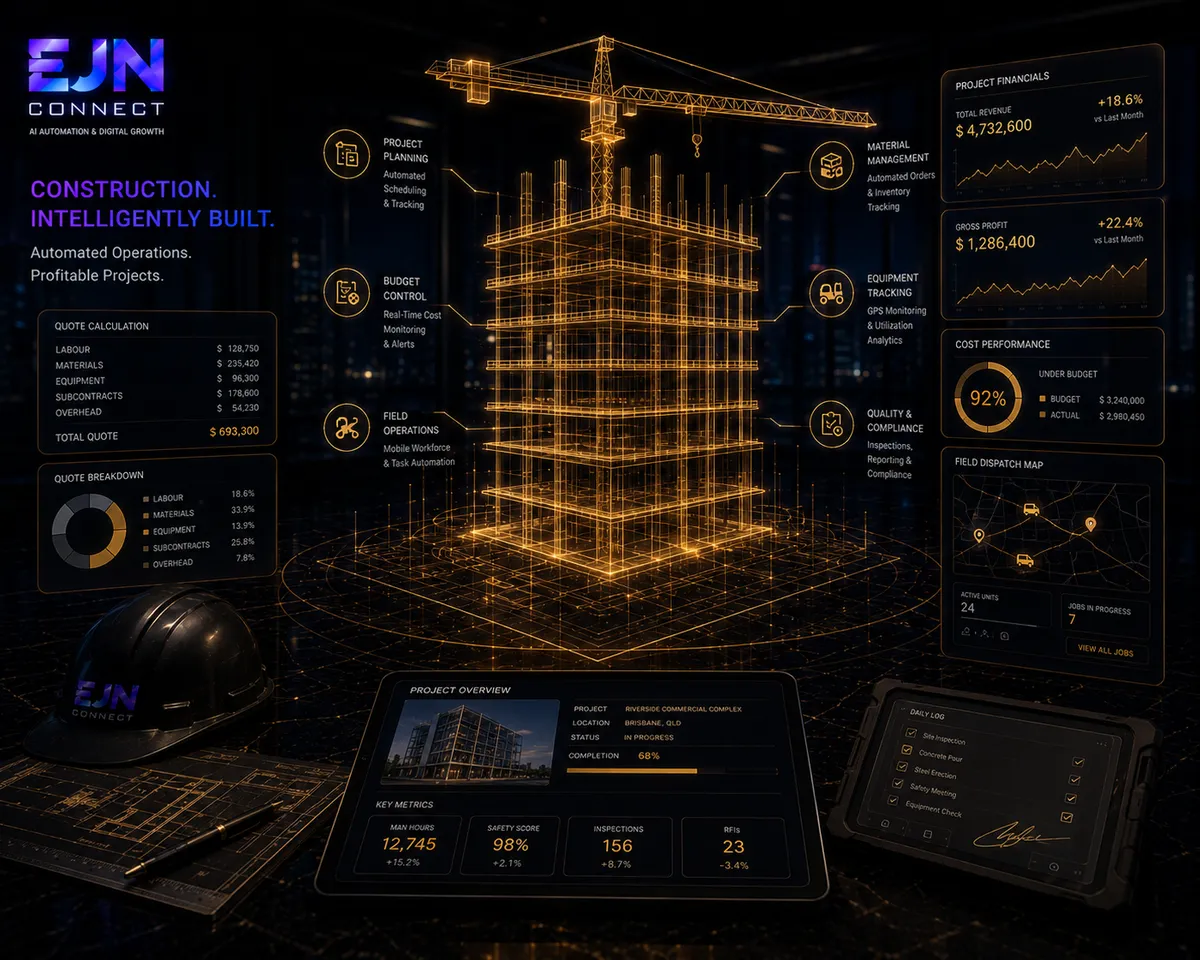
Rather than directing enquiring clients to a generic contact form and promising a quote within several business days, an AI-powered trade intake system engages them immediately with an intelligent scope assessment that produces a preliminary estimate range in real time.
The client interacts with a conversational AI, through your website, via SMS, or through a QR code on your vehicle or site signage that guides them through the key parameters of their project: the scope and nature of the work, the site dimensions or specifications, the access conditions, the material requirements, and the desired timeline. Drawing from your firm's specific pricing matrix and rate structures, the AI produces an immediate preliminary cost range that gives the client a realistic picture of the investment required.
This preliminary estimate serves multiple commercial functions simultaneously. It sets accurate expectations before any estimator time is invested. It qualifies the client's budget position, if the preliminary range exceeds what they were expecting to spend, it surfaces that misalignment before a site visit is arranged. And it demonstrates, from the very first interaction, that your business is organized, technologically capable, and responsive qualities that build confidence in a prospective client before they have met anyone from your team.
Autonomous qualification and zone verification
Before any estimator time or dispatch resource is committed, the AI automatically verifies whether the job site falls within your operational coverage zone, assesses the project scale against your firm's capacity parameters, and categorizes the enquiry accordingly.
Smaller, straightforward jobs are directed to self-service booking with automated deposit collection, freeing your team from the coordination overhead of managing routine callouts manually. Mid-range projects progress to an automated scheduling workflow that books the site assessment and collects the assessment fee upfront. Enterprise-scale commercial tenders are immediately escalated to the appropriate senior estimator with a complete pre-populated project brief, so the estimator's first engagement with the project begins at a substantive level rather than from scratch.
Your estimators are no longer triaging inbound enquiries. They are working on the projects that justify their expertise briefed, focused, and not distracted by the volume of enquiries that the qualification layer has already processed and routed appropriately.
Automated dispatch and deposit collection
For emergency commercial callouts and urgent service requests, the AI accesses your live dispatch calendar, confirms the availability of the appropriate field technician or specialist, and locks in the callout with the client, collecting the callout fee or initial deposit via secure payment processing before the booking is confirmed.
This process happens within minutes of the initial enquiry, at any hour, without requiring anyone from your operations team to be available to coordinate it. The client who called about an urgent breakdown at nine pm on a Friday has a confirmed dispatch booking and a payment receipt before they have put the phone down while your competitors' calls are going to voicemail.
What This Means for Your Estimating Team
The most significant operational transformation that AI trade intake automation produces is in how your estimating team spends their working hours and the quality and profitability of the work that results.
When the qualification, zone verification, preliminary scoping, and basic inquiry management is handled automatically, your estimators engage exclusively with pre-qualified, appropriately scoped projects that match your firm's capabilities and commercial criteria. They receive a complete project brief before they invest any time. They are not taking calls from clients outside your service zone. They are not producing detailed quotes for projects that were never going to proceed at a viable budget.
The result is a meaningful increase in the proportion of estimator hours that produce actual revenue, not through working longer or harder, but through systematic elimination of the unproductive work that the manual intake process was funneling to them.
For contracting businesses where senior estimator time is the primary constraint on how many high-value tenders can be pursued simultaneously, this reallocation of capacity is a direct and measurable growth lever.
The Competitive Positioning Argument
In Australian commercial contracting and high-end trade markets, technical capability is increasingly a baseline expectation rather than a differentiator. The businesses that win the most profitable contracts are the ones that combine technical authority with operational professionalism and operational professionalism is demonstrated from the first interaction, before any site visit or technical discussion has taken place.
A contracting business that responds to a commercial enquiry within sixty seconds, at ten pm on a Sunday, with an intelligent preliminary scope assessment and a clear path to booking a site assessment is demonstrating something specific about how it operates. It is signaling that it is organized, systematic, and capable of managing a complex project professionally. That signal, delivered before any technical capability has been demonstrated, is a meaningful competitive advantage in a market where the alternative is a callback promised for Monday morning.
At ejnconnect.com.au, we implement AI-powered intake and dispatch automation systems for Australian trade businesses and commercial contractors including intelligent quote calculators, autonomous qualification systems, CRM integration, and automated dispatch workflows, custom-configured for your specific pricing, your service zones, your team capacity, and your project types.
Because in contracting, the job goes to the business that responds first and looks most organized doing it. With the right infrastructure, that business is yours.

