
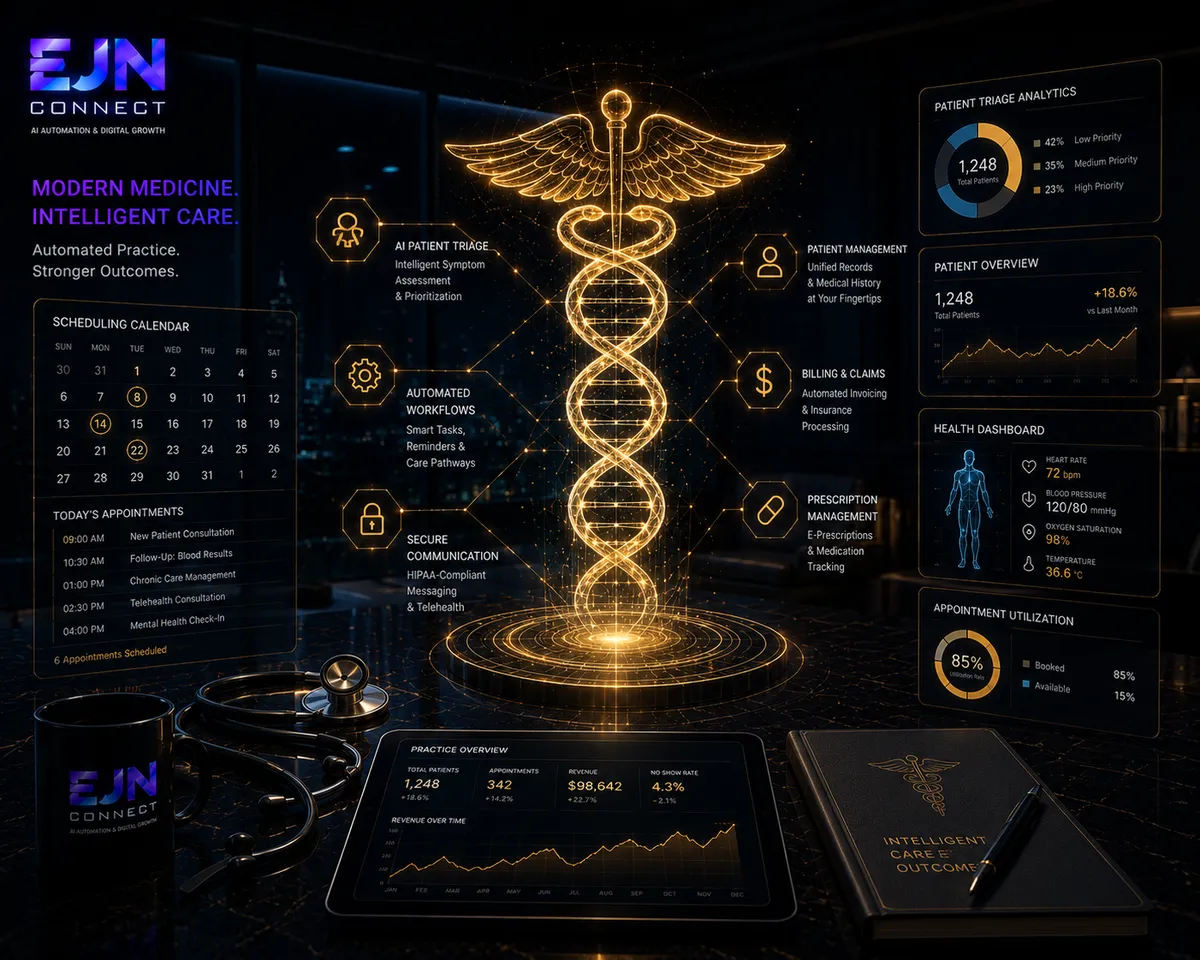
How AI automation is helping Australian healthcare practices reduce no-shows, fill cancellations, and free their front desk to focus on patients
Table of Contents
The Three Specific Ways Manual Clinic Administration Costs the Practice
How an AI-Powered Healthcare Intake System Works
In private medical practice and specialist clinical settings, two operational metrics determine the financial health of the business above almost all others: how effectively the appointment calendar is utilized, and how well the patient experience is managed from the very first point of contact.
These two metrics are more connected than they might initially appear. A practice that responds to patient enquiries slowly, manages appointment reminders manually, and relies on phone calls to fill last-minute cancellations is not just creating an inefficient administrative process. It is creating a patient experience that falls short of what modern patients expect and a revenue environment where empty practitioner slots are accepted as inevitable rather than addressed as the significant and recoverable cost they actually represent.
For Australian private practices and specialist clinics, the combination of rising patient expectations, increasing competition from well-resourced healthcare providers, and persistent front desk capacity constraints makes this an increasingly urgent operational challenge. And AI automation is the practical, accessible solution that an increasing number of forward-thinking practices are implementing.
The Three Specific Ways Manual Clinic Administration Costs the Practice
The no-show and cancellation revenue leak
In specialist practice, a single unused forty-five minute consultation slot represents between $250 and $800 in lost revenue depending on the specialty, the fee structure, and whether the time can be partially recovered. In a practice where no-show rates run at the industry average of ten to fifteen percent of total appointments, the annual cost of this revenue leak runs to tens of thousands of dollars.
The frustrating dimension of this loss is that a significant proportion of it is recoverable, if the right systems are in place. Patients who do not attend appointments are not all disengaged. Many forget, many have conflicting obligations that emerged after booking, and many would respond to a timely, interactive reminder that gave them a frictionless path to confirm, reschedule, or cancel in advance. The difference between a no-show that wastes a practitioner slot and a timely cancellation that fills from a waitlist is almost entirely a function of the reminder and recovery systems in place.
Front desk overwhelm and diverted attention
Medical receptionists are among the most important customer-facing roles in any healthcare practice because their interaction with patients shapes the first and most persistent impression of the practice's quality and care. But in most clinical settings, they are spending a substantial proportion of their working hours on tasks that are important but not differentiated: answering routine enquiries about fee structures, clinic locations, referral requirements, and pre-procedure preparation that could be handled automatically.
When a receptionist is managing a phone queue of patients asking routine questions, they are not available to give their full attention to the patient standing at the desk who needs something more complex. The quality of the in-person patient experience suffers not because the receptionist lacks the skill or the care, but because their attention is divided between multiple competing demands that the right automation could resolve.
Manual intake creating waiting room bottlenecks
The clinical intake process collecting patient history, processing referral documentation, gathering the information a practitioner needs to be productive from the first minute of the consultation is frequently handled at the point of arrival rather than in advance. Patients fill out paper forms in the waiting room. Referral documents arrive by fax or email and are manually processed by admin staff. The practitioner begins the appointment without the complete picture they need and spends the opening minutes of billable consultation time gathering information that could have been collected digitally before the patient arrived.
How an AI-Powered Healthcare Intake System Works
24/7 patient enquiry management
Every patient enquiry through your website, your practice phone line, SMS, or your online booking portal is engaged immediately by the AI, at any hour. A patient researching a specialist referral at eight-thirty pm receives an immediate, accurate, and empathetic response that answers their questions about the practice, the relevant practitioner's sub-specialty, the referral requirements for their situation, and the fee structure and progresses them to a booking if they are ready.
The AI draws from your practice's specific clinical information which practitioners see which conditions, what referral documentation is required for different appointment types, what preparation is needed before different procedures to provide responses that are accurate and specific rather than generic.
For patients navigating what is often an unfamiliar and sometimes anxiety-inducing process, the combination of immediate availability and genuinely informed responses creates a first interaction that builds confidence in the practice before the patient has met anyone from the clinical team.
Interactive two-way SMS reminders and cancellation recovery
The most commercially significant capability of AI healthcare automation and the one with the most immediate and calculable impact on practice revenue is the intelligent appointment reminder and cancellation recovery system.
Rather than sending a one-way SMS reminder that a patient either reads and ignores or does not read at all, the AI initiates a two-way SMS conversation at defined intervals before each appointment. The patient is asked to confirm attendance with a single reply. If they confirm, the booking is locked and the CRM is updated automatically. If they indicate they need to reschedule or cannot attend, the AI immediately offers alternative appointment times making rescheduling frictionless enough that a patient who would otherwise simply not show up instead reschedules into an available slot.
The moment a cancellation is confirmed, the system automatically contacts the waitlisted patients for that practitioner and appointment type, offering the newly available slot on a first-response basis. Patients on the waitlist receive an immediate SMS with the available time and a single-tap confirmation option. In most cases, the slot is filled within minutes of the cancellation, transforming what would have been lost revenue into a recovered appointment.
Digital intake and referral processing before arrival
Once an appointment is booked, the AI dispatches the relevant intake documentation to the patient digitally, a secure online form that collects their medical history, current medications, the nature of their presenting issue, and any other information the practitioner needs for their preparation. Referral documentation is uploaded digitally and processed before the appointment, rather than arriving by fax on the day.
When the patient arrives, the clinical team already has everything they need. The consultation starts on time, from a position of complete information, without the waiting room delays that paper-based on-arrival intake creates. The patient experience is smoother. The practitioner's time is more effectively used. And the administrative staff are managing the in-person patient experience rather than processing paperwork.
The Compliance Architecture for Healthcare AI
Healthcare AI implementation requires specific attention to patient privacy and data handling obligations and a properly designed system addresses these as foundational requirements rather than afterthoughts.
All patient data collected through the AI intake system is encrypted in transit and at rest. The AI is configured with strict guardrails that prevent it from providing clinical advice, interpreting symptoms, or making any representation about diagnosis or treatment, it facilitates the administrative and booking process and directs all clinical questions to the appropriate practitioner. Every interaction is logged completely and securely, providing a verifiable record of what information was collected and what was communicated.
The system is built for the Australian healthcare privacy landscape, compliant with the Privacy Act and the Australian Privacy Principles, with data handling practices appropriate for sensitive health information.
What Changes for Your Clinical Team and Front Desk
The transformation in day-to-day operations is felt immediately and specifically by both the clinical team and the administrative staff.
Practitioners begin each consultation with complete intake information already in the system, no opening minutes spent gathering basic history that should have been collected before the appointment. Their scheduled hours are more fully utilized because no-show rates are lower and cancellations are recovered rather than left as empty slots. Their administrative burden between consultations is reduced because routine patient communication is handled automatically.
Receptionists are no longer divided between phone queues and in-person patients. Their attention is available for the interactions that require human presence, judgement, and empathy, the complex enquiries, the anxious patients, the situations where a human response genuinely makes a difference to the patient experience. The work they are doing is more meaningful and less draining.
For practice managers and clinic owners, the operational picture changes in the ways that matter most: calendar utilization improves, revenue leakage from empty slots decreases, patient satisfaction with the booking and communication process improves, and the administrative overhead cost per patient episode reduces.
At ejnconnect.com.au, we implement AI-powered patient intake and practice management systems for Australian healthcare practices, custom-configured for your clinical specialties, your referral workflows, your practitioner schedules, and your patient communication standards, with privacy and compliance architecture appropriate for healthcare data.
Because your patients deserve a practice that is as responsive and organized in its administrative processes as it is excellent in its clinical care. And your team deserves systems that support them to deliver that experience without burning out in the process.

