Australian SMBs: How to Optimize Your Website for AI Search Engines in 2026
⏳ 3 min read
Table of Contents
The rise of AI search engines is transforming the way people search for information online, with significant implications for Australian businesses and their SEO strategies. According to recent statistics, 88.5% of Australian websites have measurable AI traffic, up from 13.5% in 2023. This shift towards AI-driven search requires businesses to adapt and optimise their content for these new platforms. In this article, we will explore the key considerations and strategies for optimising your website for AI search engines and maintaining visibility in a rapidly changing online landscape.
Understanding AI Search Engines
Search isn’t what it used to be and that’s not a subtle shift.
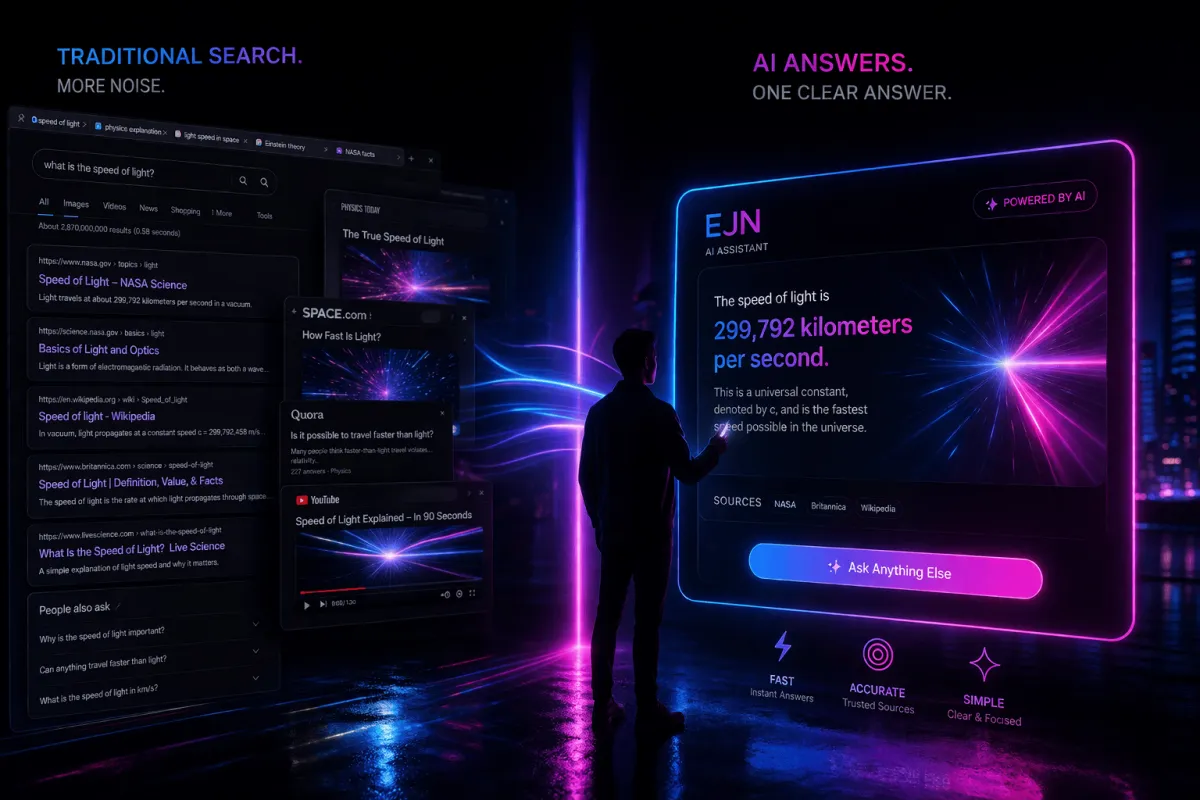
Platforms like ChatGPT aren’t just helping people find information anymore; they’re delivering answers directly. That changes the game entirely. Instead of competing for clicks, brands are now competing to be included in the answer itself.
AI search engines rely on natural language processing and machine learning to interpret intent, not just keywords. They prioritise clarity, context, and credibility. In simple terms: if your content is hard to understand, loosely structured, or vague, it’s invisible.
What matters now is whether your content can be trusted, extracted, and summarized.
And that’s a very different kind of optimization.
Learn more: https://ejnconnect.com.au/
Adapting Your SEO Strategy for AI Search
Most SEO strategies today are still built for a version of the internet that’s fading.
Ranking on page one used to be the goal. Now, a growing percentage of searches never result in a click at all. AI engines resolve the query instantly, pulling from the most relevant and structured sources.
So the question becomes: Is your content built to rank, or built to be referenced?
Adapting means thinking in conversations, not just keywords. It means anticipating the exact questions your audience would ask—and answering them clearly, upfront, and without friction.
The brands that win here aren’t necessarily louder. They’re simply easier for AI to understand.
Learn more: https://ejnconnect.com.au/
Measuring AI Search Performance and ROI
This is where things get uncomfortable for a lot of businesses.
Traditional metrics—clicks, sessions, even conversions—don’t tell the full story anymore. If AI is answering the question before the user visits your site, your influence may be growing while your traffic appears flat.
That doesn’t mean your strategy isn’t working.
It means the definition of visibility is changing.
Tools like Google Analytics still matter, but they need to be paired with a broader lens:
Are you being cited in AI-generated responses?
Is your brand showing up in conversational queries?
Are users searching for you after encountering AI summaries?
The ROI of AI search is less about immediate clicks—and more about sustained authority.
Learn more: https://ejnconnect.com.au/
The Impact of AI Search on Local SEO and Google My Business
Local search is becoming less about directories—and more about recommendations.
Your Google Business Profile still plays a critical role, but AI engines are increasingly interpreting and summarising that data on behalf of users.
That means:
Reviews aren’t just read—they’re analysed
Listings aren’t just displayed—they’re interpreted
Businesses aren’t just ranked—they’re recommended
Accuracy, consistency, and responsiveness matter more than ever. A well-maintained profile doesn’t just improve visibility—it strengthens trust signals that AI systems rely on when suggesting businesses.
If your information is incomplete or outdated, you’re not just harder to find—you’re easier to overlook.
Learn more: https://ejnconnect.com.au/
Best Practices for AI Search Optimization
There’s no shortcut here but there is a pattern.
Content that performs well in AI search tends to share a few characteristics:
It answers questions directly, without delay
It’s structured in a way that’s easy to scan and extract
It demonstrates depth, not just surface-level knowledge
It connects ideas clearly, without unnecessary complexity
Think of it less like writing for algorithms and more like explaining something to a smart person who values clarity.
Because that’s essentially what you’re doing.
And while tools and tactics will continue to evolve, this principle will hold:
If your content is genuinely useful and easy to understand, it will travel further.
Learn more: https://ejnconnect.com.au/
Conclusion
AI search isn’t a trend—it’s a shift in how information is discovered, filtered, and trusted.
The brands that adapt early won’t just maintain visibility. They’ll define it.
This isn’t about abandoning SEO. It’s about refining it—so your content isn’t just found, but chosen.
And in a space where answers are generated instantly, being chosen is everything.
Learn more: https://ejnconnect.com.au/
Key Takeaways
✓ Optimize your website for AI search engines by creating high-quality, well-structured content
✓ Prioritise technical SEO and user experience to improve your website's visibility in AI search results
✓ Use AI-driven analytics tools to measure performance and ROI and refine your SEO strategy
✓ Optimise your Google My Business listings for AI search to improve your local search visibility
✓ Stay up-to-date with the latest developments in AI search and adjust your SEO strategy accordingly
Frequently Asked Questions
How to optimize website for AI search
Optimise your website by creating high-quality, well-structured content and prioritising technical SEO and user experience.
What is AI search engine optimization
AI search engine optimisation is the process of adapting your SEO strategy to cater to AI-driven search engines and improve your online visibility.
How does AI search affect my website traffic
AI search can increase or decrease your website traffic, depending on how well your website is optimised for AI search engines.
What are the best practices for AI search optimization
Best practices include creating high-quality content, prioritising technical SEO, and staying up-to-date with the latest developments in AI search.
How to create content for AI search engines
Create content that is clear, concise, and well-structured, and prioritise entity signals and structured data to help AI search engines understand your content.
