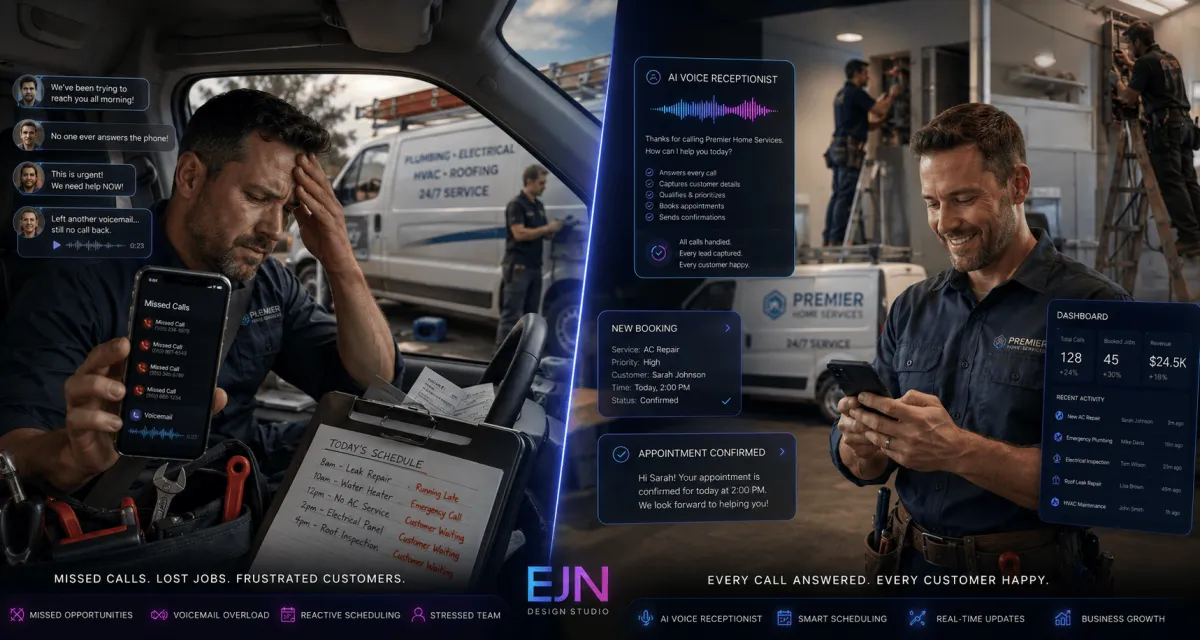
Capture Every Call Automatically
A missed phone call is easy to dismiss.
But for many trades businesses, it is often a missed job, a lost customer, and revenue that quietly disappears to a competitor who answered first.
For plumbers, electricians, roofers, HVAC companies, and maintenance providers, the phone remains the engine of new business. While many industries have shifted toward online forms and automated bookings, trades businesses still rely heavily on direct calls from customers who need immediate help.
And that creates a problem.
Most teams are not sitting behind desks waiting for enquiries. They are onsite, driving between jobs, coordinating staff, managing suppliers, or handling urgent work. Calls frequently arrive at the worst possible moments.
The result is that many businesses miss far more enquiries than they realize.
Why Trades Businesses Miss Calls
The issue is rarely poor service. It is usually operational reality.
A small or mid-sized trades company is often balancing multiple responsibilities at once:
technicians onsite completing jobs
staff travelling between appointments
fluctuating workloads throughout the day
after-hours emergency enquiries
limited administrative support
In practice, this means calls regularly go unanswered.
And customers rarely wait.
When someone has a leaking pipe, an electrical fault, or a roofing emergency, they usually contact the next business within minutes.
Speed matters more than most businesses think.
The Hidden Cost of Missed Enquiries
The financial impact of missed calls compounds quietly over time.
One unanswered enquiry may seem insignificant. But over weeks and months, missed calls can lead to:
lost revenue opportunities
inconsistent lead flow
lower marketing ROI
reduced customer trust
slower business growth
For businesses investing in advertising, SEO, or local marketing, missed calls also create another problem: wasted acquisition spend.
Generating leads is expensive.
Failing to capture them is even more expensive.
Why AI Voice Receptionists Are Growing Quickly
This is where AI voice receptionists are beginning to reshape how trades businesses manage customer communication.
The appeal is not necessarily replacing staff. It is ensuring that every enquiry receives an immediate response, even when teams are unavailable.
The technology acts as a 24/7 front desk for the business.
When a customer calls, the AI receptionist can:
answer instantly
collect customer details
identify service requirements
assess urgency
capture location information
route enquiries appropriately
Instead of losing potential work, businesses maintain continuous availability.
That changes the economics of lead generation.
The Real Advantage Is Consistency
One of the biggest operational challenges in trades businesses is inconsistency.
Some days enquiries arrive steadily.
Other days calls surge unexpectedly.
During peak periods, even well-run businesses struggle to manage inbound communication efficiently.
AI receptionists create consistency during both busy and quiet periods by ensuring:
no call goes unanswered
customer information is captured accurately
urgent jobs are prioritized
after-hours enquiries are still handled professionally
This reduces administrative pressure while improving customer experience.
Customers Reward Fast Response Times
Most customers do not expect perfection.
They expect responsiveness.
In many local service industries, the business that responds first often wins the job.
Fast communication creates:
higher customer confidence
stronger professionalism
improved trust
higher conversion rates
Even simple actions — answering immediately, acknowledging urgency, confirming next steps can significantly influence buying decisions.
This is why responsiveness has become a competitive advantage.
Beyond Answering Calls
The larger opportunity emerges when voice AI connects with automation systems behind the scenes.
Modern AI receptionists can now:
trigger follow-up confirmations
schedule callbacks
send appointment reminders
log enquiries into CRM systems
maintain ongoing communication automatically
What was previously handled manually by office staff can now happen instantly and continuously.
For growing businesses, this creates operational leverage without requiring large administrative teams.
A Shift in How Trades Businesses Scale
Historically, scaling a trades business required hiring more office staff to manage rising enquiry volume.
AI is beginning to change that equation.
By automating call handling and enquiry capture, businesses can improve responsiveness without dramatically increasing overhead.
The technology does not replace skilled tradespeople.
It removes communication bottlenecks around them.
And in industries where speed, trust, and availability directly influence revenue, that may become one of the most important operational advantages of all.
