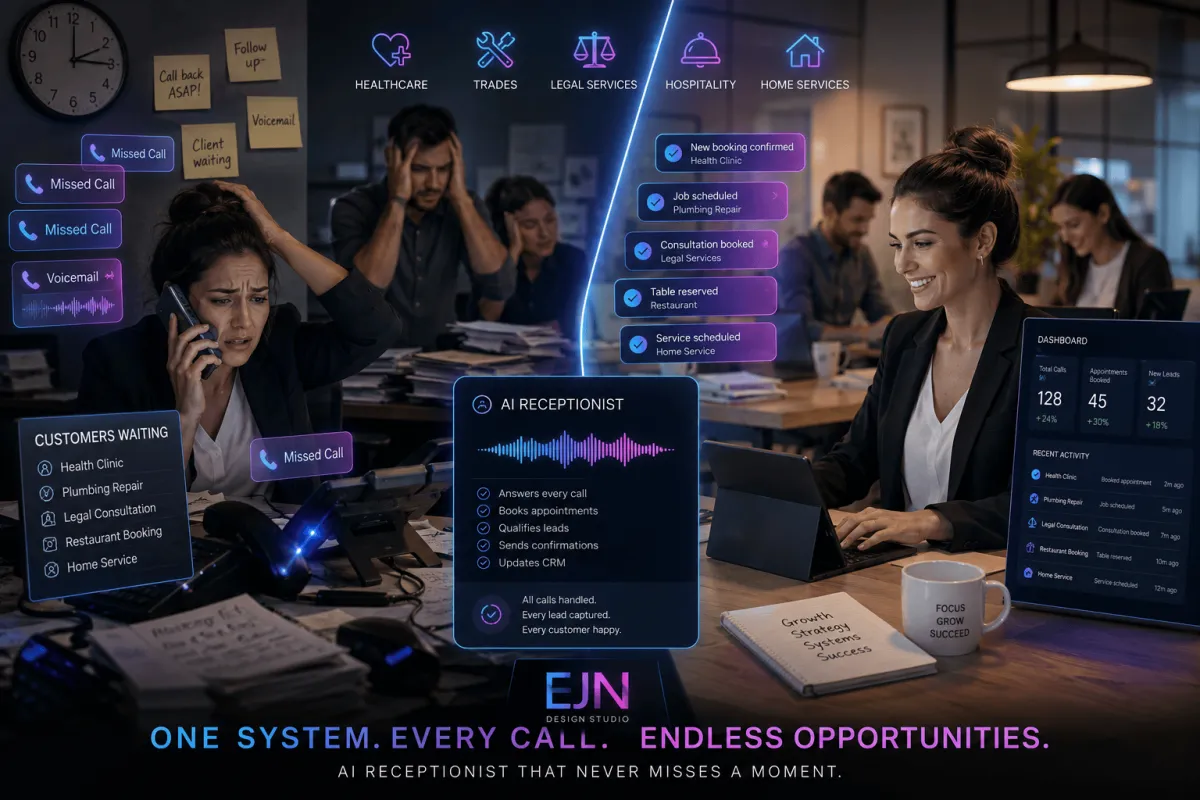
How AI Phone Systems Capture More Leads
For many small businesses, growth still begins with a phone call.
A customer needs help.
They search online.
They call the first few businesses they find.
What happens next often determines who wins the customer.
The problem is that many small businesses struggle to answer every enquiry consistently. Teams are busy serving existing customers, handling operations, travelling between appointments, or simply managing the pressure of day-to-day work.
Calls get missed.
Voicemails pile up.
Follow-ups happen late or not at all.
And in increasingly competitive markets, delayed responses quietly become lost revenue.
This is why AI receptionists are gaining traction across small business operations.
Not because businesses want to remove human interaction, but because responsiveness itself has become a competitive advantage.
The Communication Problem Small Businesses Face
Most small businesses operate with limited administrative capacity.
Unlike large companies with dedicated front-desk teams or call centers, smaller operators often juggle customer communication alongside everything else.
This creates predictable bottlenecks:
calls go unanswered during busy periods
enquiries arrive after business hours
staff become overloaded
follow-up processes become inconsistent
In many industries, customers contact multiple providers at once. The business that responds first often becomes the business that gets the job.
Speed matters more than many owners realize.
What an AI Receptionist Actually Does
At its simplest level, an AI receptionist is an automated voice system designed to manage inbound phone enquiries.
But modern systems go far beyond traditional voicemail or phone menus.
Instead of forcing callers through rigid prompts, AI receptionists can:
answer calls instantly
engage customers conversationally
collect lead information
route enquiries appropriately
trigger follow-up actions automatically
The experience feels closer to speaking with a front-desk assistant than navigating an automated machine.
And that distinction matters.
Why Traditional Voicemail No Longer Works
For years, businesses treated voicemail as an acceptable fallback.
But customer behavior has changed.
Most callers no longer leave detailed messages or wait hours for callbacks. They simply move on to the next available provider.
This is particularly true in service-driven industries where urgency matters:
trades services
healthcare clinics
legal enquiries
appointment-based businesses
home services
Customers increasingly expect immediate engagement.
AI receptionists address this expectation directly by responding the moment the phone rings.
The Real Advantage: Consistency
The most valuable feature of AI receptionists is not automation itself.
It is consistency.
Every caller receives:
an immediate response
a professional interaction
structured information capture
clear next steps
That consistency becomes difficult to maintain manually as businesses grow.
AI systems help standardize communication without increasing staffing pressure.
How AI Improves Lead Capture
Many businesses underestimate how much revenue is lost through missed or poorly managed enquiries.
AI receptionists improve lead capture in several ways.
Instant Answering
Calls are answered immediately, reducing hang-ups and abandoned enquiries.
Structured Information Collection
The system can automatically collect:
names
contact information
service requests
booking preferences
urgency levels
This ensures no enquiry is partially captured or forgotten.
After-Hours Availability
One of the biggest advantages is continuous availability.
Customers often enquire outside standard business hours. AI systems allow businesses to remain responsive even when staff are offline.
Automated Follow-Up
When integrated with CRM or automation systems, AI receptionists can:
trigger notifications
schedule callbacks
send confirmations
initiate lead workflows
The phone system becomes part of a larger operational infrastructure.
Why SMEs Are Moving Toward Automation
The shift toward AI receptionists reflects broader economic and operational pressures affecting small businesses.
Business owners are trying to balance:
rising customer expectations
staffing limitations
growing enquiry volumes
operational efficiency
At the same time, digital competition has increased dramatically.
Customers now expect local businesses to deliver the same responsiveness they experience from large technology platforms.
That expectation is reshaping how businesses manage communication.
Industries Seeing the Fastest Adoption
AI receptionists are proving especially valuable in industries where:
phone enquiries drive sales
response speed influences conversions
administrative workload is high
This includes:
trades businesses
clinics and healthcare providers
real estate agencies
law firms
automotive services
hospitality businesses
appointment-based services
In these sectors, a missed call is often more than a missed conversation.
It is a missed opportunity.
A Broader Shift Is Happening
The rise of AI receptionists is part of a larger transition toward automated front-desk systems and operational automation more broadly.
Businesses are increasingly building systems that:
capture leads automatically
maintain customer engagement
reduce repetitive admin work
improve responsiveness at scale
What used to require large support teams can now increasingly be managed through intelligent software.
And for small businesses, that changes the economics of growth.
The Businesses That Respond Fastest Will Likely Win
Technology rarely changes industries all at once.
It usually changes customer expectations first.
Customers now expect businesses to be available immediately, respond quickly, and communicate consistently.
AI receptionists help small businesses meet those expectations without dramatically increasing overhead.
The technology is not replacing relationships.
It is helping businesses protect opportunities that would otherwise be lost between the ringing phone and the unanswered call.
