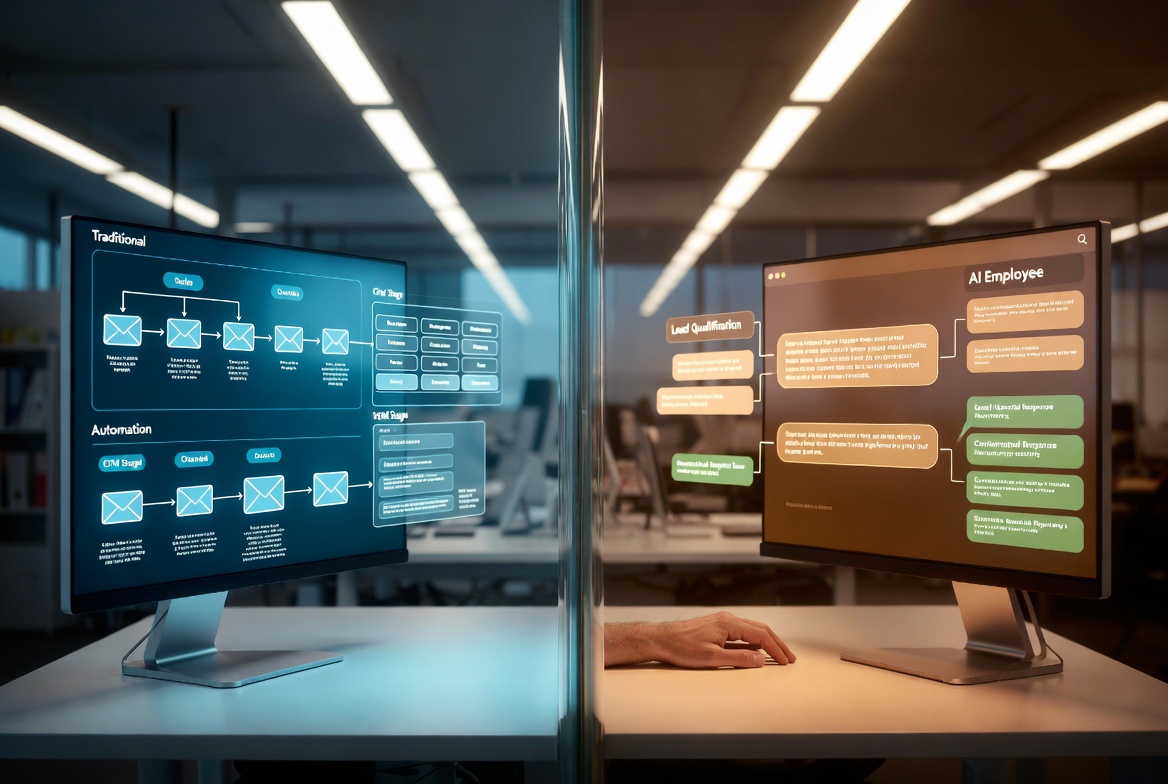
AI Employees vs Traditional Automation Tools: What’s the Difference?
If you've been paying attention to the conversation around business automation lately, you've probably noticed that the terminology is getting more crowded. Traditional automation. AI employees. Digital workers. Intelligent workflows. Smart systems. It all starts to blur together and when you're a small business owner trying to make a practical decision about what your business actually needs, the jargon doesn't help.
So let's cut through it. Because the distinction between traditional automation tools and AI employees is actually straightforward and understanding it clearly is one of the most useful things you can do before investing time or money into either.
Traditional Automation Tools: The Foundation That Still Works
Traditional automation has been around for long enough that most small businesses are already using some version of it, often without thinking of it as "automation" at all.
Email sequences that send when someone fills out a form. Appointment reminders that go out automatically at a set time before a booking. CRM workflows that move a lead to the next stage when a specific action is taken. Task notifications that fire when a deadline approaches. These are all traditional automation tools and they are genuinely powerful for the right applications.
The defining characteristic of traditional automation is that it follows rules. If this happens, then do that. When a condition is met, a predefined action triggers. The system doesn't think, doesn't adapt, and doesn't respond to nuance it simply executes the instruction it was given, reliably and consistently, every single time.
For structured, repetitive, process-driven workflows, that reliability is exactly what you want. You don't need a system that thinks about whether to send an appointment reminder. You need it to send the reminder, at the right time, to the right person, every time. Traditional automation does that exceptionally well and it has been doing it for years.
AI Employees: What They Add to the Picture
AI employees operate differently and the difference matters most in situations that require genuine interaction rather than simple task execution.
Where traditional automation follows a fixed script, AI employees can engage in dynamic, contextual conversations. They can respond to what a customer actually says rather than just triggering a preset sequence. They can ask clarifying questions, handle unexpected responses, adapt their communication based on context, and guide a prospect through a conversation toward a meaningful outcome whether that's booking an appointment, submitting an enquiry, or getting the information they need to make a decision.
Think about the difference between an automated email that goes out when someone submits a form useful, reliable, but completely static and an AI chat agent that engages that same person in a real conversation, answers their specific questions, qualifies their enquiry, and guides them toward the next step based on what they actually say. Both are automation. But one is rule-based and one is intelligent.
This conversational capability is what makes AI employees particularly valuable for customer-facing applications inbound enquiry handling, lead qualification, after-hours communication, and any interaction where the customer's response is unpredictable and a meaningful reply is required.
Comparing the Two Side by Side
The most useful way to think about the difference is in terms of what each approach does best.
Traditional automation excels at structured, predictable workflows where the same action needs to happen every time a condition is met. Appointment reminders, follow-up email sequences, CRM stage progressions, internal task notifications, payment reminders all of these are ideal use cases for traditional automation. The process is defined, the outcome is consistent, and human intervention is rarely needed.
AI employees excel at unstructured interactions where the outcome depends on what the other person says or does. Answering a customer's specific question about your services. Qualifying a lead through a natural conversation. Handling an inbound call when your team is unavailable. Engaging a website visitor who isn't sure what they need yet. These situations require something more flexible than a rule-based system they require the ability to understand context and respond intelligently.
Neither approach is universally superior. They are designed for different situations and the businesses that get the most value from automation are the ones that use each approach for what it does best.
Why the Most Effective Businesses Use Both
Here's the insight that changes how most business owners think about this: traditional automation and AI employees are not competing technologies. They are complementary ones and when combined thoughtfully, they create something more powerful than either provides alone.
A practical example: a prospective customer visits your website at 8pm and starts a conversation with your AI chat agent. The AI employee engages them, answers their questions, qualifies their enquiry, and books them in for a consultation all without any human involvement. That interaction then triggers a traditional automation workflow: a booking confirmation sends immediately, a reminder fires the morning of the appointment, the lead is added to your CRM and moved to the appropriate pipeline stage, and your team receives an internal notification with everything they need to know before the meeting.
In that single customer journey, both technologies played a critical role. The AI employee handled the dynamic, unpredictable conversation. The traditional automation handled the structured, process-driven follow-through. Together, they delivered an experience that felt seamless and professional and required zero manual effort from anyone on your team.
This is the model that forward-thinking Australian small businesses are building toward not choosing one technology over the other, but understanding how each fits into a cohesive, efficient operational system.
How to Decide What Your Business Needs
The practical starting point for most small businesses is an honest assessment of where the friction actually is.
If the biggest operational challenges in your business are around consistency reminders not going out, follow-ups being forgotten, CRM records not being updated, internal communications being missed traditional automation is likely the highest priority. These are structured problems with structured solutions.
If the biggest challenges are around responsiveness and engagement enquiries not being answered quickly enough, website visitors leaving without converting, leads going cold because nobody had a meaningful conversation with them at the right moment AI employees are likely where the most immediate value sits.
And if both are true which is the case for most growing small businesses the answer is a phased approach that builds both layers over time, starting with the area of highest friction and expanding from there.
The Bottom Line
Traditional automation tools are not being replaced by AI employees. They are being complemented by them. The businesses that treat these technologies as either-or are leaving significant operational value unrealized. The ones that understand how they work together and build systems that use each for what it does best are the ones creating genuinely scalable, efficient, and responsive operations.
The good news is that neither technology is as complicated or as expensive to implement as most small business owners fear. The barrier to entry has dropped dramatically in recent years, and the practical applications are more accessible than ever.
ejnconnect.com.au helps Australian small businesses understand exactly where each technology fits, build the systems that combine them effectively, and create operational foundations that support growth without adding complexity.
Because the goal was never to automate for the sake of it. It was always to build a business that runs better and knowing which tools to use, and when, is where that starts.
